India 5-2 · A Loop Around Jaipur
The Uber Driver and 100 Rupees
I always watch the Uber app to check we are going the right way, and this driver kept going straight on instead of taking the turn for Nahargarh Fort.
The app was showing the route that way, so I told him to just keep going along it, and in halting English he said the road there was very rough and narrow and he could not go.
He said that if he did go, I should pay him much more.
The fare was already fixed in the app and the route was laid out, so having him pile up excuses and ask for more money infuriated me.
I told the driver that if he could not take the road, he should just stop.
The driver cancelled the Uber on his own, so in the end no money was taken.
But thinking about the time I would lose off my plan, and getting out halfway and booking another Uber on data that barely worked, I felt stuck.
Otherwise I would have to take a tuk-tuk, and the thought of the stress of haggling again and then riding it eating exhaust in hot wind really annoyed me.
In the end the driver pulled over on a road by a lake and brought over an older woman guide who spoke good English.
That guide looked extremely sharp and spoke English well, and when I explained what had happened she said something to the driver that sounded like a telling-off.
I said my piece: he had not taken the route laid out to the destination, had made excuses and asked for more money to take it, and had then cancelled the contract in the app on his own.
The woman said she understood, but that I should pay the driver extra for the distance he had come.
In the end I paid 100 rupees.
We had not even come half the way to Nahargarh Fort, so 100 rupees was more than it was worth.
I was not in a good mood, so I swore at length in English and got out of the car.
Jal Mahal

Trying to keep a positive mindset, and having had rougher things happen by then, once I was out of the car it did not annoy me that much.
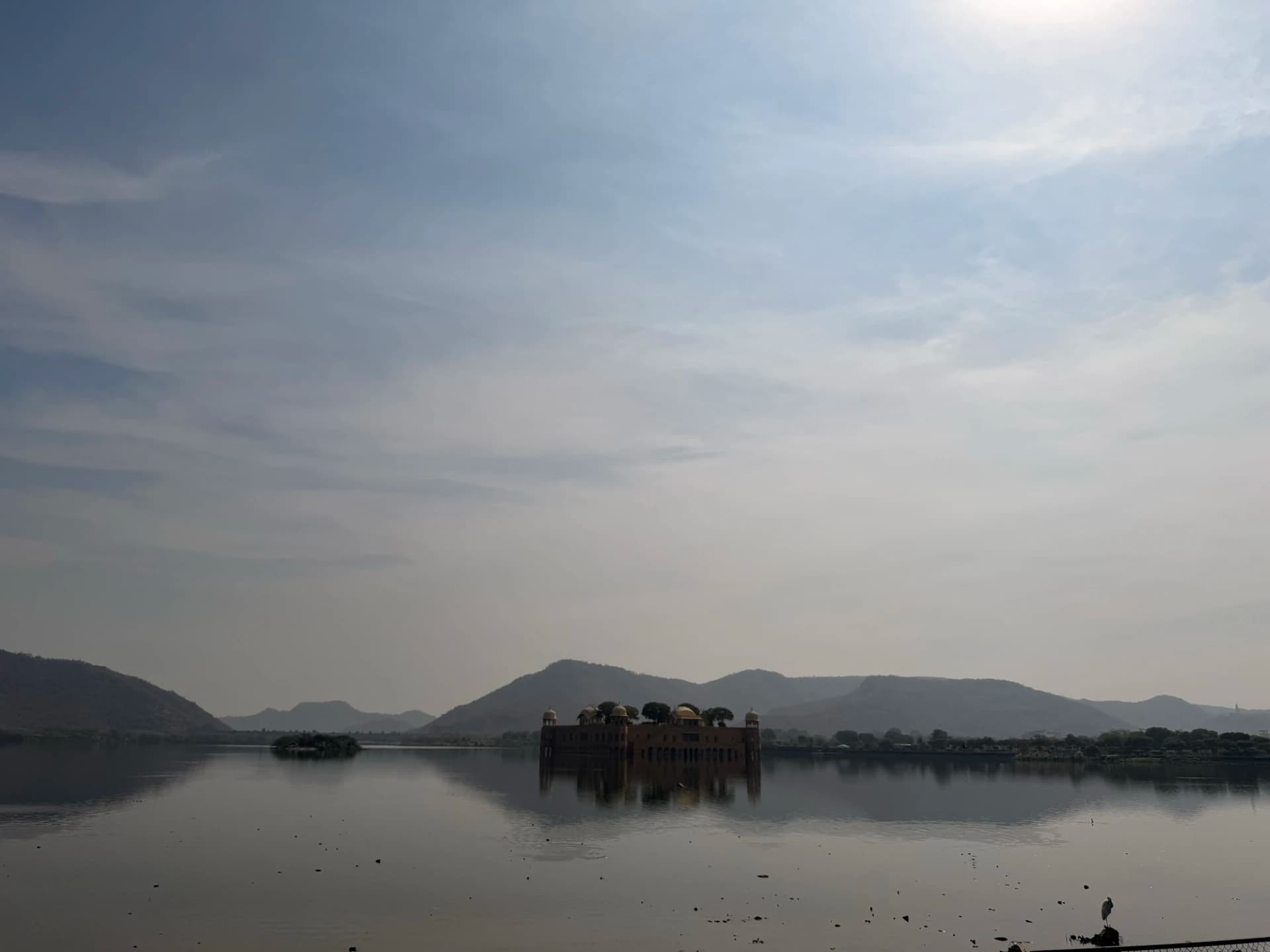
And the lake turned out to be Jal Mahal, which I had planned to visit and then cut.
It was a palace sitting in a wide lake, and there were a fair number of people here too.
You cannot get to the palace itself, and looking at it from a distance like this is all there is, which is why I had decided not to come, so ending up here anyway was funny.
The sun was too hot so I did not stay long; I went to a shaded spot by the road and booked an Uber on data that barely worked.
I booked one, but it was far up the road, and even after walking up for about five minutes I could not see the car.
This driver was not even sharing his position properly, so I just cancelled.
That palace in the middle of the lake is Jal Mahal, the water palace.
Built in 1699 and extended under Sawai Singh, it was originally a place to stay while out duck shooting.
Haggling for a Tuk-tuk
I thought I might as well ride a tuk-tuk once, so I started haggling among the many tuk-tuk drivers.
My attitude was to go with whoever bit at a low price.
Demand was low and supply was enormous anyway, so my price was the price.
The destination was not Nahargarh Fort but Nahargarh Hotel.
I planned to walk up to the fort from there.
It was already twelve.

I pushed 120 rupees at a tuk-tuk driver, and though he was unimpressed he agreed in the end, so I got in.
I came to think you are better off not taking tuk-tuks if you can help it.
For one thing they are far hotter than an air-conditioned Uber.
And you breathe in a lungful of exhaust.
And lastly the ride is far worse than you would expect.
The Woman Holding a Child
There was a woman on the road begging for money while holding a baby, so I just held up my phone and took a photo, and she smiled brightly and threw a peace sign.
In the end I gave no money and she left with a sour face, but it left me with a strange feeling.
I was ashamed of myself for taking a photo and raising the expectation of money when I had no intention of giving any.
On the other hand I also thought that wandering a dangerous road holding a child to draw sympathy, all to get money somehow, is not normal.
Up the Wall by Motorbike
When the tuk-tuk went through an entirely unpaved alley it was so bumpy and loud that it felt like sitting on a rock.
When we arrived I counted out the money with a swagger, as if rewarding this young driver for his trouble.
And then I pressed 120 rupees into his hand.
I smiled and offered my hand, and the driver left.

And Nahargarh Fort, visible between the alleys, looked brutally far and high.
After walking up for about thirty seconds I thought the height was absurd and seriously considered turning back.
But a young man on a motorbike happened to come up behind me and offered to take me for money.
He proposed 100 rupees and I accepted gladly.
I slung my bag round to the front properly and sat behind him, feeling uneasy.
The guy riding looked light-framed and the wall road going up was so absurdly bumpy that it felt like we might go over at any moment.
And the bends were so sharp that he leaned the bike almost halfway over to take them.
But this guy's riding skill, from growing up on India's rough roads, was superb.
After three to five minutes of riding we reached the wall.
Walking up would have taken twenty to thirty minutes.
Because it was hot, the sun was harsh and the slope was steep.
It was only after going up that I realised the Uber driver had been right.
That the road was rough and narrow had not been an excuse.
Once we were up, as I paid him in front of the entrance, he said to contact him when I wanted to come down.
I said fine and that I would call, said something vague and sent him off, but amusingly he had said all that without ever giving me his number.
Jaipur From Above
Inside there was not much, so I moved toward the wall.
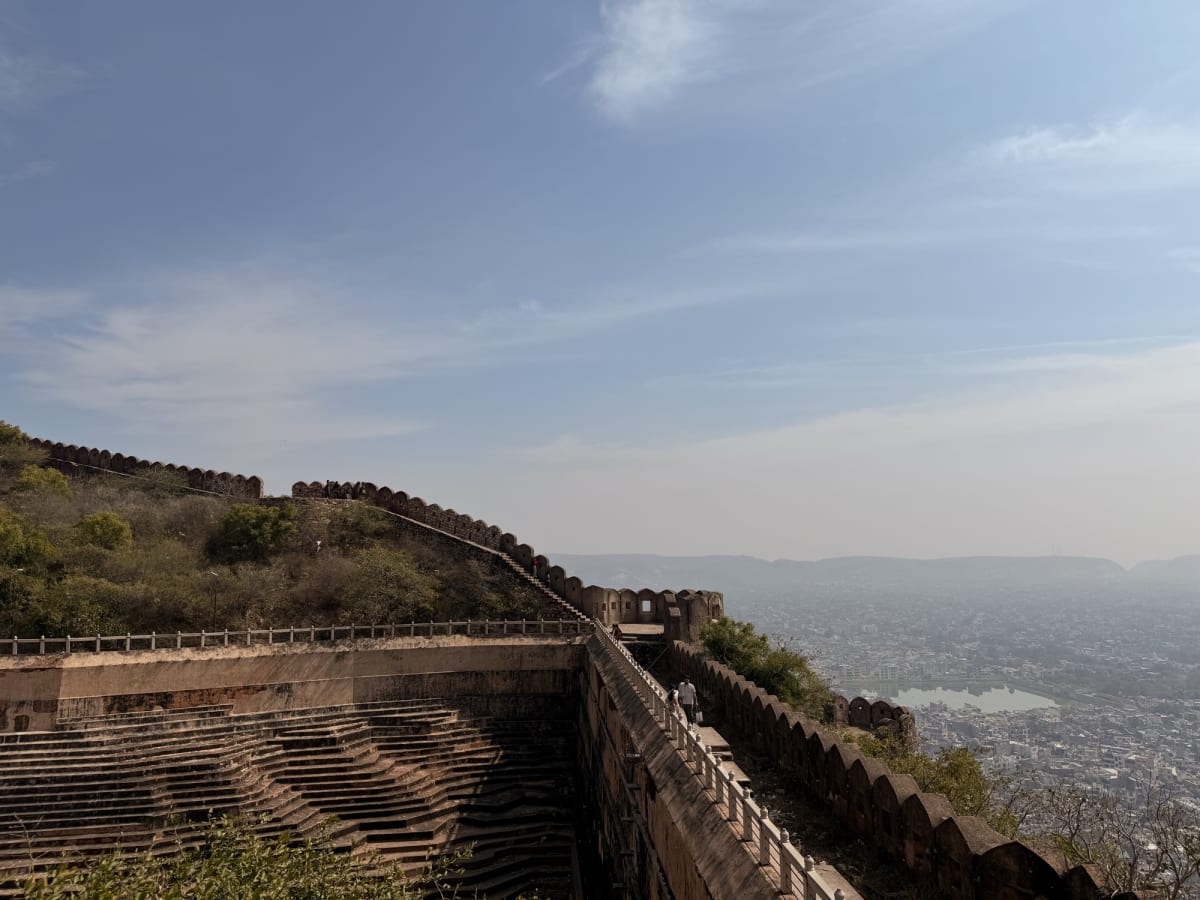
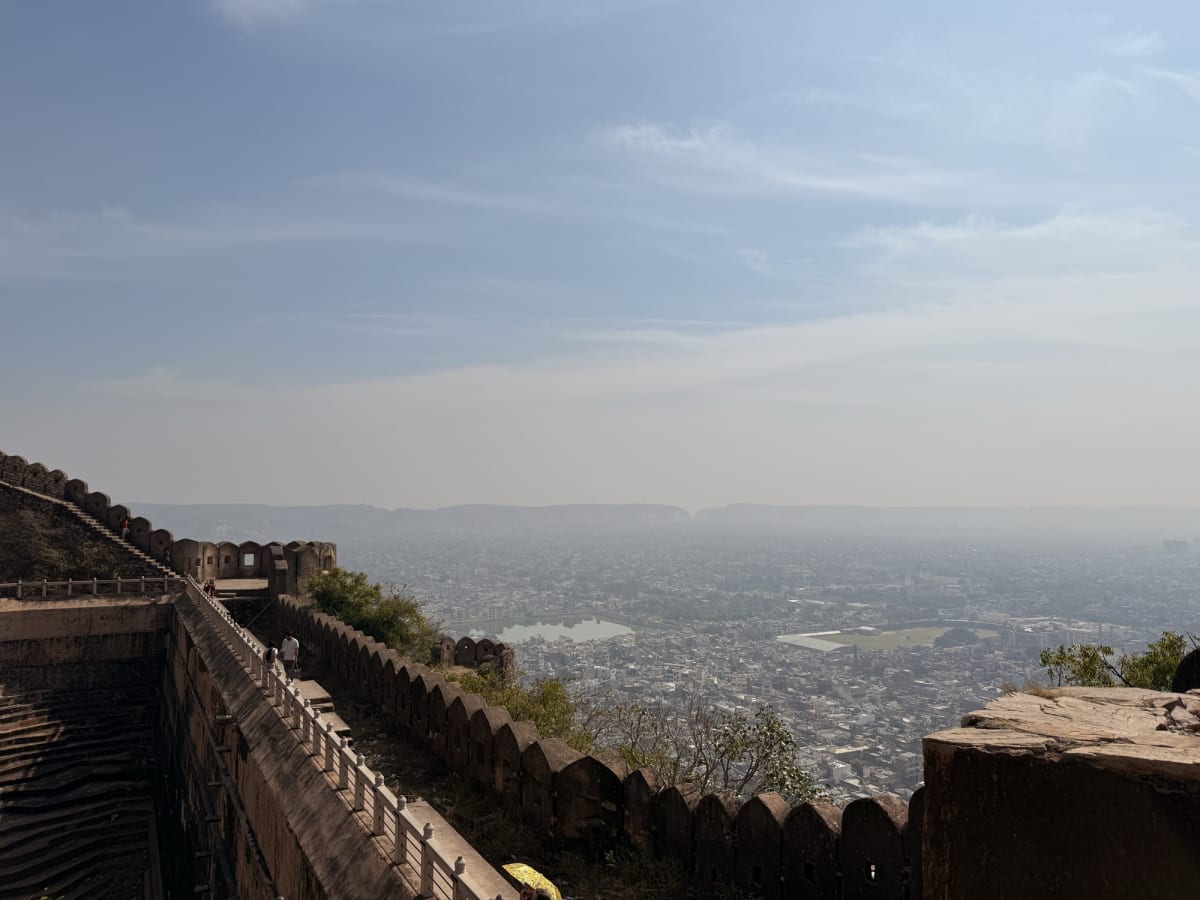
Below I could see a wide site that had been used as a well, and outward I looked down over Jaipur.
There were so many bees it was genuinely serious, with bees passing close enough overhead to almost hit me, but I was not stung.

I thought Nahargarh Fort was all there was and looked around only this part.
There is nothing to see, but I thought the view of Jaipur below was spectacular even half hidden in smog.
The well site was full of rubbish, so I threw the empty bottle I had been drinking from in there too, with no conscience about it.


And then I simply started back down.
Looking it up online after I got home, the thing I had vaguely wondered about behind the fort was Nahargarh Palace.
If I had known the palace was there I would have been very sorry not to look around properly, but thinking about it I would not have had much time anyway, so I let it go.
If I ever go to Jaipur again, I will go to Nahargarh Palace.
Nahargarh was built in 1734 under Jai Singh and greatly extended in 1868.
It is a defensive line set on an Aravalli ridge to look down over Jaipur.
The Way Down
The way down looked winding and long too and I felt daunted, but I was down quickly.
Partway I checked that nobody was looking and relieved myself outdoors once.
I think the environment does have some influence in changing behaviour.
But I also think this was simply a crude thing to do, and I did it because I found it funny on my own.
And I badly needed to go.
The way down took about ten minutes.

Partway there was a group of kids who looked like middle or high schoolers, stopped on their motorbikes and messing about.
One of the younger ones was staring at me the way many people here do, and since he was rather cute I suddenly thrust my face at him.
He flinched, pulled a face as if about to cry and stepped back, which was funny.
And countless cows, seemingly abandoned with no way to tell if they had owners, lay in dirt full of their own dung.
Chewing Tobacco

Coming down toward the alleys, some kids walking along, middle or high schoolers, spotted me and spoke to me.
In halting English they asked where I was from and whether I had a girlfriend, and laughed and giggled among themselves, every inch the schoolboys.
It felt like they had some scheme to tease or laugh at me, but it also reminded me of how immature I had been.
They told me to follow them, and full of curiosity I did.

They went to a street vendor, bought something that looked like cigarettes and pushed it at me.
It was inside a small square packet that looked like cheap sweets, and on the surface I saw a brutal photo of a jaw cut badly away and a warning to tobacco users written in English.
I did not know exactly what it was, but it seemed to be chewing tobacco.
It felt like these kids wanted to prank me and enjoy it, so I played along for a bit and then meant to turn it around on them.
One of them tore one open and mimed tipping the powder into his mouth, and gave me the unopened rest, and I just dropped it on the ground in front of them, pocketed what was left over and walked off laughing.
And walking on I threw the rest into the street.
It seemed to be chewing tobacco, but the picture really was shocking.
And kids are kids wherever you go in the world, and it made me think I should have been more careful about showing respect to people a little older than me when I was at school.
To the Pink City

Walking to Jantar Mantar took about thirty minutes, and with almost no pavement I walked a long way along a roadside packed with cars and motorbikes.
The bits of pavement that did exist were full of rubbish and the smell was so bad I thought I would rather breathe the exhaust.
But walking the road the exhaust stung my nose, and I just wanted to get out of India as soon as possible.


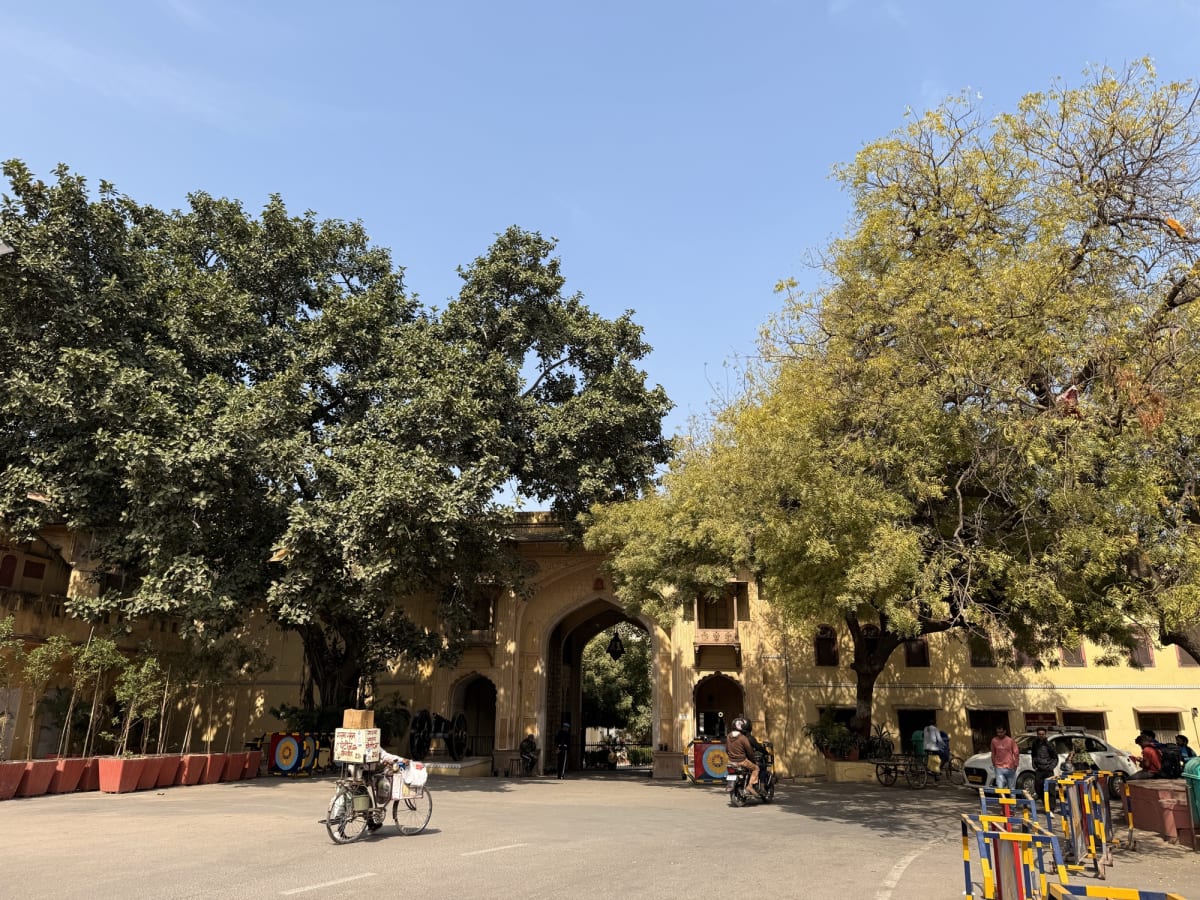
What made me feel I had reached the centre of Jaipur was when distinctive traditional buildings in red filled the view.
Then, walking and looking at the shops inside, a large yellow gate looked like an entrance, and going through it I saw traditional yellow buildings inside.
Jantar Mantar

Then I arrived at Jantar Mantar.
I could not work out where the entrance was, and while looking a young guide attached himself.
He was a young man who said he could guide me here and at Amber Fort and everywhere around Jaipur.
Still, having his own car, he looked like he was in his thirties or around the middle of them.
I pretended to listen, said we would talk later, bought a ticket and went into Jantar Mantar.
Looking into it, there seem to have been Jantar Mantars in Varanasi and New Delhi as well.
It turns out Maharaja Sawai Jai Singh II, who founded Jaipur, built observatories in Jaipur, Delhi, Varanasi, Ujjain and a place called Mathura.
Of these, the Jaipur Jantar Mantar is the largest.
It seemed Jantar Mantar meant observatory, so I looked it up.
It is said to mean an instrument for measuring the motion of the heavens.
Jantar comes from the Sanskrit yantra, meaning instrument or machine, and mantar from the Sanskrit mantrana, meaning to see or to measure.
Eighteen Instruments


Jaipur's Jantar Mantar was built in the early eighteenth century and is said to have eighteen instruments.
Each instrument is effectively a building, and the shapes were so unusual that there was pleasure in walking around them.
It was as if the equipment from a children's playground had been scaled up several times over.
Triangles, circles, curves: seen as a whole from a distance, the instruments looked rather like a set of building blocks.


The one that struck me most was something called the Vrihat Samrat Yantra, 27 m high.
It is the world's largest sundial, and its face is said to be tilted at 27 degrees, matching Jaipur's latitude.
With steps running along the slope, it struck me as a building rather than an instrument.
Being the most conspicuous thing the moment you come through the entrance, it had the most people gathered around it.
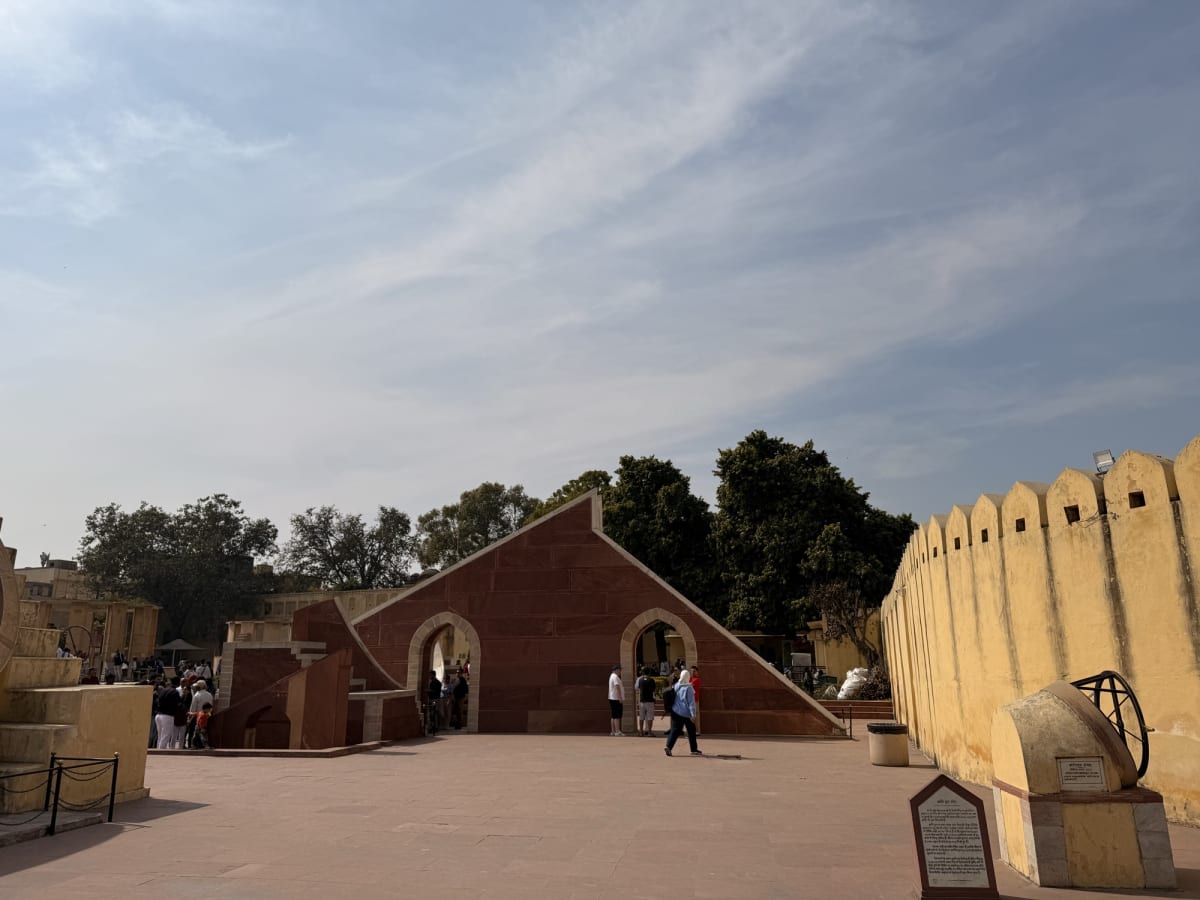

The other one I remember is the gong-shaped instrument I saw before the Vrihat Samrat Yantra.
It is called the Yantra Raj, and unlike the other building-like instruments it was, quite literally, a giant gong.
The name, though, apparently means king of instruments.
It is said to be a 200 kg metal disc able to measure the positions of the sun and the planets, and their rotation and revolution.

Jaipur's Jantar Mantar was inscribed as a UNESCO World Heritage Site in 2010.
City Palace
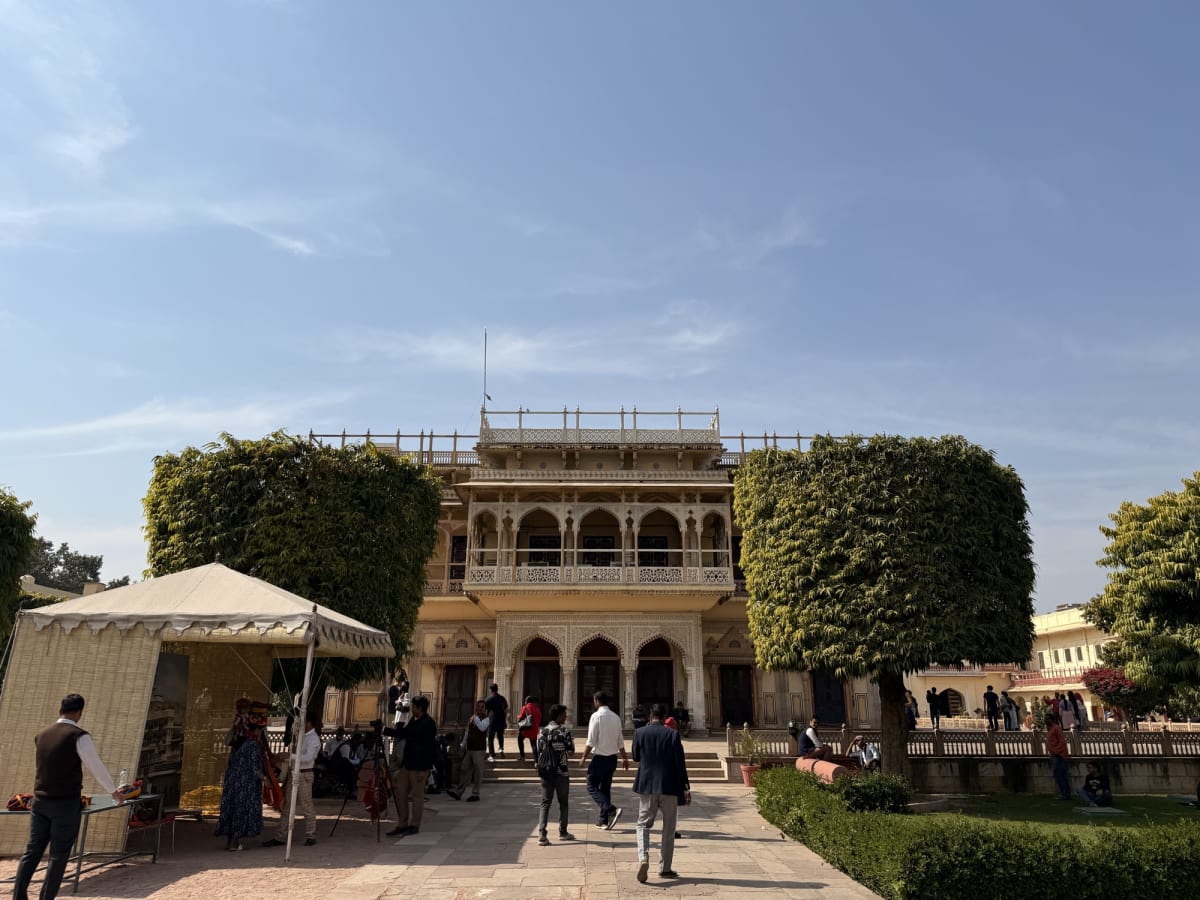
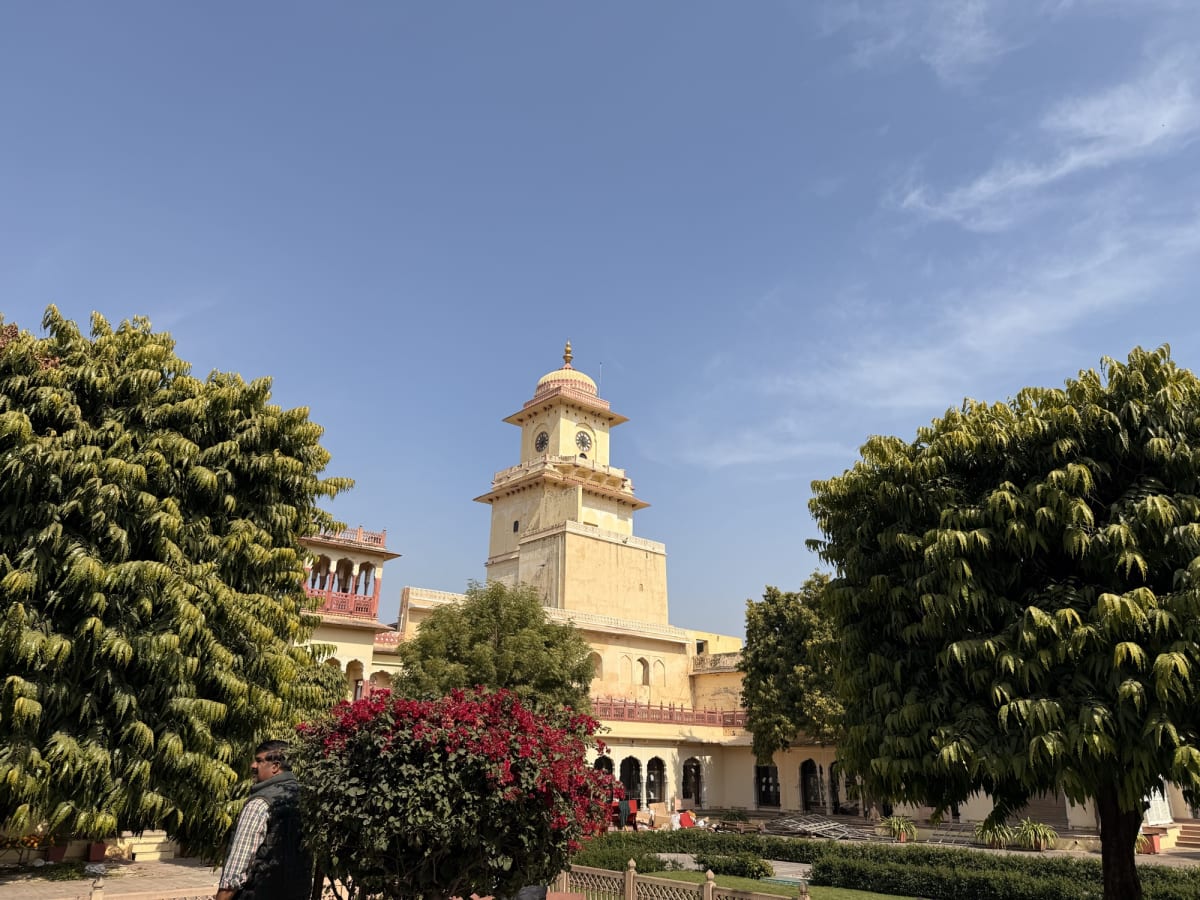
The next place I went was the City Palace right beside it.
Being the highlight, perhaps, the entrance fee was an expensive 1,000 rupees.
Inside, instead of the plain forsythia-yellow buildings of Jantar Mantar and the other backdrops, there was red decoration here and there against the yellow, which gave a more refined feel.

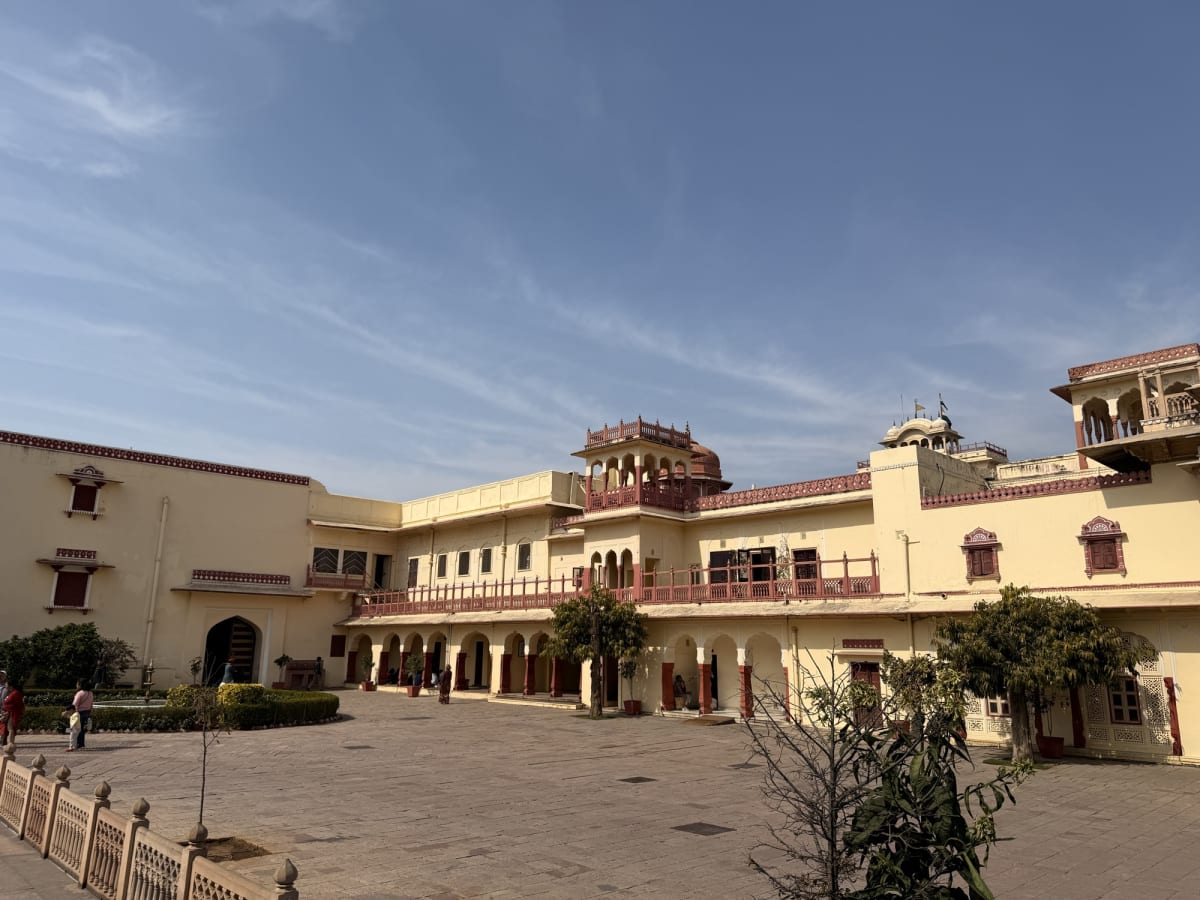
The building in the middle, straight ahead, is called the Mubarak Mahal, said to have been a building for receiving visiting envoys.

Inside, crafts and artworks are now on display.
Photography is not allowed, though I do not think there is anything there worth going to the trouble of forbidding.
There were exhibits like the historical evolution of dress, and the clothes were beautiful.
The City Palace was also completed in 1734.
It was built mixing Mughal and Rajasthani styles, and the royal family still uses part of it.
The Mubarak Mahal in the middle is the building where guests were received.
The Peacock Gate
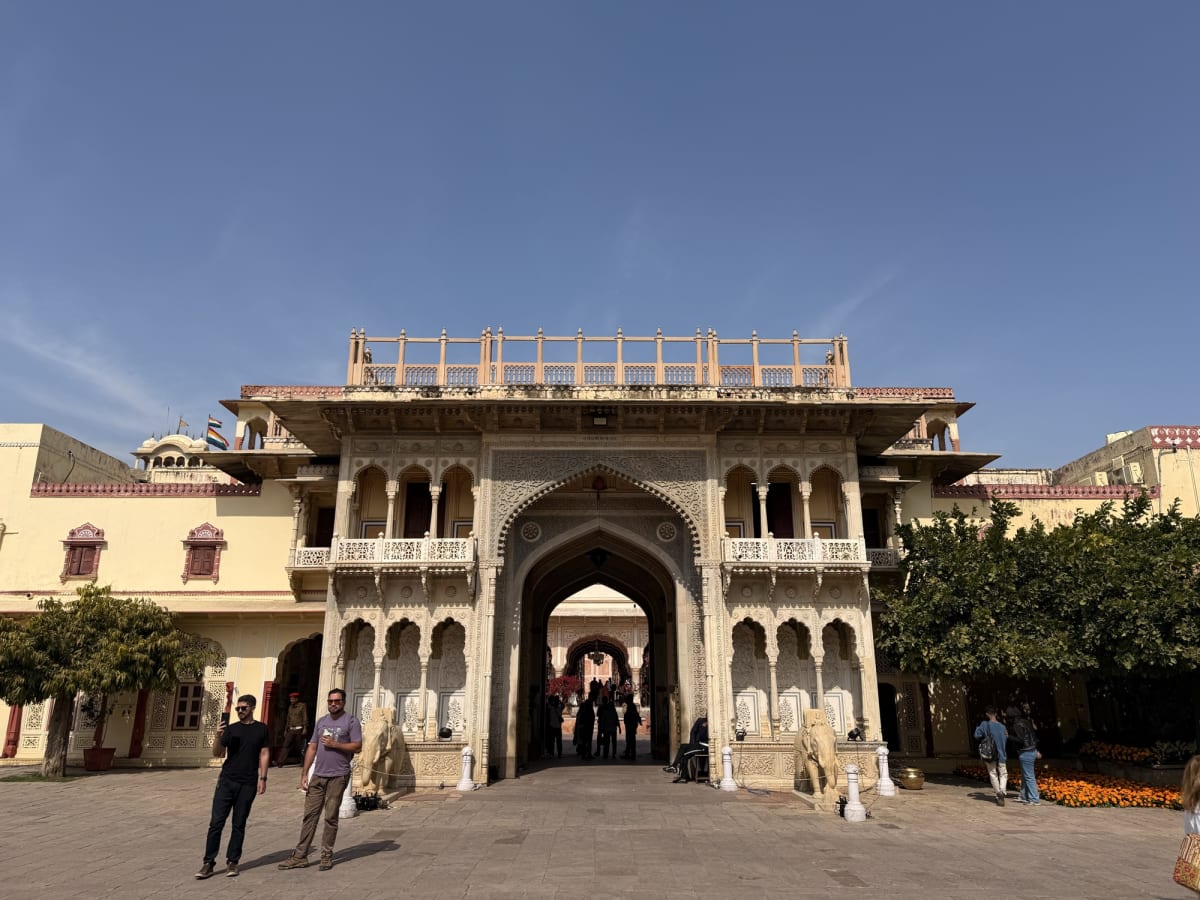

The large gate on the right, called Rajendra Pol, had beautiful decoration, and the elephant sculptures in front of it are said to be among the finest elephant carvings in India.
They were small, but very beautiful marble sculptures.
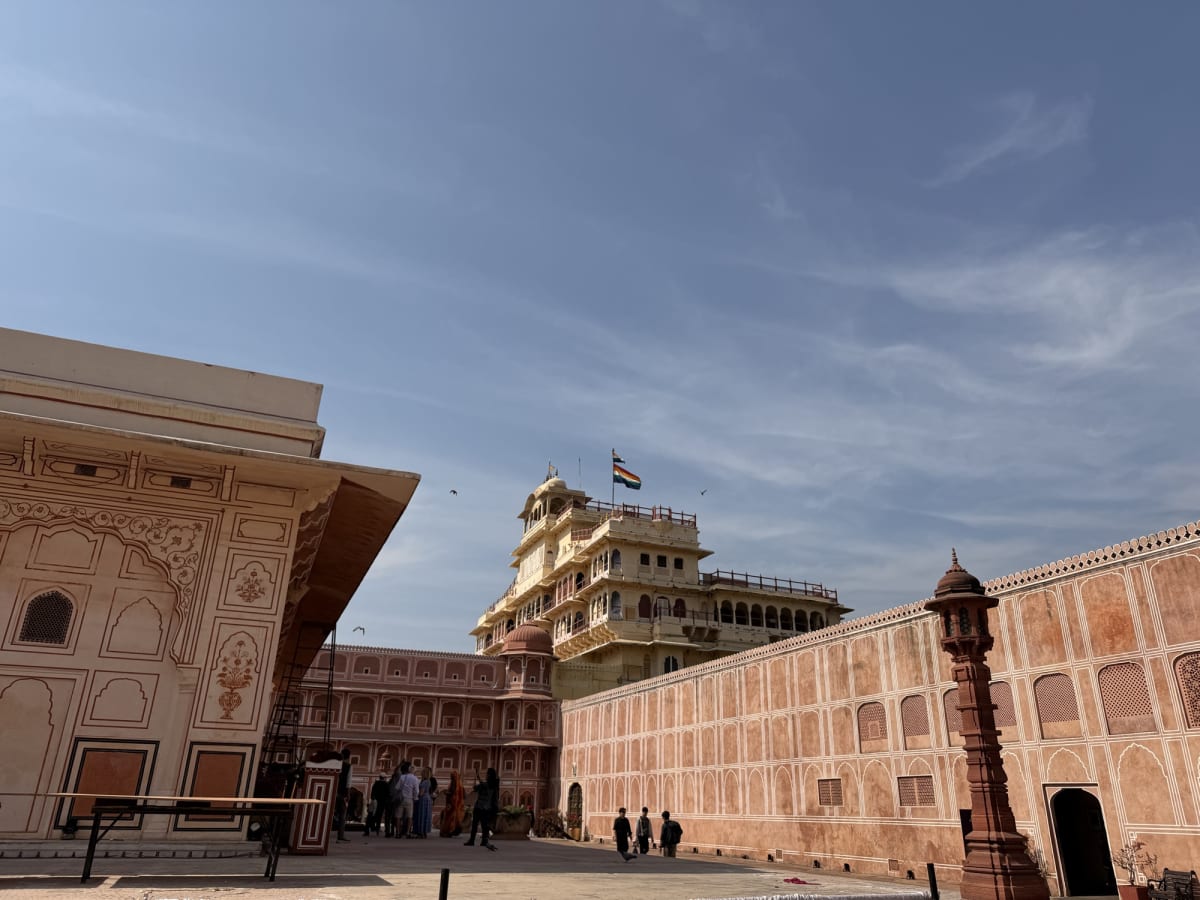
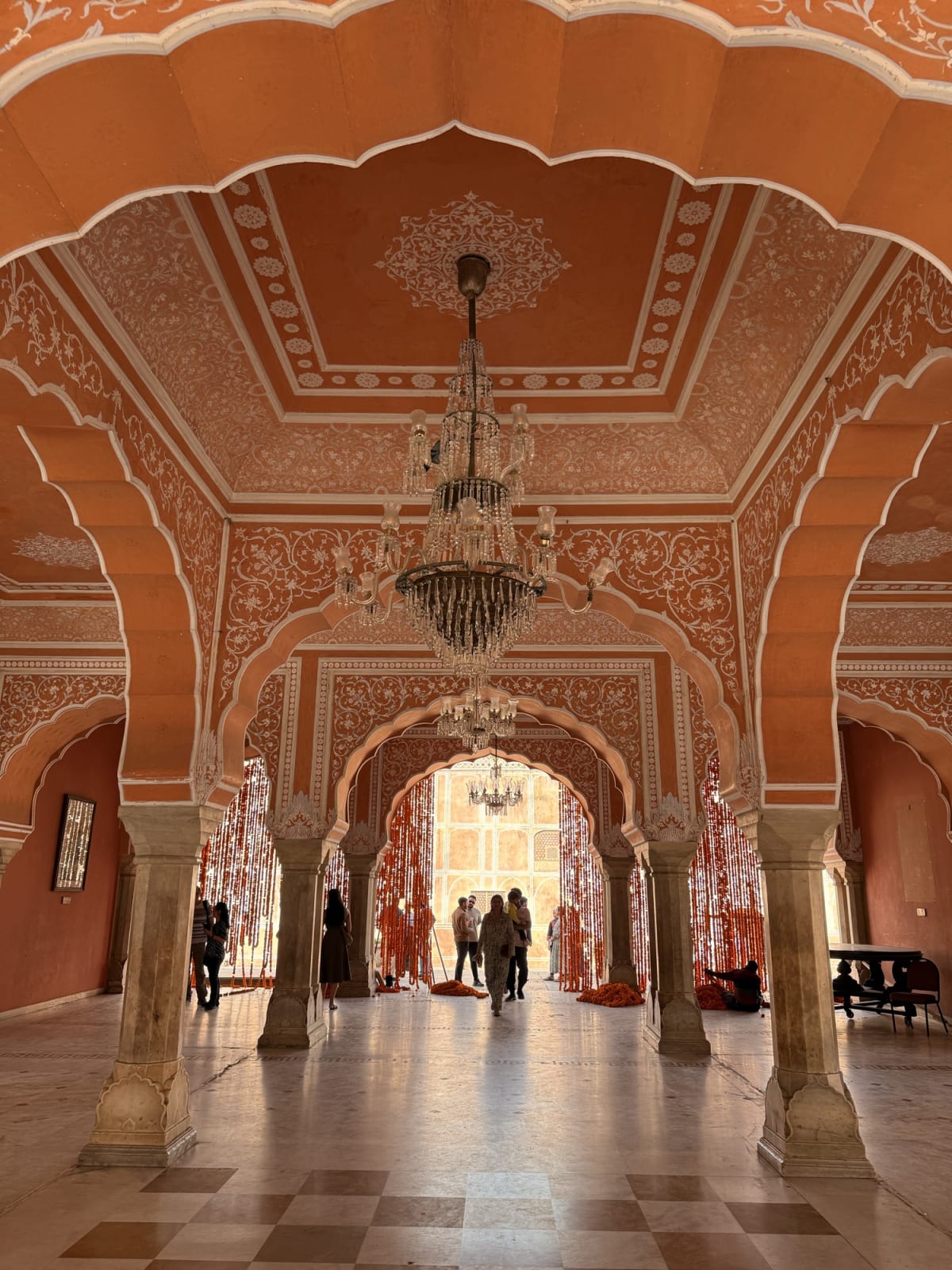
Past the gate is the Diwan-i-Khas, the audience hall, and going inside and looking up at the ceiling you are again entranced by India's beautiful patterning.
And it was cool in the shade.

Moving to a courtyard called Pritam Chowk you can see the famous emerald-toned gate with its peacock decoration.
Parts were under construction and it was very distracting, but the peacock gate was very beautiful.
The courtyard with that peacock gate is Pritam Niwas Chowk, the courtyard of the beloved.
There are four gates, each standing for a season.
The green gate is spring, the lotus gate summer, the peacock gate autumn and the rose gate winter.
The Guide Who Walked Away

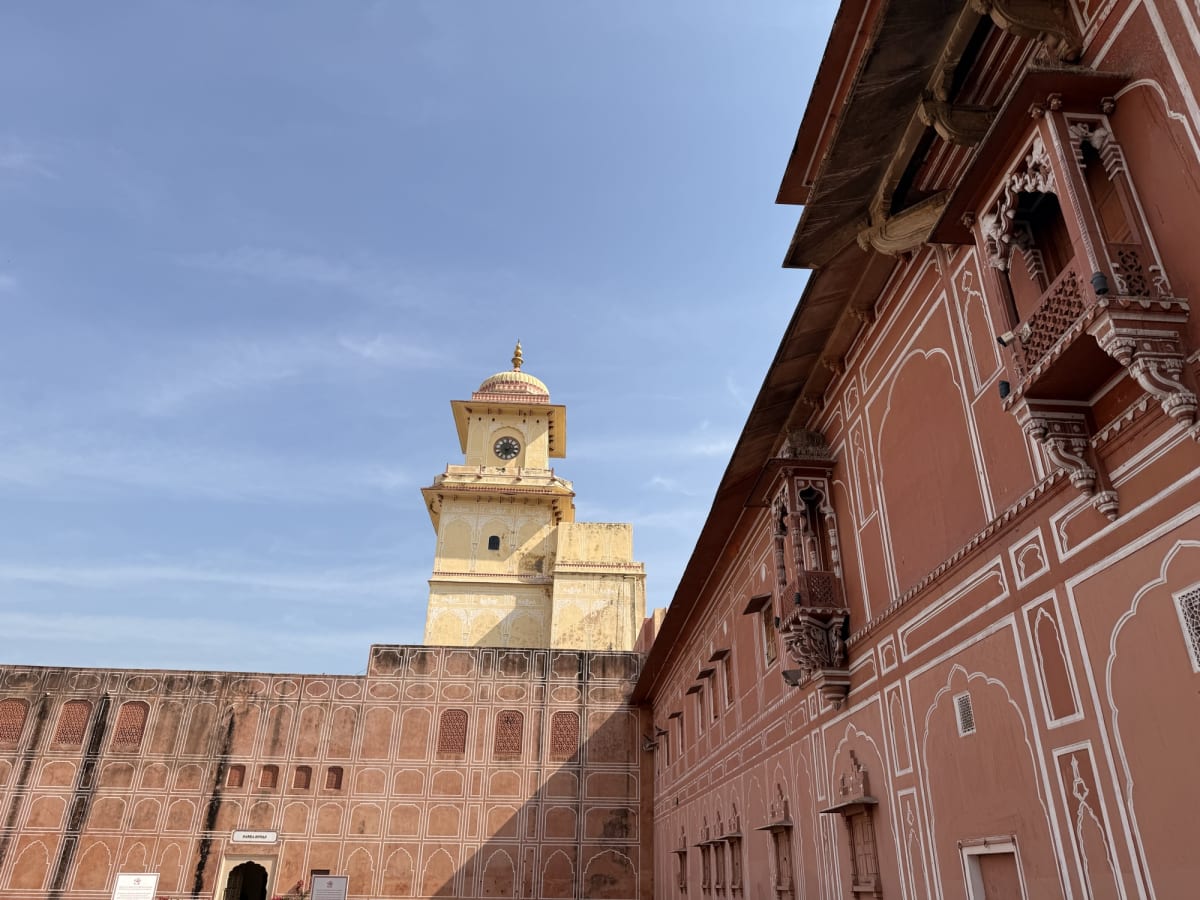
Coming out, I moved on to Hawa Mahal, the last thing to see.
The moment I came out of the City Palace I met the guide who had been touting earlier, and he worked hard at describing the sights, saying he would take me everywhere, even far out, in his own car.
But I had already been round almost everything from Amber Palace on, so I told him I had been to all of it.
And I said it was a good offer, but I had already been everywhere and had no money on me now.
The guide went back looking disappointed, but he must have understood, because he did not cling at all and dropped away cleanly.
I suspect that if I had asked him to guide me he would have done it very capably.
Hawa Mahal
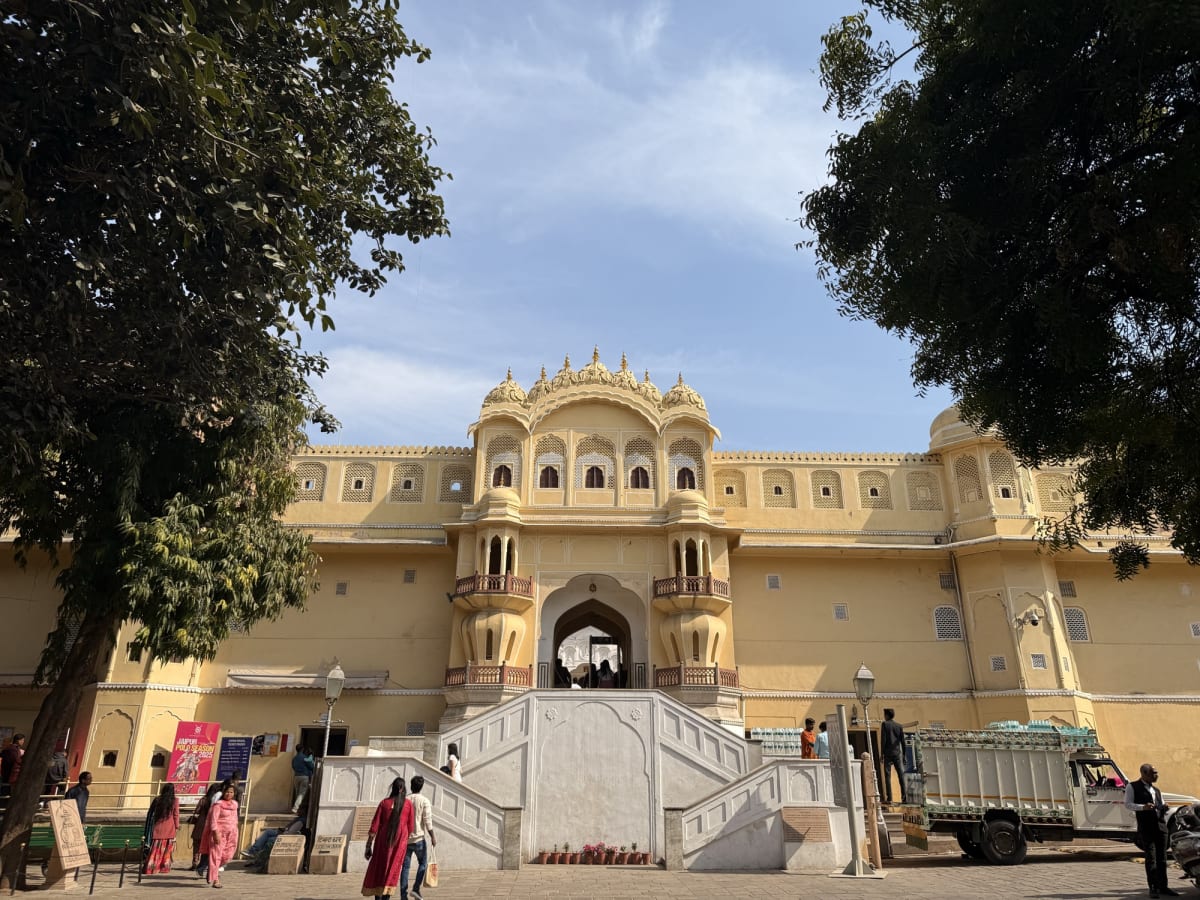
Hawa Mahal was hard to find inside this maze of a tourist quarter.
In particular the ticket office was crowded, plenty of people pushed in, and the staff were unfriendly.
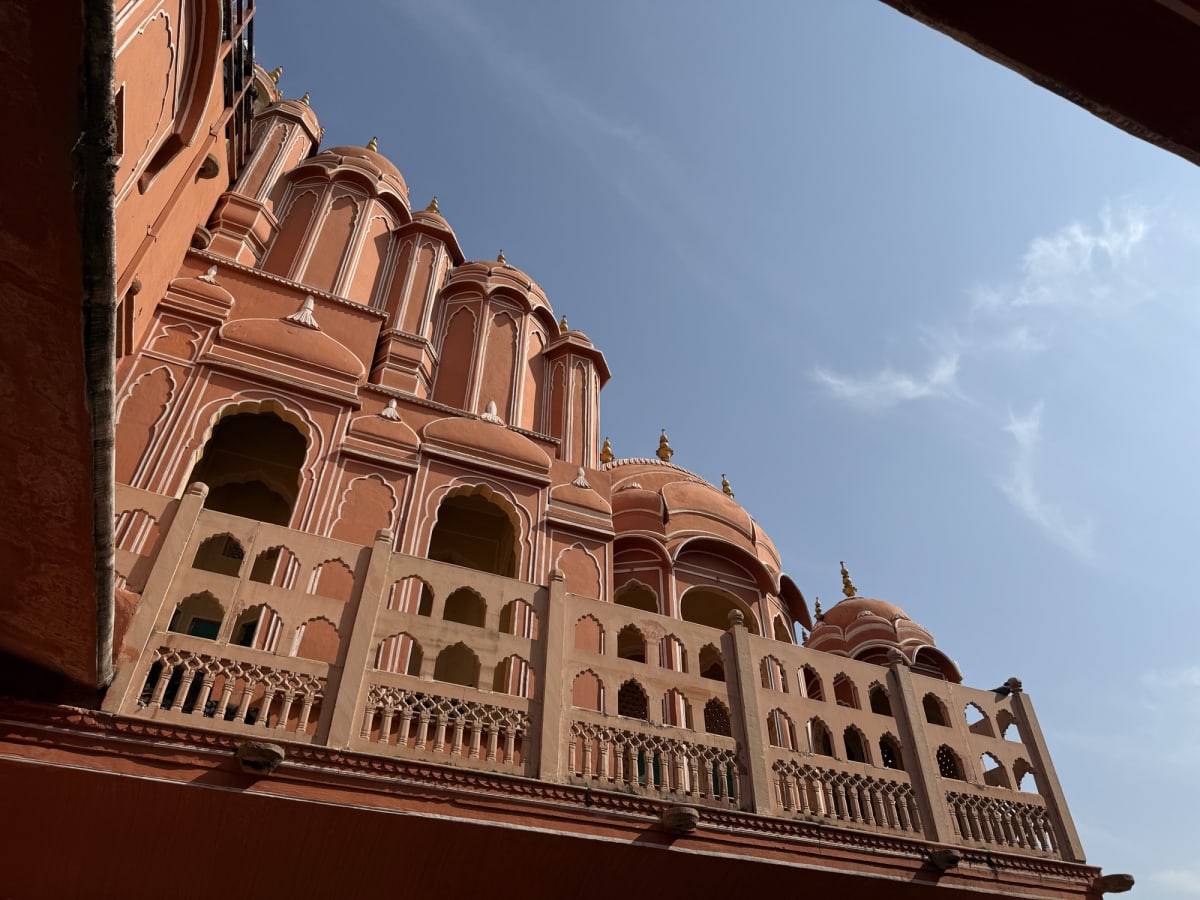
The outer face of the building is also famous, and sadly it did not even occur to me to go and see it, so looking around the inside was all I did.
But the substance of it was the inside anyway, so I enjoyed it.


Hawa Mahal is said to be a palace built for the women of the court.
It was built by Pratap Singh, grandson of Maharaja Sawai Jai Singh II, who founded Jaipur.
So that the court women, who could not go outside, could see out, a great many windows were made like a honeycomb, and because wind passes well through this latticed window it is said to be called the palace of the winds.
Inside the Palace of the Winds


It is a place you go round while climbing, and at the very top it was excellent as a lookout over Jaipur.
There is a fountain spouting water in the very centre, and going into the building that surrounds the fountain you can go up and down by very steep stairs.
The inside of this place was like a maze too.


In one space you could see a puppeteer holding puppets while traditional instruments were played beside him.
The way up to the very top is a single staircase, so staff were controlling it, letting people up and out in batches.
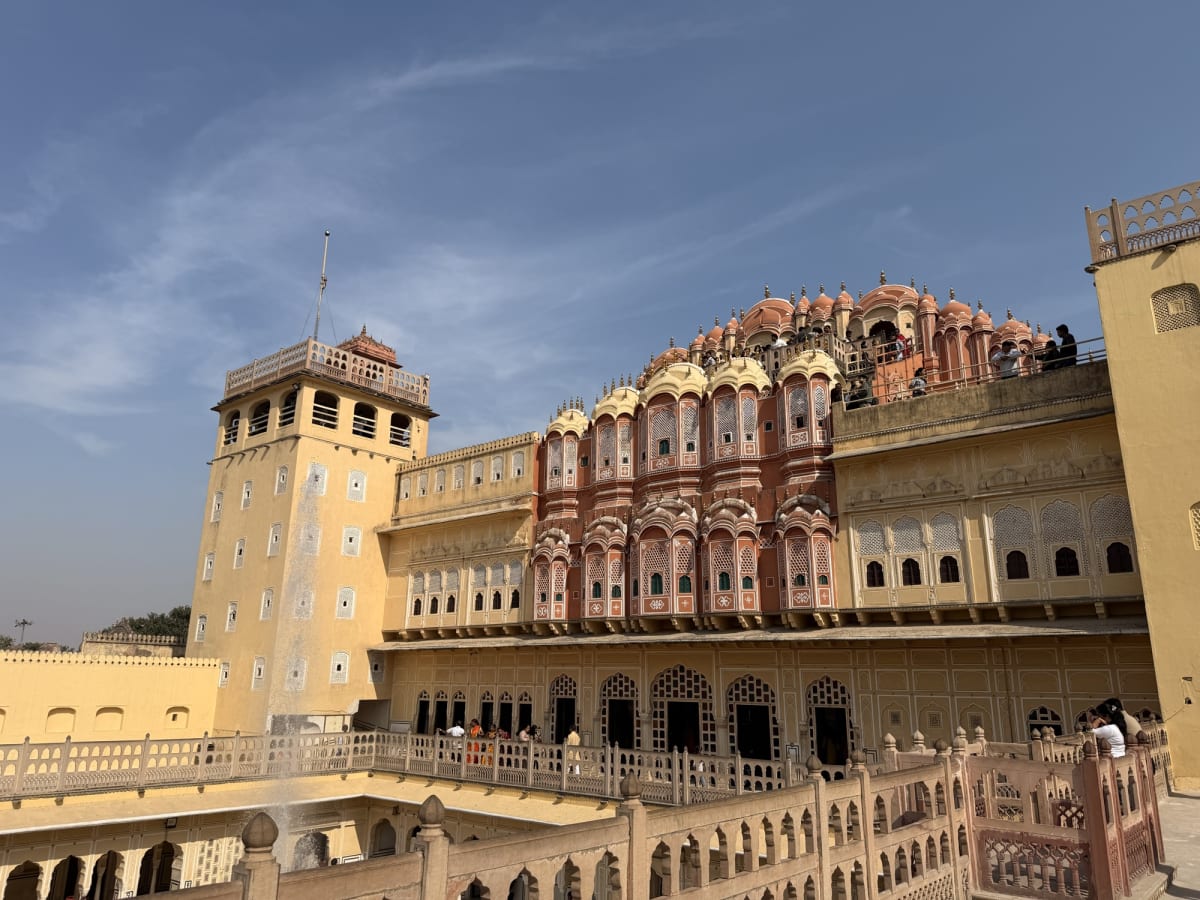

Going up and looking down you do not get a panorama of Jaipur, but you can see all of this walled tourist quarter.
Looking at Jantar Mantar and the City Palace from there, the nickname Pink City suits it less than Forsythia City would.
Outside the walls, brown or red city suits it better than pink.
Jaipur was painted pink in 1876.
The whole city was painted in a colour of welcome for a visit by the Prince of Wales, and that colour stuck as the name Pink City.
Mixed with the original sandstone colour, it is now closer to ochre than to pink.
Lassiwala
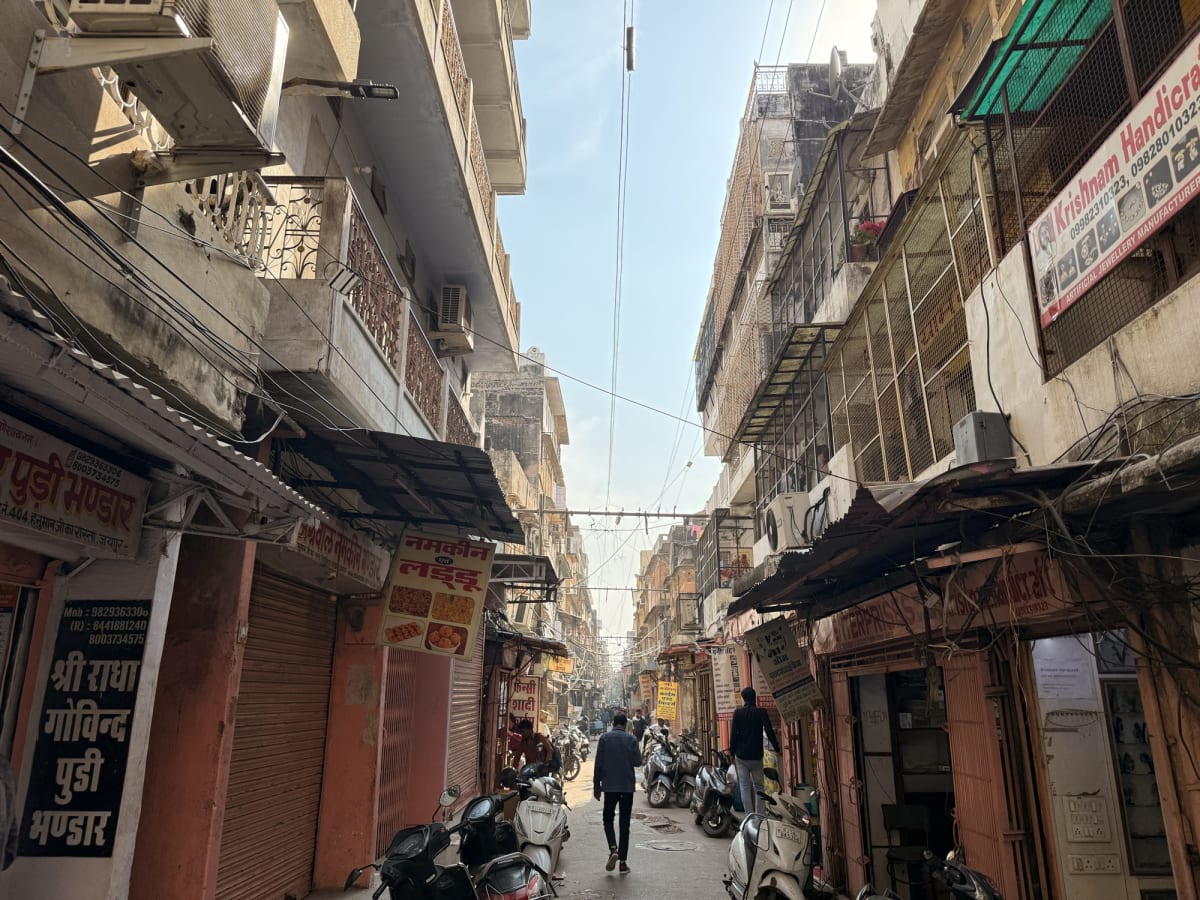

Having seen Jantar Mantar, the City Palace and Hawa Mahal, the place I had liked most so far was Jaipur, over Varanasi and Agra.
But the roads here were awful too.
The alleys were full of monkeys and it was remarkable watching them play along the power lines, and the streets were full of stray dogs.

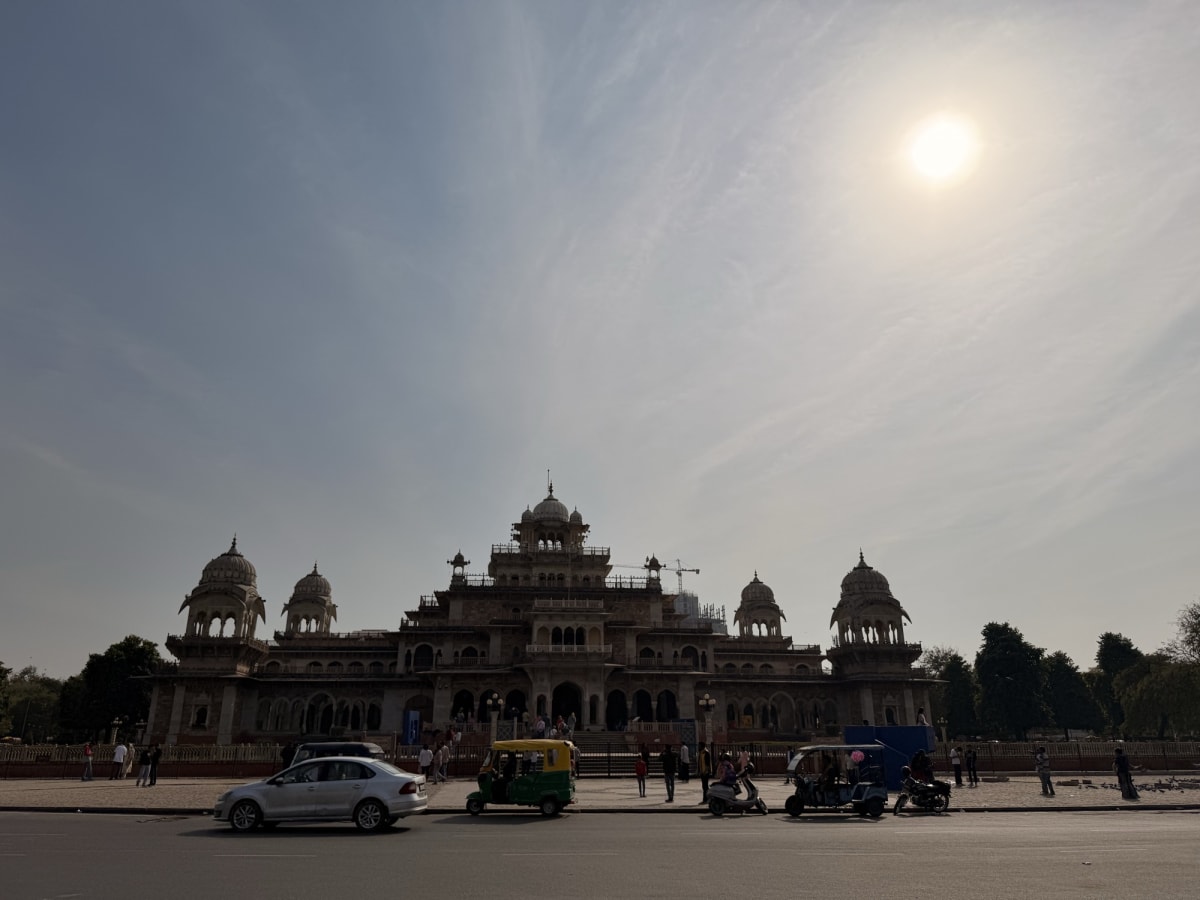
After walking about twenty-five minutes I arrived in front of the Albert Hall Museum, but there was no time to look inside, so I gave the outside a rough look and moved on to Lassiwala.
Getting there took a long time again, and the smog was so bad it felt like my airways were ruined.
My nose stung and breathing was a nuisance.

I was worn out from all the walking, but as I got close to Lassiwala my mood lifted.
Looking from across the road there were four signs all saying Lassiwala, and since I had to pick the real one I searched online.
Checking online and working out which it was, the other shops had almost no customers while only the real one had a queue.
Crossing over and waiting my turn, a man beside me who was waiting on a very large number of takeaway orders asked me in English what I wanted and ordered for me.
And then he bought it for me.
It was 40 rupees, about 640 won.
That unexpected windfall wiped out all the exhaustion and irritation of the walk.
And I was desperately thirsty and craving sugar.
Dust to Dust
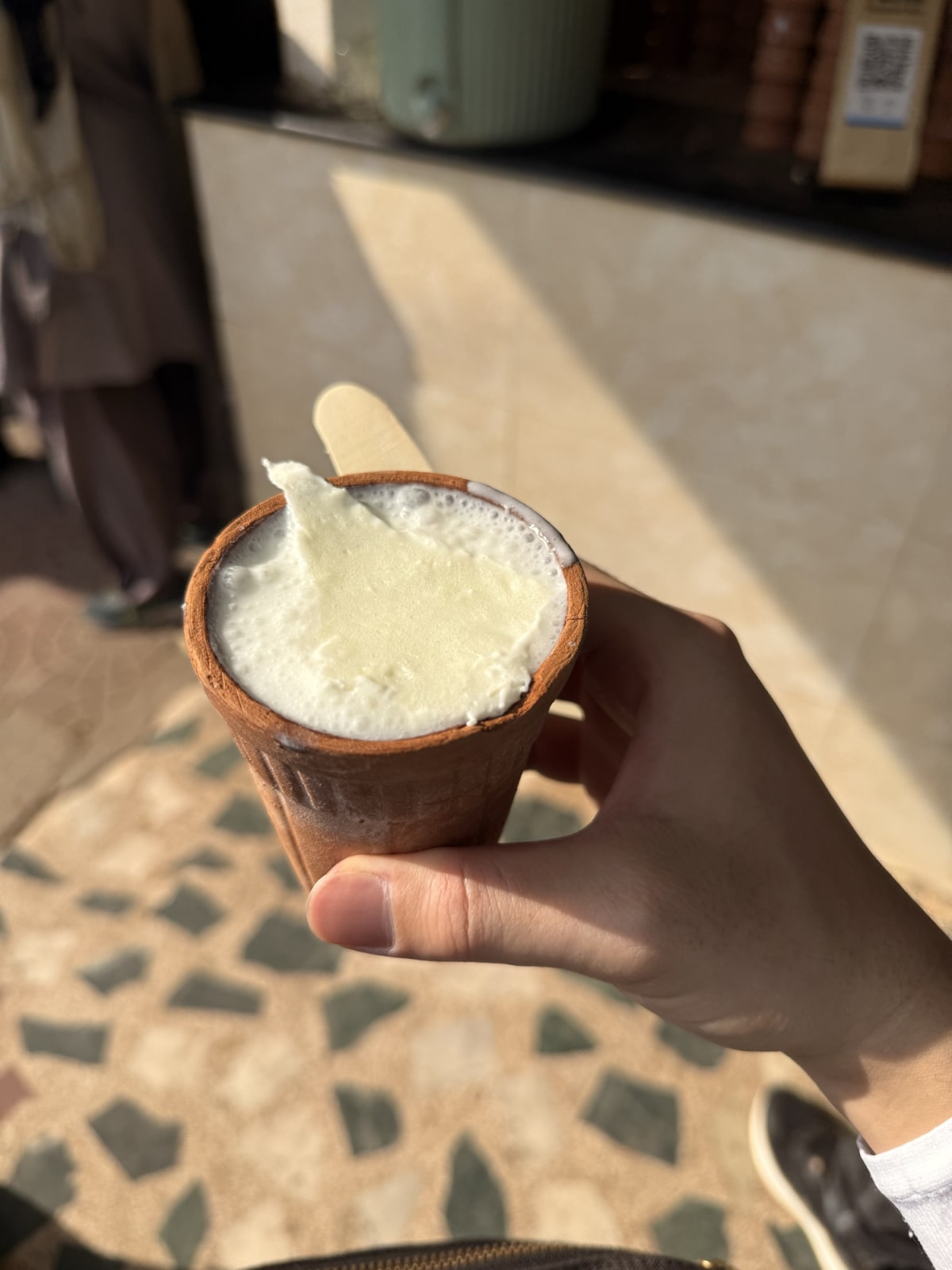
In a red cup that looked freshly fired from clay was lassi that looked very thick, with a shell on top like set cheese.
Picking it up and eating it, there was a rich, cheesy yogurt flavour, and the sugar hit was welcome.
Drinking the lassi felt like drinking a sweet, sour, very deep yogurt.
It was good, but the taste is not all that special.
I drank it in Varanasi too, but lassi itself does not seem to be a drink that tastes special anywhere.
Fundamentally it is a drink that is above average wherever you go.
My satisfaction was very high, so next time I come to Jaipur I will stop at Lassiwala several times or buy several at once.
One is nowhere near enough.

The cup is the other pleasure; it looks unsafe hygienically, but smashing it on the ground is very satisfying.
Hurling it down while saying, you were made of earth, return to earth, relieves the stress.

Walking on, I laughed at three small children in an auto-rickshaw who spotted me and waved hello.
They looked about six, and they did not ask for money, only hi!
Just hi, hi, which made them all the more endearing.