India 5-1 · Amber Fort
Morning in Jaipur

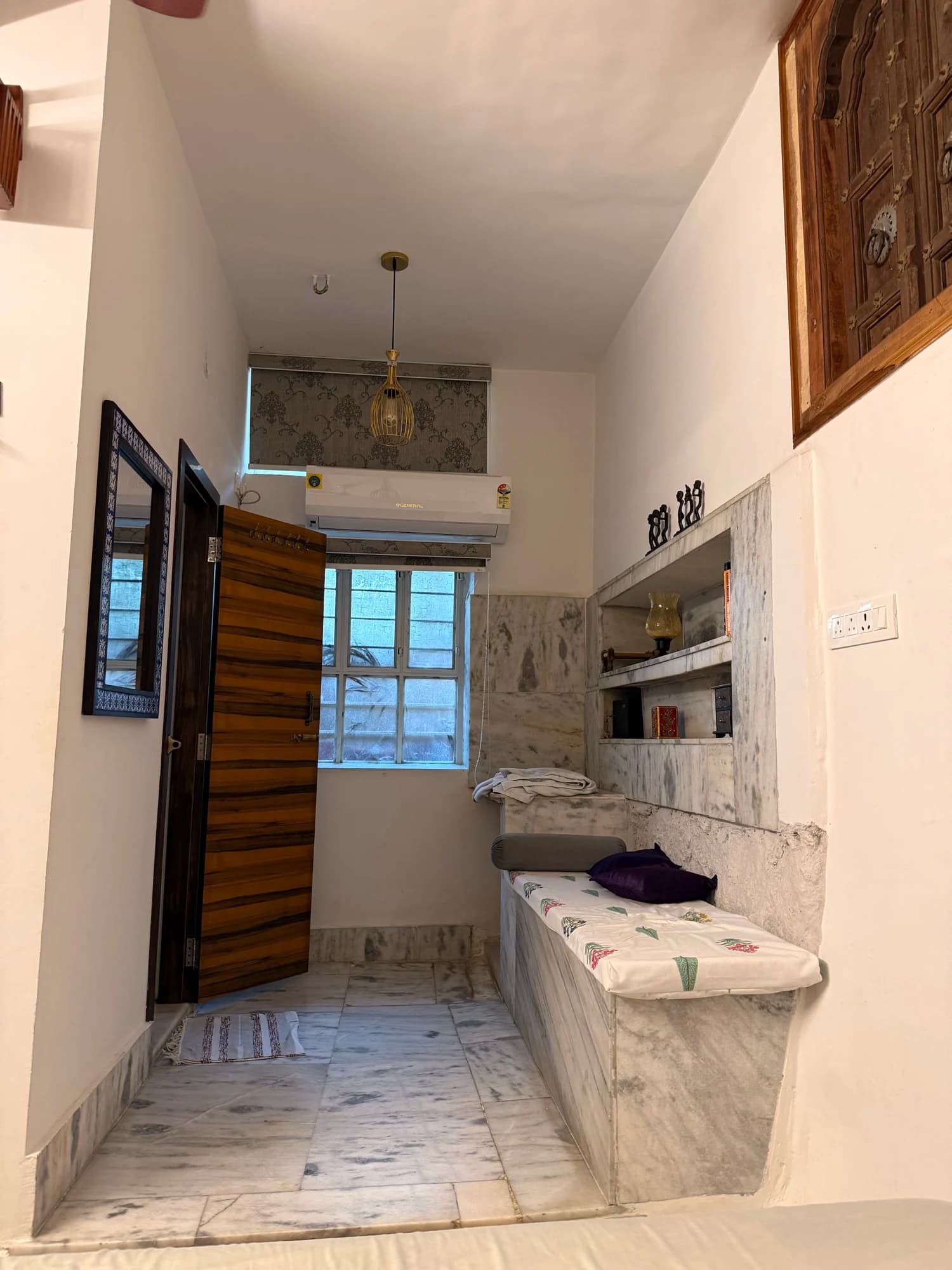
I woke around seven and kept drying my laundry before heading out.
I used the dryer, and whether there is a limit on the electricity, after about thirty seconds all the power in the room went out.
In the end I just put the half-dry clothes on, thinking wearing them would dry them faster.

Then I went up to the roof, paid, and left the guesthouse around nine.
The Uber Driver
The data was barely working as it was, so I used the guesthouse wifi to call an Uber to the door.
I set Amber Fort as the destination, and a pointless message came through the Uber app saying drivers do not usually go that far but he would.
It seemed he wanted more money, but if he would not go for this fare I could just call another Uber, so I told him to come for now.
I got in and there was a swaggering-looking man at the wheel.
Even after I was in the car he kept saying that Uber drivers do not usually go to Amber Fort but he would.
I had no intention of paying more, since Uber takes the fare automatically.
But then he started saying unpleasant things.
He suddenly asked if I had a girlfriend, and when I said I was from Korea he started in on what Korean women's breasts were like, close to harassment.
I was not the one being talked about, but hearing talk that low was enough to put me in a bad mood.
I used the 'listen, listen' line I had ended up using all through the trip, and spoke calmly.
I said 'what are you doing', asked him what he thought he was doing, and told him why he should not say things like that.
He said he had lost a good job and ended up driving for Uber, and was saving money to start a business one day.
So I told him that for that he would need to learn how to treat people with manners.
Being talked to like that by someone with children who looked over forty, he did listen reasonably well.
He brought up something sexual once more partway through and I told him off again, but ironically, compared with the people I had dealt with up to then, he was on the better end for listening.
It was a very unpleasant experience all the same.
Among taxi drivers there do seem to be some whose manner is awful or rude.
The Fort Across the Lake
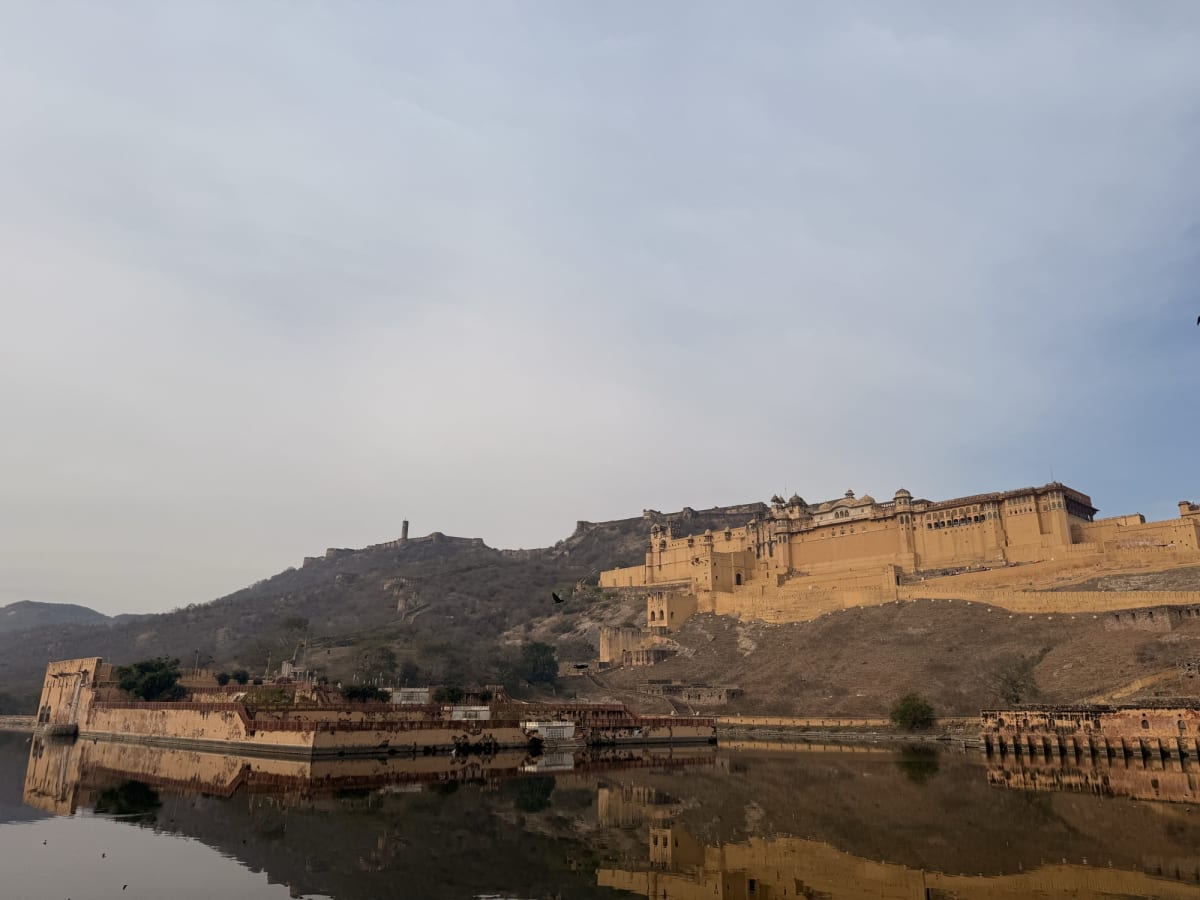

The ride took about twenty-five minutes, and on the way I could see a wall running long along the ridge.
And up close, Amber Fort looked enormous in scale and imposing.
I arrived at half past ten.
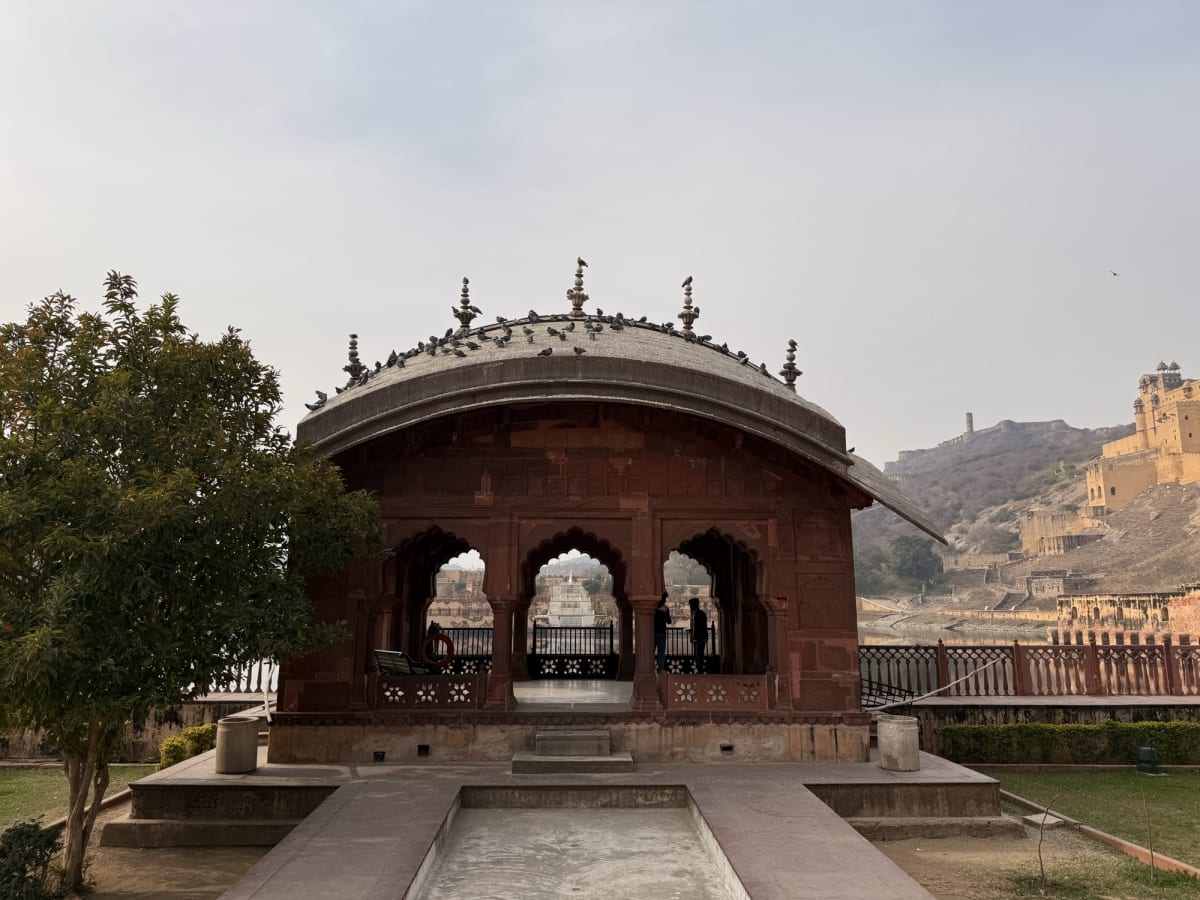

There is a pond at the entrance that looks man-made, though 'lake' would suit it better than 'pond'.
Go through the entrance and there is a garden right there, where the guides latch on again.
But I refused politely and quickly and started walking up.

I had seen plenty of forts built mostly in red sandstone, but Jaipur was closer to a golden city.
Amber Fort too was built in yellow, and what came through was not the toughness of red but the brilliance of gold.
Though looking at the countless pigeons and the under-maintained garden inside, it was closer to a dull, impoverished yellow than a brilliant one.
Amber Fort was built not by the Mughals but by the Rajputs.
The Kachwaha dynasty, which ruled this region from the eleventh century, began building it in 1558 under Raja Bharmal, and Raja Man Singh I, a commander under Akbar, raised it into its present form in 1592.
It was extended over the following two centuries and completed under Sawai Jai Singh II in 1727.
And in that same year he moved the capital from Amber to Jaipur.
That is why this fort stands empty.
The lake below the fort is Maota Lake, the palace's only water source.
In 2013 it was inscribed on the UNESCO World Heritage list as part of the Hill Forts of Rajasthan.
Elephants


You have to climb along the wall, and unexpectedly I saw people riding up on enormous elephants.
They were charging people to ride tamed elephants up the slope.
Which is why the ground was covered in elephant dung and you had to walk around it carefully.

Here and there on the steps were women and older women selling beads and small crafts.
Among them were women with very young children.
I saw some all but living on the steps, lying down asleep, or with the children trying to sell in their place.
There were people with physical difficulties or disabilities as well.


The climb is not terribly steep but there is some gradient, and even walking up slowly it took about ten to fifteen minutes.
Jaleb Chowk

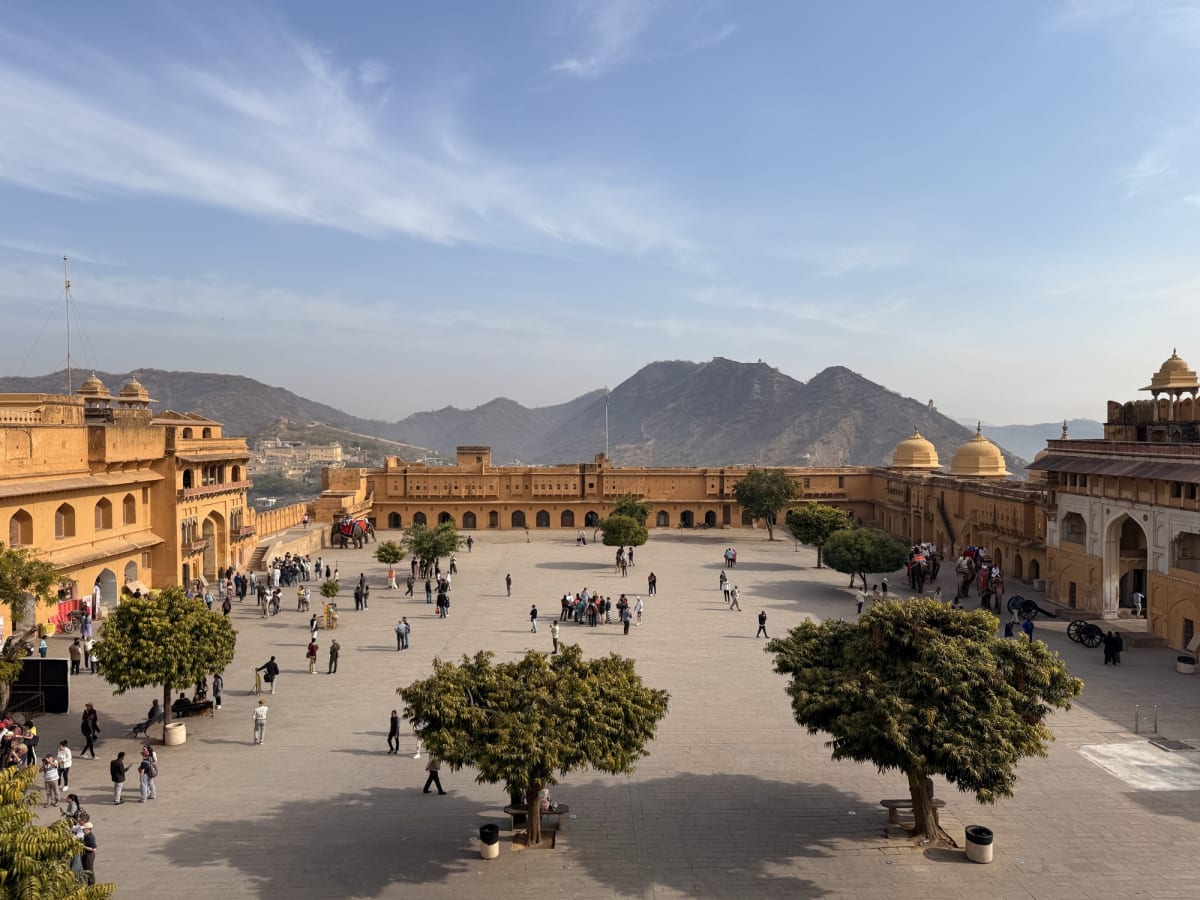
Coming in through the fort entrance, there were many Indian couples having wedding photos taken.
The courtyard inside the fort was quite wide, and you had to buy a ticket at a counter across it.
It was 1,100 rupees, which I thought was fairly expensive.

I bought the ticket and walked up the steps that lead to the upper part of the fort.
This was where you hand over the ticket and go in.
At the top I asked a foreign man to take a photo, and he kindly took several, which I appreciated.


The view down over the courtyard was good, and the landscape with other walls and the hills in the distance was spectacular.
Chahar Bagh

By the lake in particular there is a garden laid out in distinctive patterns, called the Chahar Bagh, which makes it even more worth looking at.
Nobody was in it, so presumably it is off limits.

Looking down at the wall path I had climbed, I could see countless elephants coming up.

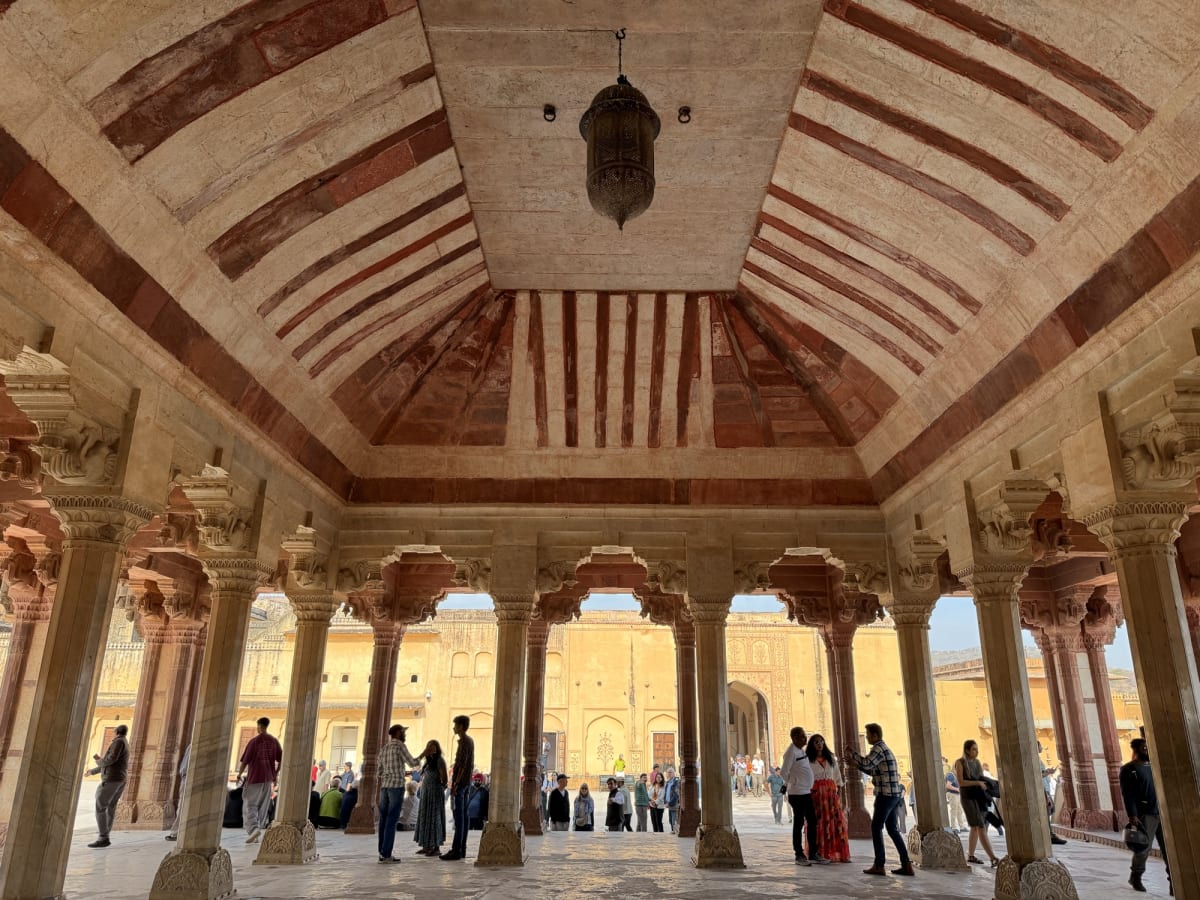
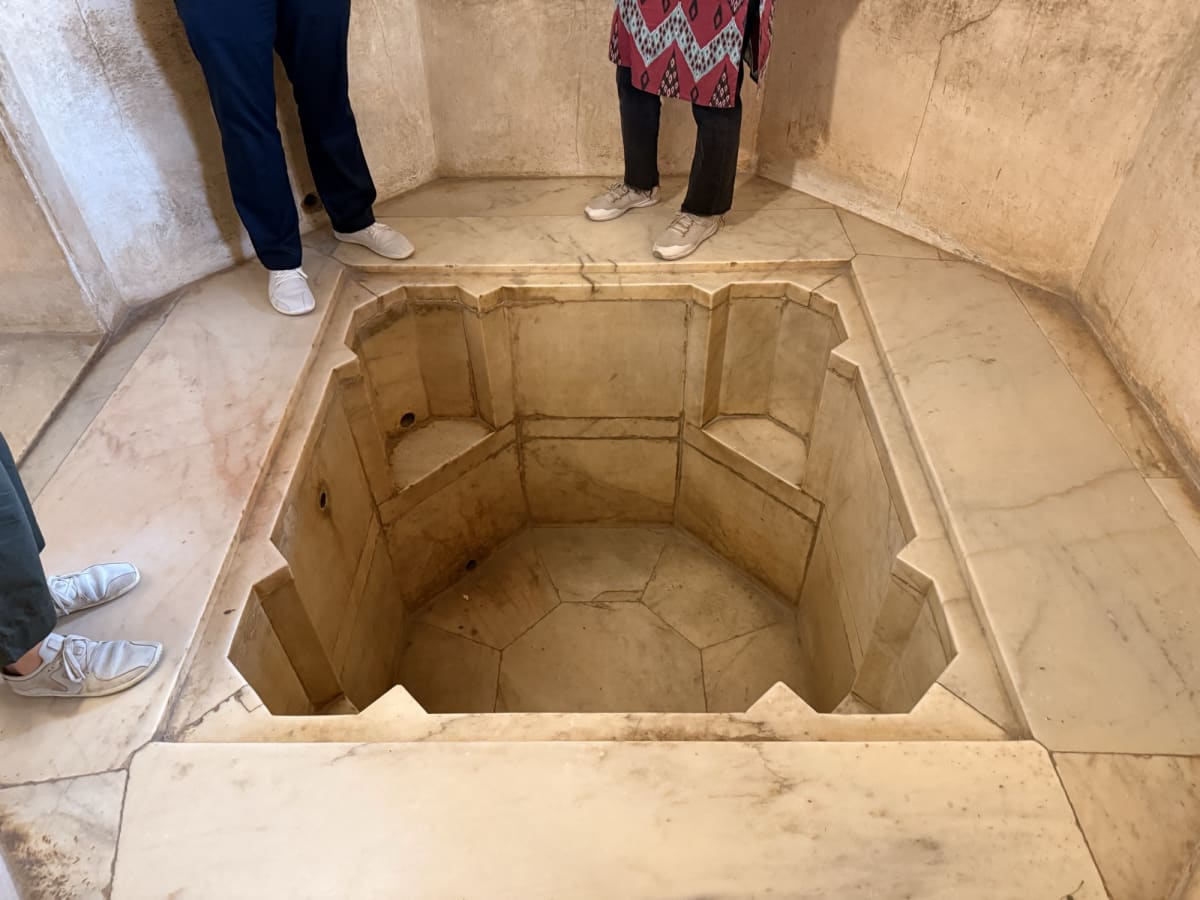
Now and then I tagged along behind guided tours and listened in.
That garden floating on the lake is Kesar Kyari, which means saffron bed.
Saffron is said to have been planted in the star-shaped beds, but in this climate it never took hold.
Ganesh Pol
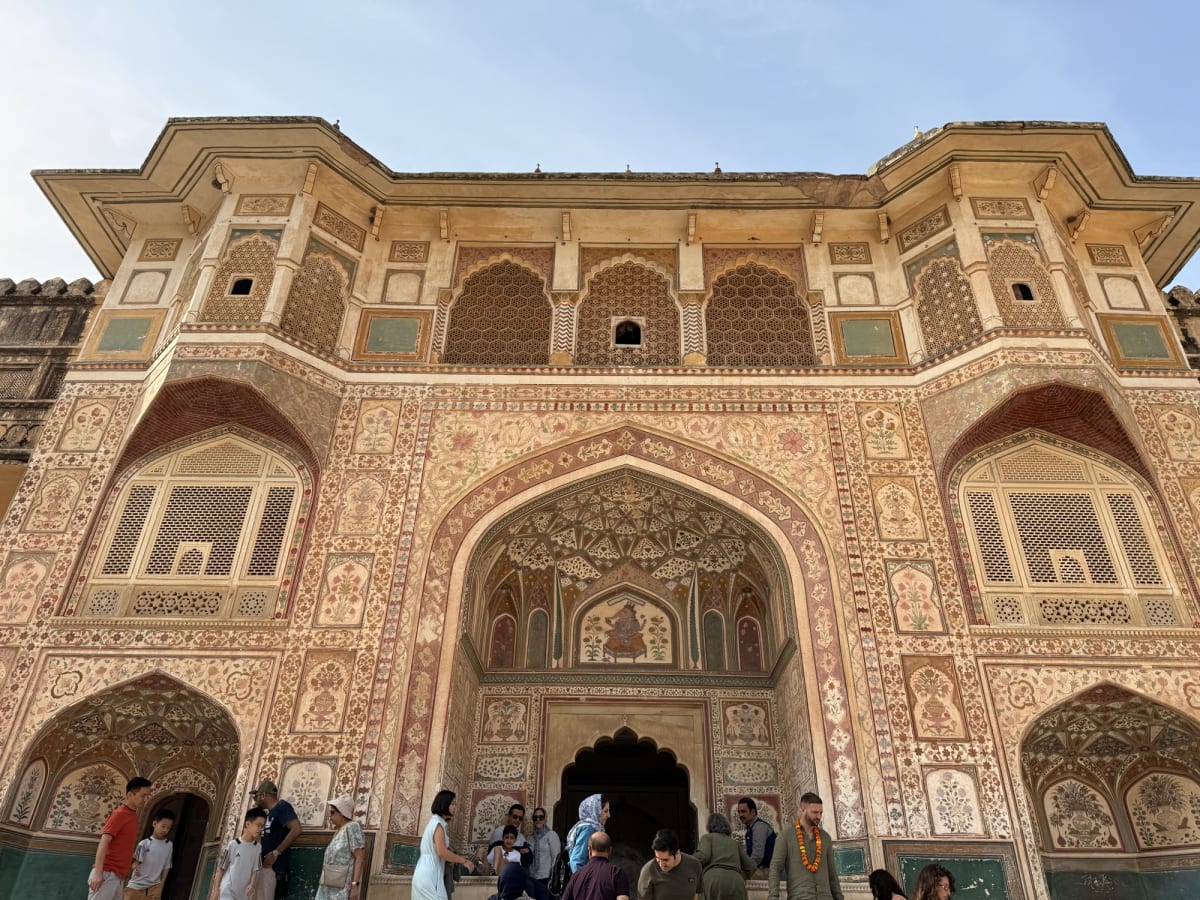

The gate visible from the courtyard, called Ganesh Pol, is beautifully and gracefully decorated, and a great many people were taking photos in front of it.
Right above the gate there is a painting of an elephant drawn like a cartoon character, which at the time was presumably painted with some reverence.
And going through Ganesh Pol takes you properly into the centre of the palace.
The elephant-headed figure above the gate is Ganesha, the remover of obstacles.
The name Ganesh Pol comes from that, and everything inside this gate was the king's private domain.
The upper floor of the gate is the Suhag Mandir.
From behind latticed marble windows, royal women who could not go outside looked down on the ceremonies in the courtyard below.
Inside the Palace

Going through a narrow, shaded passage, I was annoyed by couples blocking the way to shoot wedding photos.
Out of the passage there is another palace interior.
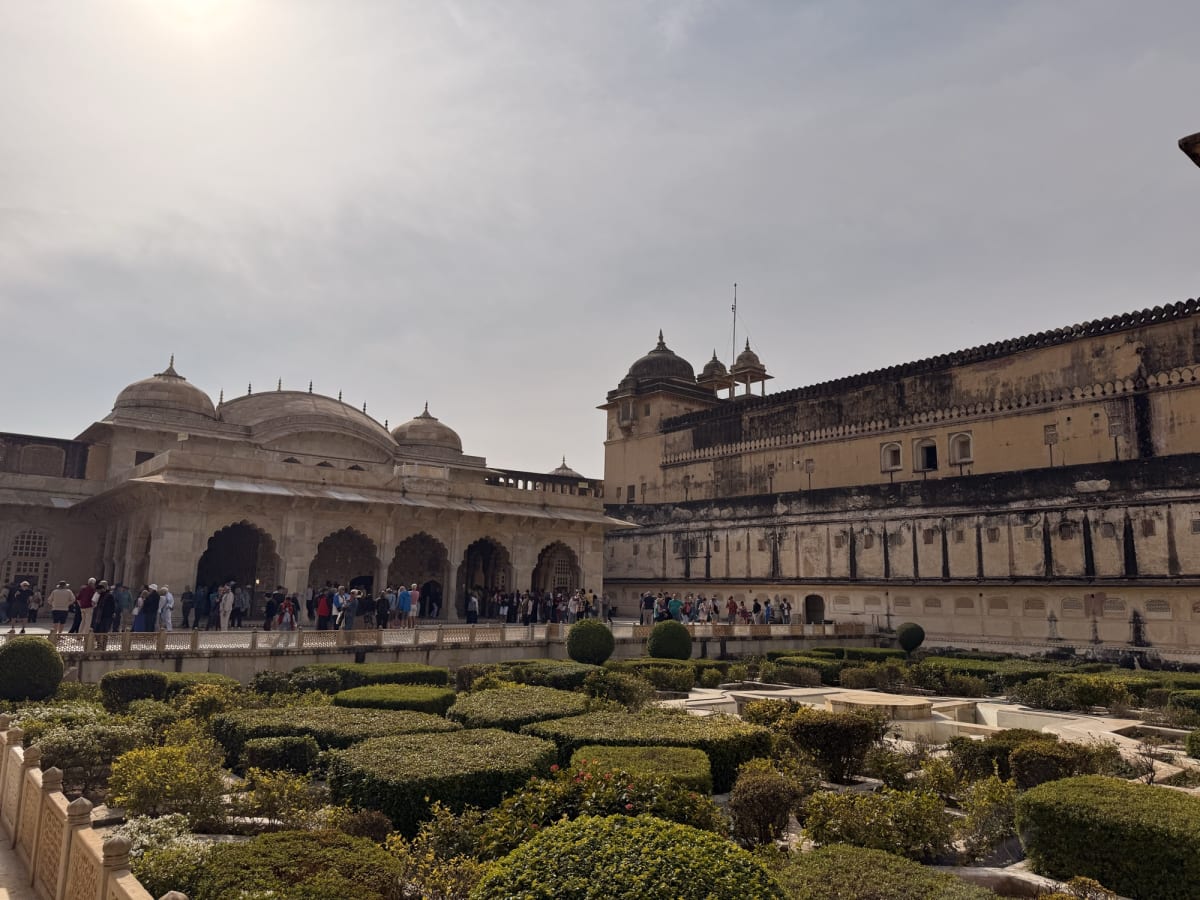
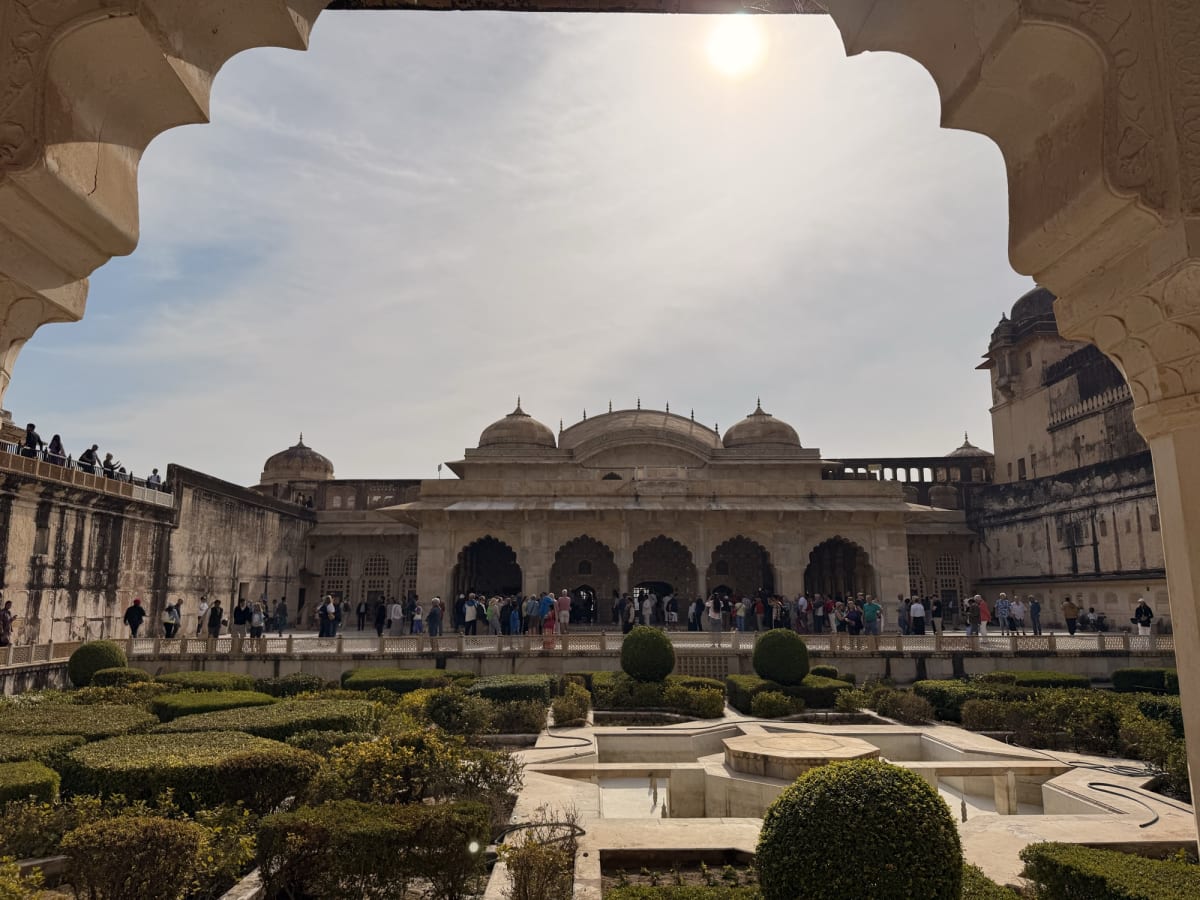
A garden with a more intimate charm to it.


I went right first and looked at the wall, where I could see an unusual pattern of water-bottle shapes worked together.
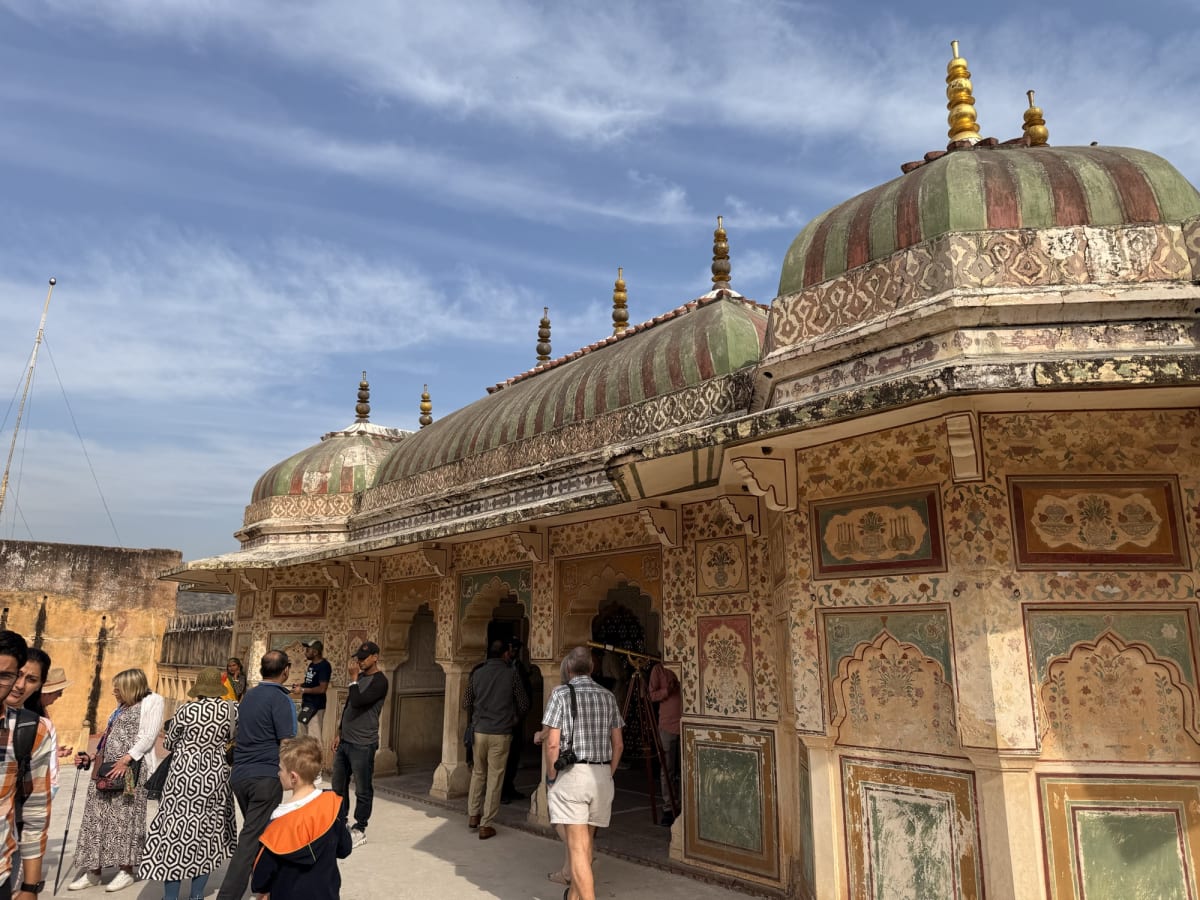
To the left stands the Jai Mandir, an ornate space used as the king's private audience hall.
The Mirror Palace


Inside is the mirror palace that was the king and queen's bedchamber, with mirrors packed over the walls.
I took a photo of my own reflection in those mirrors.


Since this was the most ornate part, I was sure it was the highlight of Amber Fort.
It was also where people and guides crowded most.
That mirror room is the Sheesh Mahal, part of the Jai Mandir.
The fragments of glass set into the walls were brought from Belgium.
The story goes that it was built for a queen who wanted to sleep under the stars.
Such a bed being thought unsuitable for a queen, they built her instead a room where a single lit candle made the mirrors on every side glitter like stars.
The Maze of the Second Floor
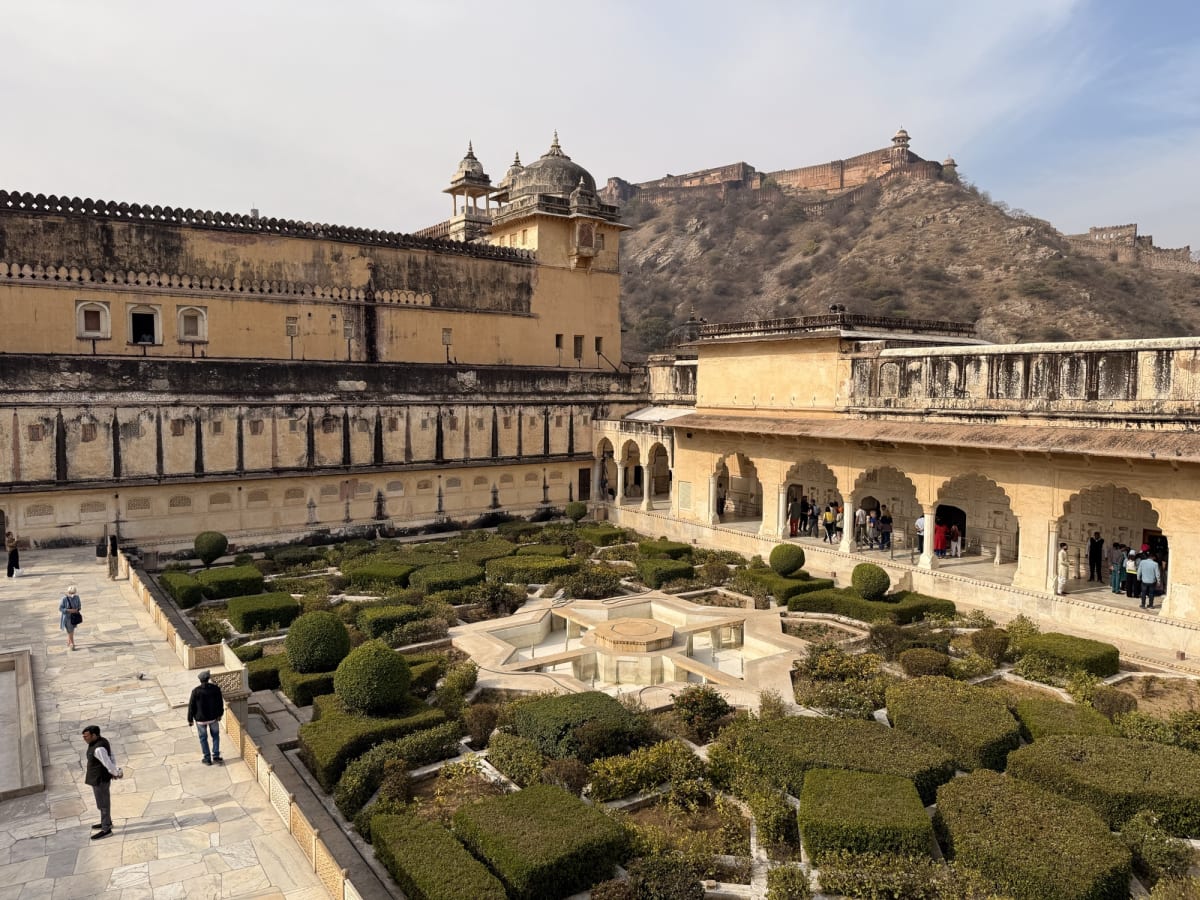
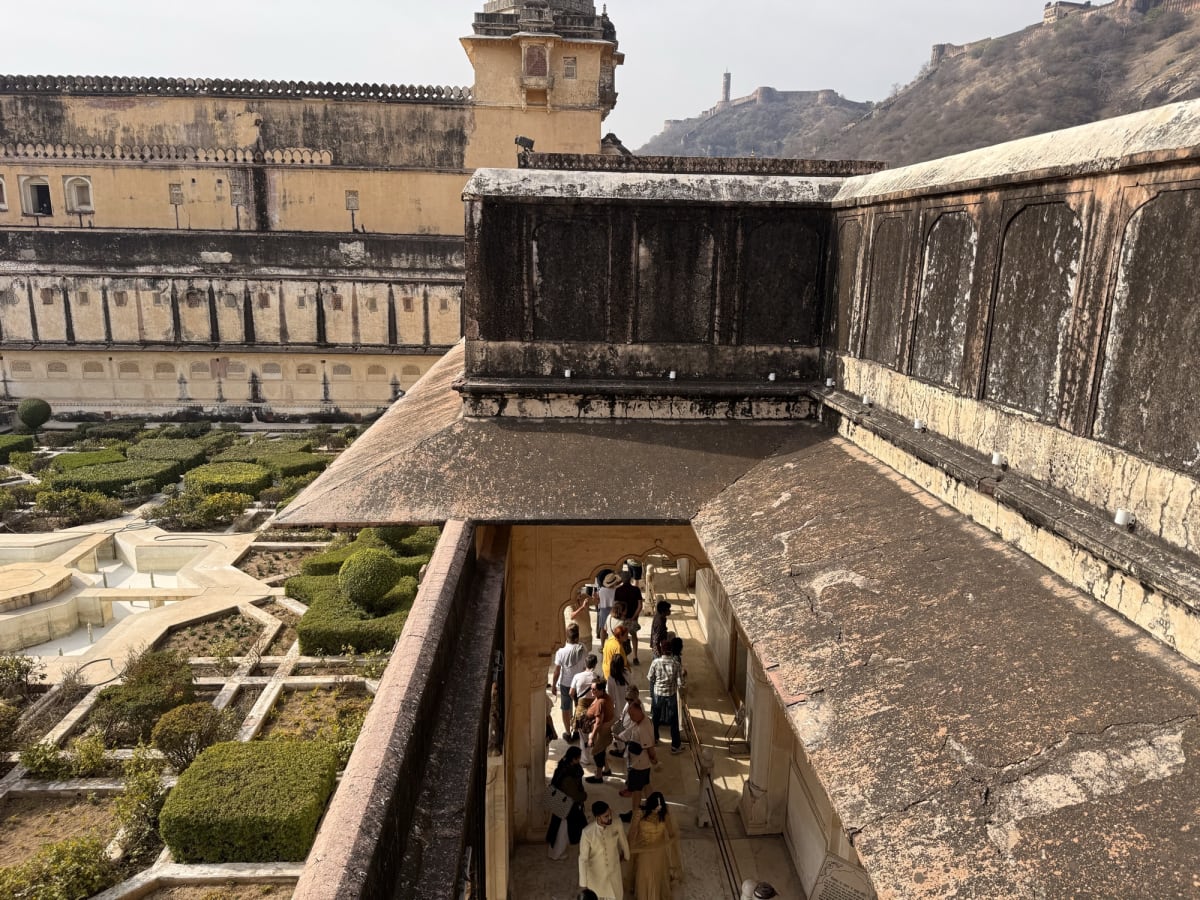
Coming out and climbing the stairs to the second floor, it is full of different spaces, and I went around them as if through a maze.
More than exploring it like a maze, there were so many paths and so many spaces that it practically was one.
Some of the spaces on this second floor are said to have housed the concubines.


One space had such an ornate ceiling that the men going around sweeping the floor with brooms would hold tourists' phones from below and take photos with the tourists and the ceiling together.
One of them took a photo for me too, but I did not hand over the rupees they were expecting all that readily.
The Concubines' Pavilion


Somehow I came down into another large courtyard-like space.
There was a big pavilion in the middle, said to be where the concubines gathered to keep watch on one another and talk.

Amber Fort is under-maintained and the worn walls can make it look shabby, but the palace high up and deep inside was full of ornate spaces.
Even there the walls are worn, but thinking back to the time and how the spaces were used, you can guess how brilliant it must have been.
On the Way Down

Because of that thought, Amber Fort looked different when I turned now and then on the way down and looked back up at it than it had on the way up.
Going up, what I felt from Amber Fort was grandeur and poverty.
Coming down, what I felt was deep history, beautiful design, and a history faded by time, which spares nothing.
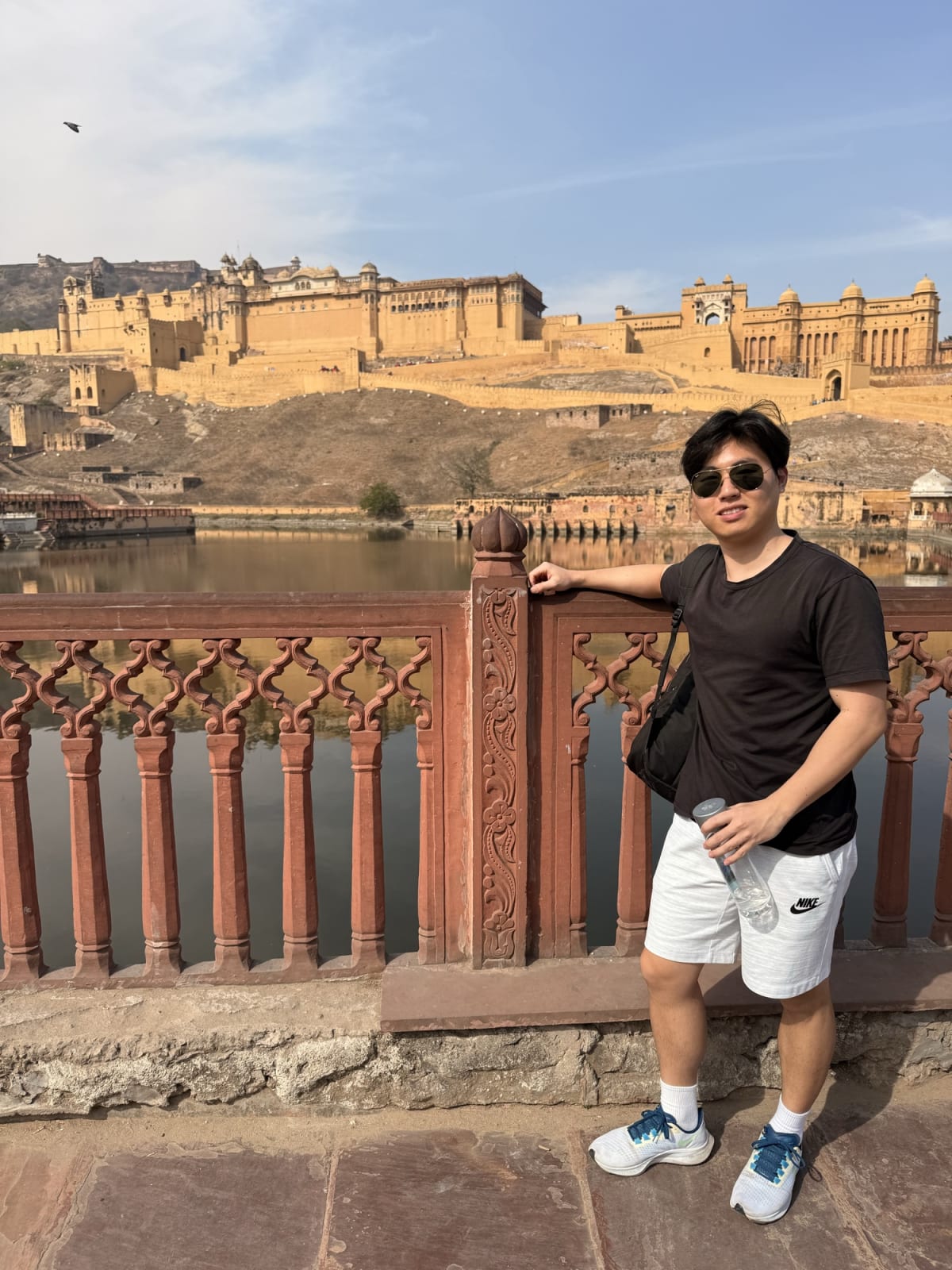

I booked an Uber the moment I came down, and before it arrived I asked an Indian couple who looked like high schoolers to take a photo with Amber Fort behind me.
The boy had been taking photos of the girl with great care, and watching from behind I was not really impressed, but I asked anyway.
The photo was no good, and since I wanted to take a proper photo of them for once I told them to go and stand there and I would shoot it.
The couple were delighted, apparently surprised that the photo of the boy came out comparatively well.
We said goodbye and I hurried into the Uber, which arrived soon after.
The destination was Nahargarh Fort.