India 3-1 · The Taj Mahal
Arriving in Agra
However tired I was, I think I still got three or four hours in that human parcel box where I could not even straighten my legs.
I had worried I would not sleep until half past two, and then I came to at four, and came to at five, and came to at six.
I woke up freezing — the temperature was 9°C.
I pulled the curtain back and glanced out, and the roadway too was full of rubbish.
Having barely slept, my body and face were a wreck.
Even so, I was very much looking forward to seeing the Taj Mahal today.
The bus driver called out for the people getting off at Agra, and I went out.
They just drop you in the middle of the road, not in the town.
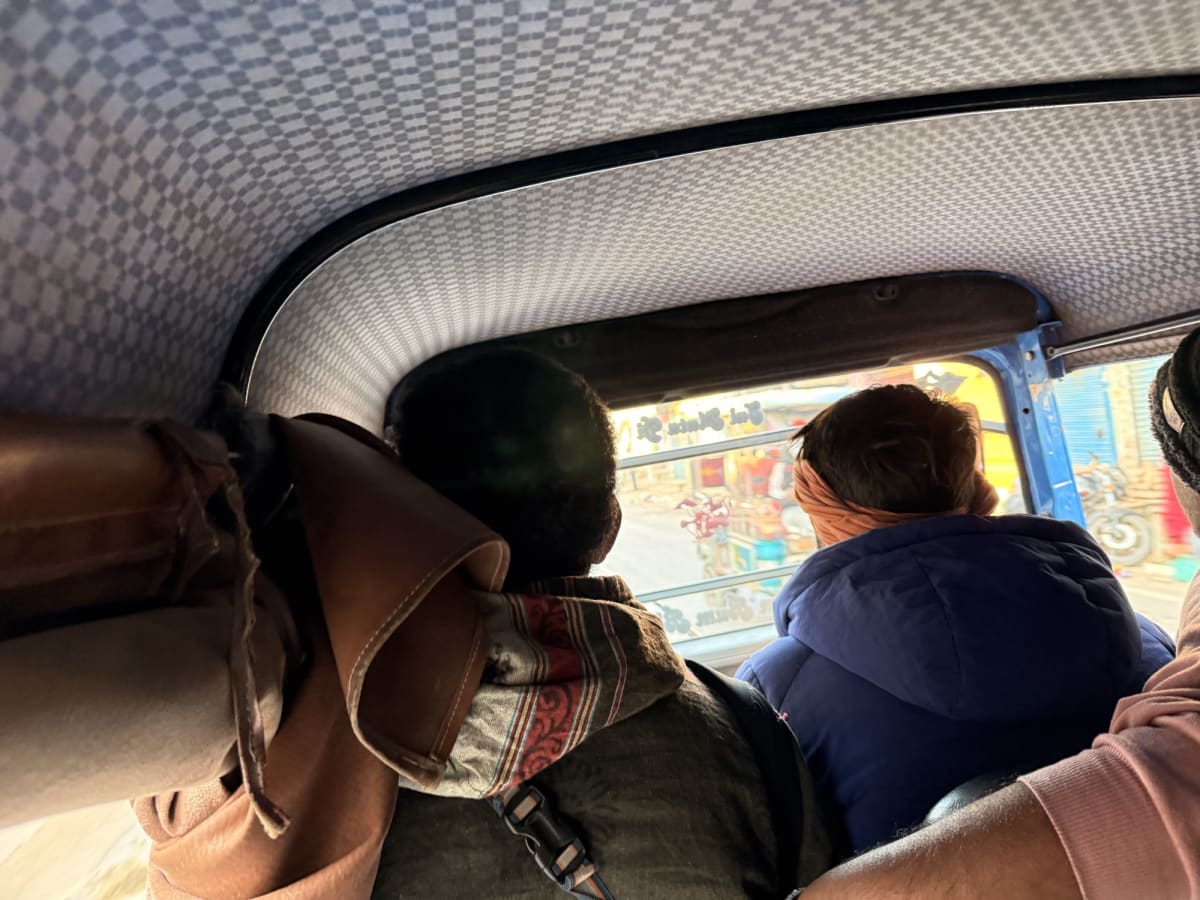
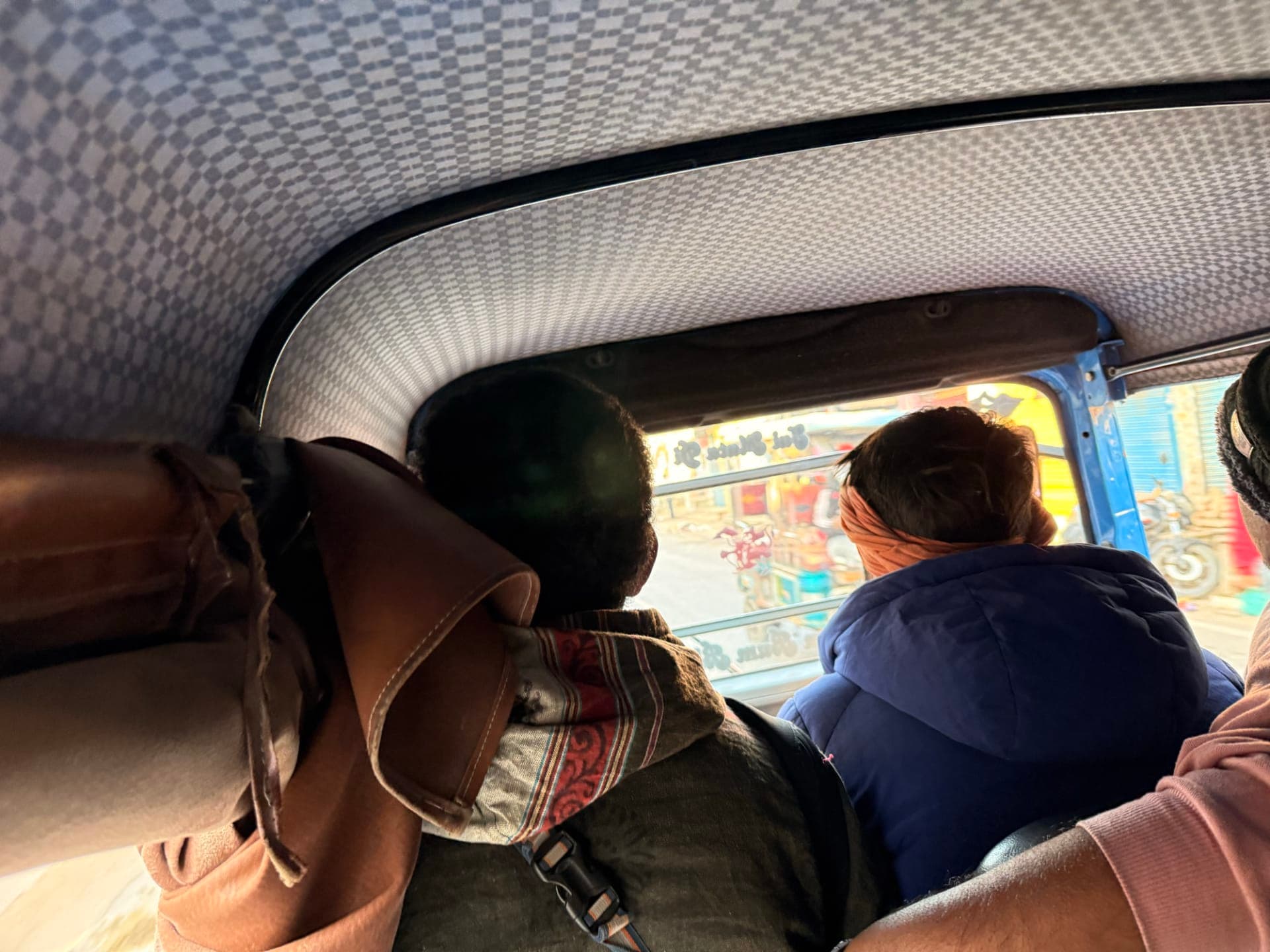
When I got off there were tuk-tuk drivers stationed everywhere, and two Asians I had taken for Chinese were haggling with one of them, so I went over.
They were Japanese, early twenties by the look of it, full of nerve, and they could not speak English at all.
I stepped in out of nowhere and pushed the driver down a little further on the price.
I told the Japanese lads that splitting it with me on top would make it cheaper, so we should go together.
Another foreigner suddenly joined us, and the four of us took the tuk-tuk together.
These kids were textbook young ones whose manners were not exactly composed, but coming to a place this hard to travel and working through it looked like a good thing to me.
One of them, the one in glasses, told me he had enjoyed the drama ‘Queen of Tears’.
Everyone in the world seems to have seen that Queen of Tears except me.
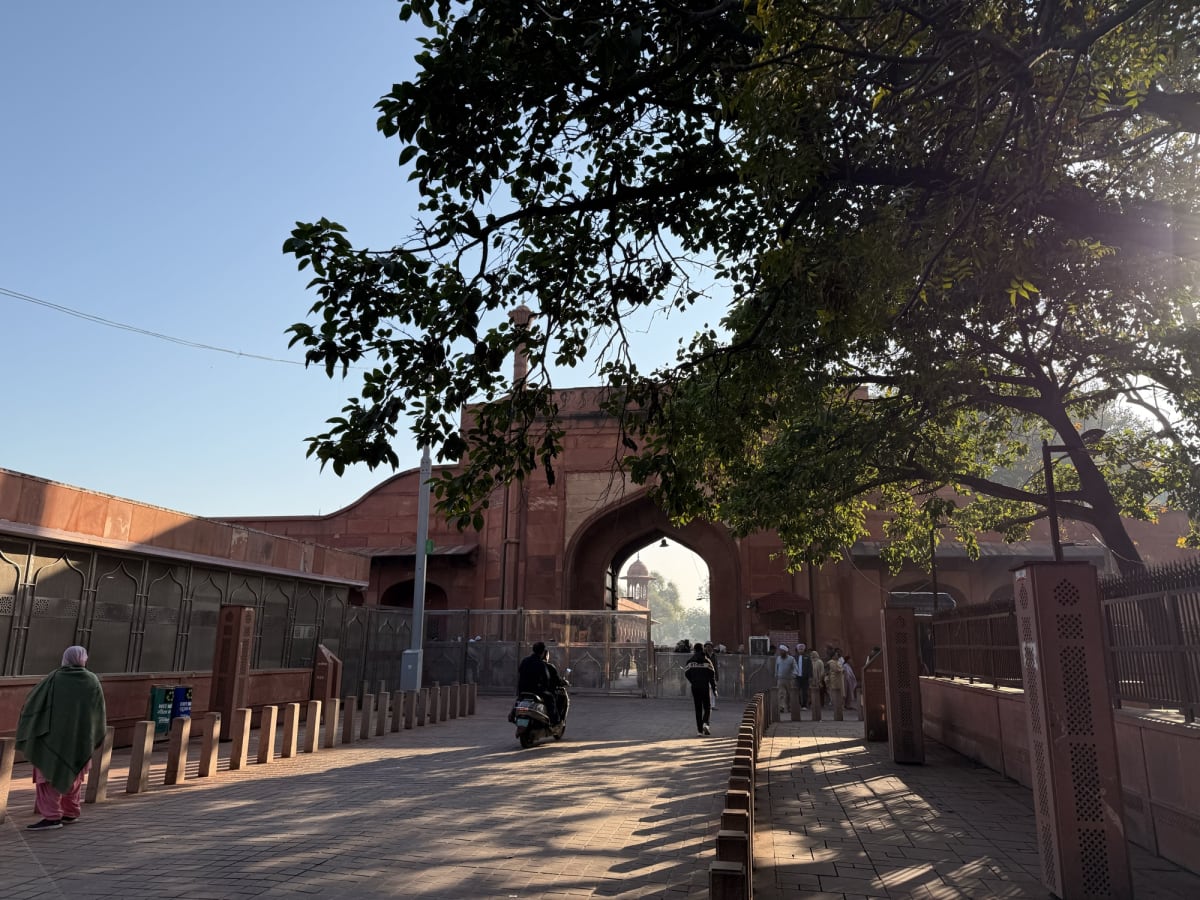

They cannot take you as far as the Taj Mahal; they drop you some distance away.
Walking on, I came to what looked like the Taj Mahal ticket office.
The way to my lodging was blocked by the Taj Mahal entrance, and the side I had come from was the exit, so I could not pass through and had to go the long way round.
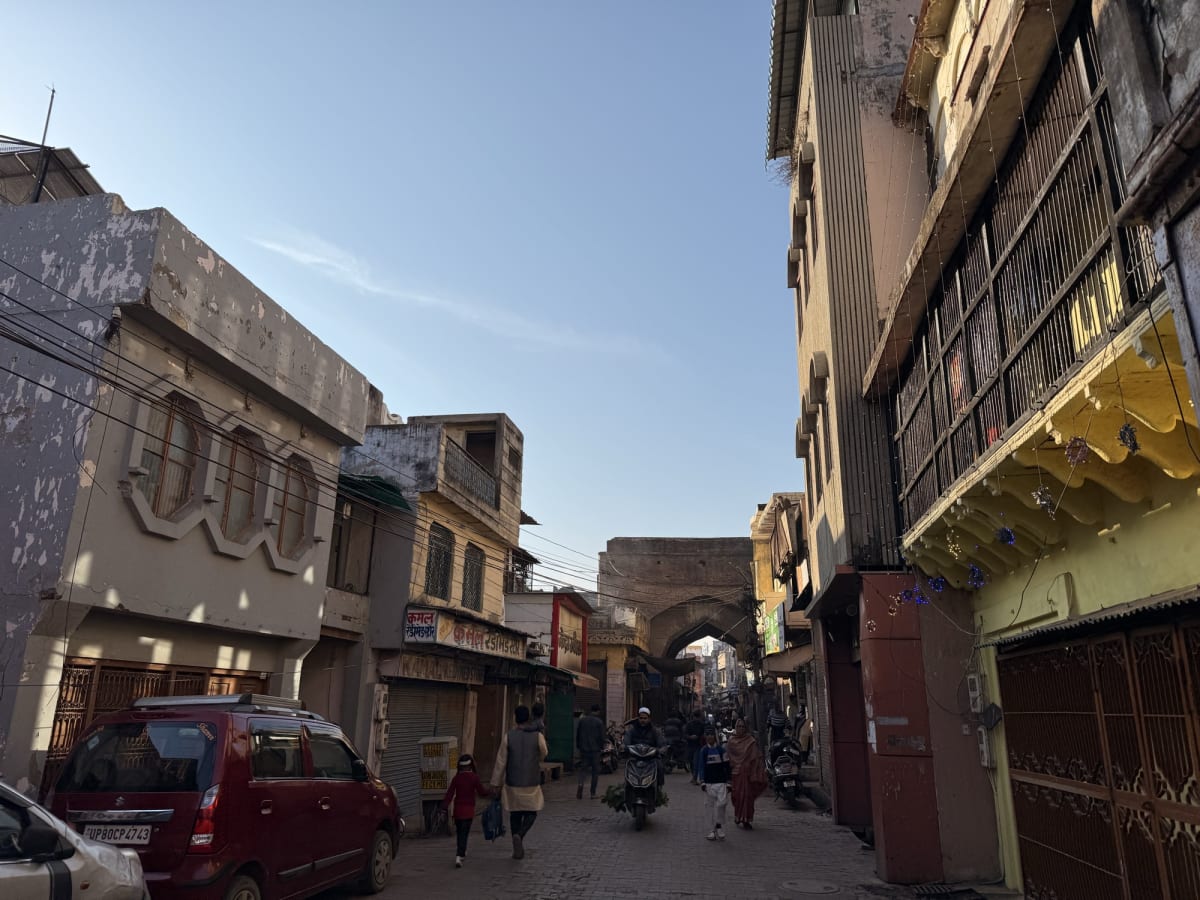
I went to the lodging looking over the market and the alleys below, and perhaps because it was early morning, there was the smell of people living.
Livestock, and the Ten-Rupee Street
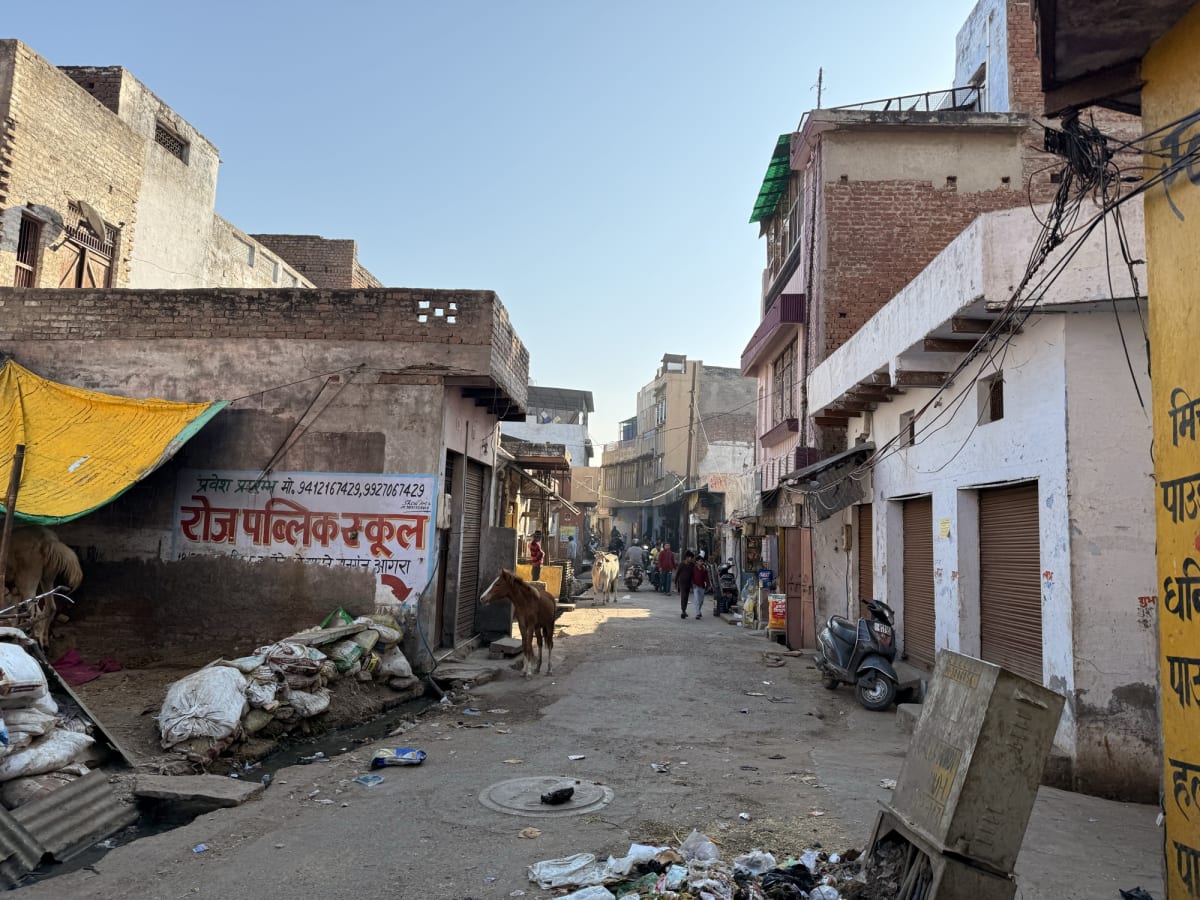
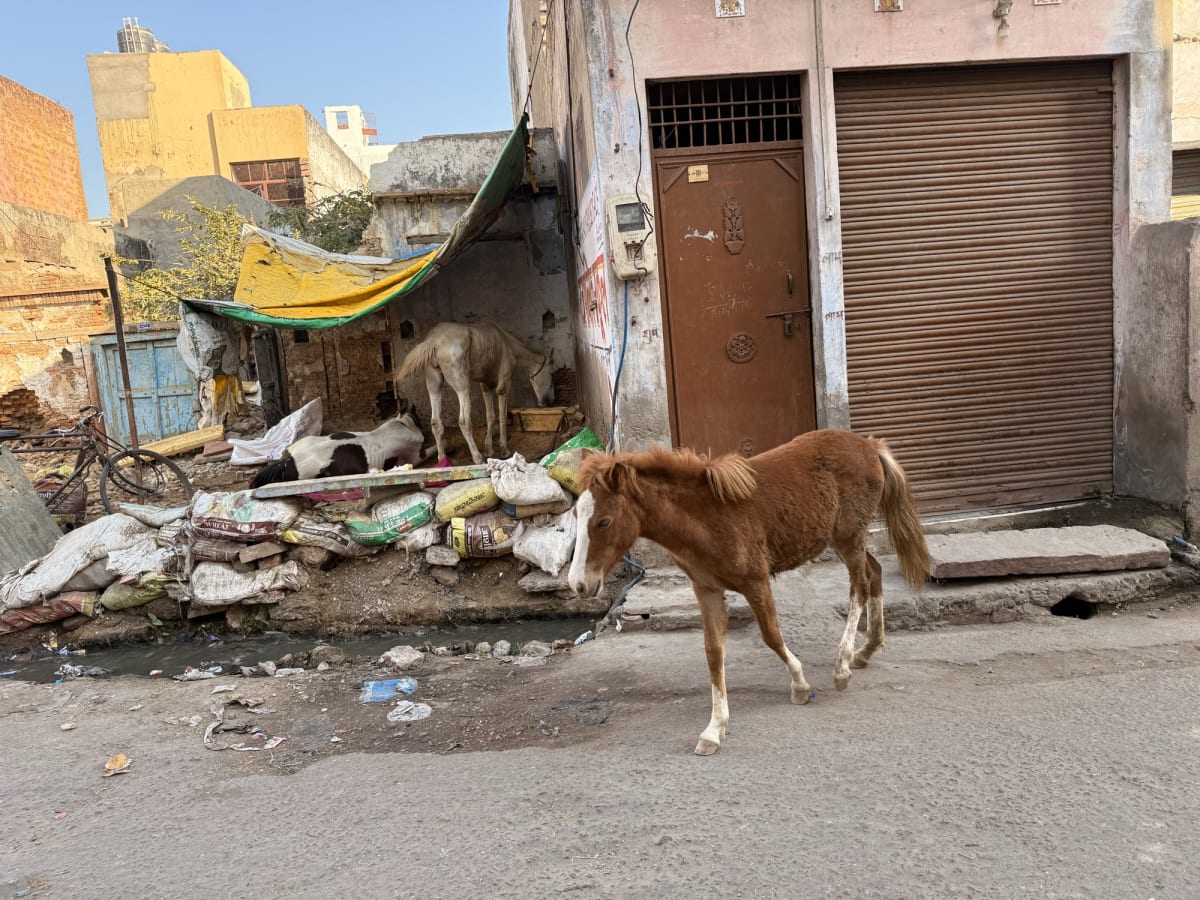
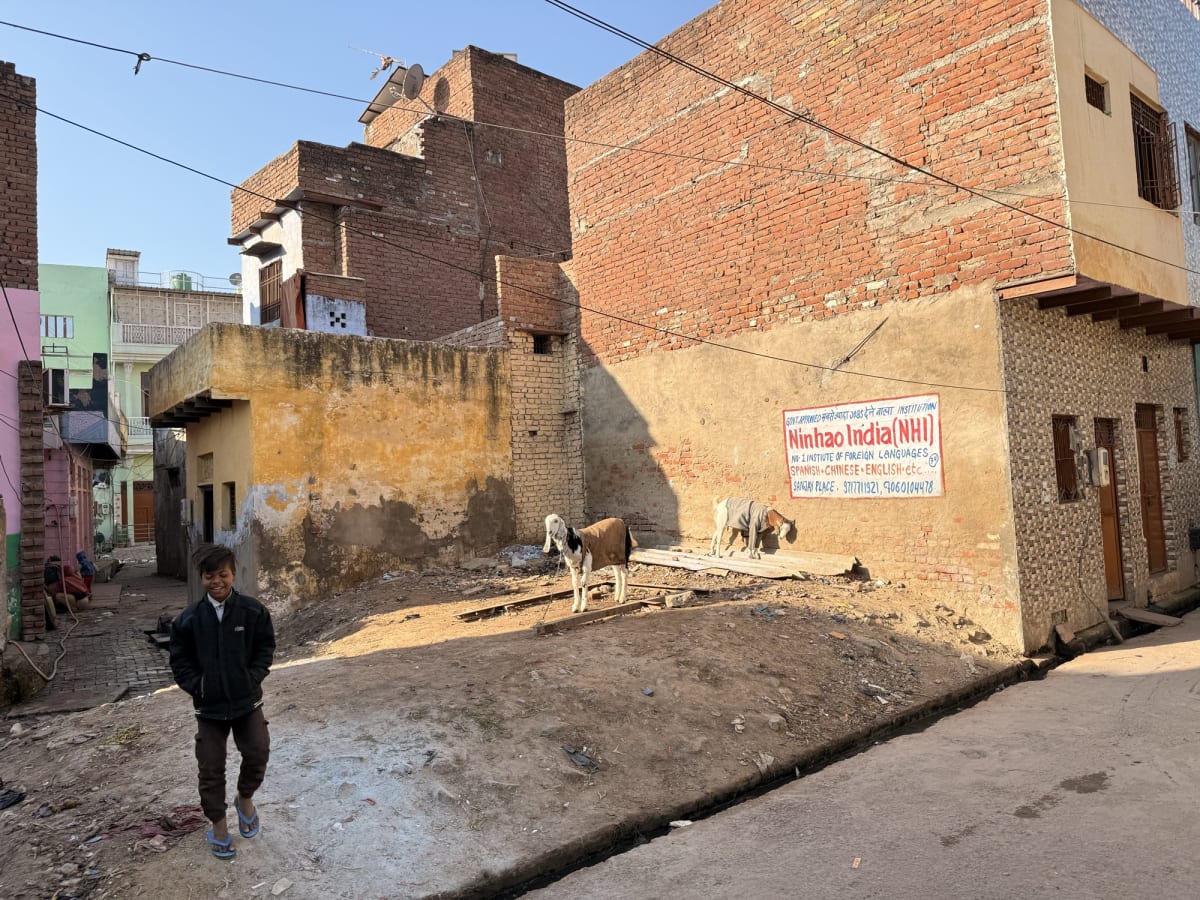
Here they leave the animals to themselves as well.
Cows, horses, sheep, dogs — every kind of livestock is here.
In the stables roughly walled off with tarpaulin, the horses spread dung everywhere and wander out into the street to play when they are bored.
Every time the little ones saw me they put out a hand asking for ten rupees.
When I put my own hand out and said ten rupees back at them, the kids laugh and press me as though they had said it first.
There is nothing spoiled in it, so you just let it pass as something endearing.
The street is covered in filth and rubbish, so there are moments you step on tiptoe, but the scene of people living was not bad, so it barely bothered me.
Wherever I go,
"What would it feel like to live here?"
is a thought I have often.
Passing through the alleys myself, meeting people and looking around, it landed with real weight.
Taj Street Hostel
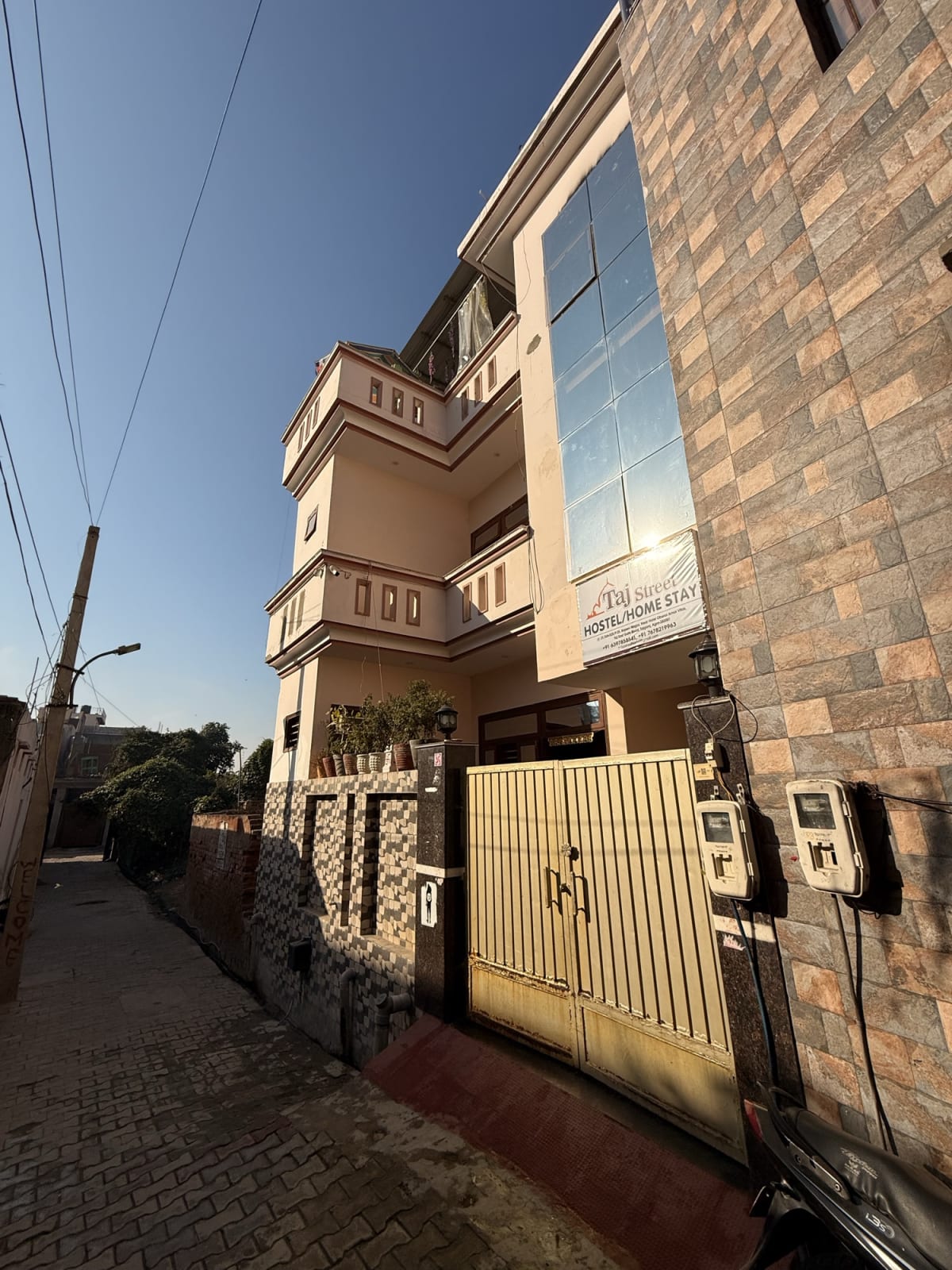
The lodging was Taj Street Hostel, and when I opened the gate and went in, the ground floor was where the owner lived with his family.
Up on the first floor was the hostel counter.
I was so tired that I thought I should shower and sleep a while.
I paid for the hostel and put my bags on the bunk I was assigned.
The good thing about this place is that they give you a big lockable locker and a key for free.
I showered and went to sort my bags roughly, and that ended up taking a while.
For this trip I had brought clothes I could throw away, to discard one by one along the way.
Working that out while sorting the bags, far too much time went by.
Deciding I would not get any sleep, I took only the valuables — sunglasses, wallet — and went out.
Off to the Taj Mahal


Walking from the lodging to the Taj Mahal took less than ten minutes.
India admits locals and foreigners separately; locals pay far less but the queue is enormous.
Foreigners pay a higher entrance fee but get in smoothly.
I went to buy a ticket at the counter and a man who looked like a guard showed me the way.
Once you buy the ticket they give you a token that lets you into the mausoleum itself.
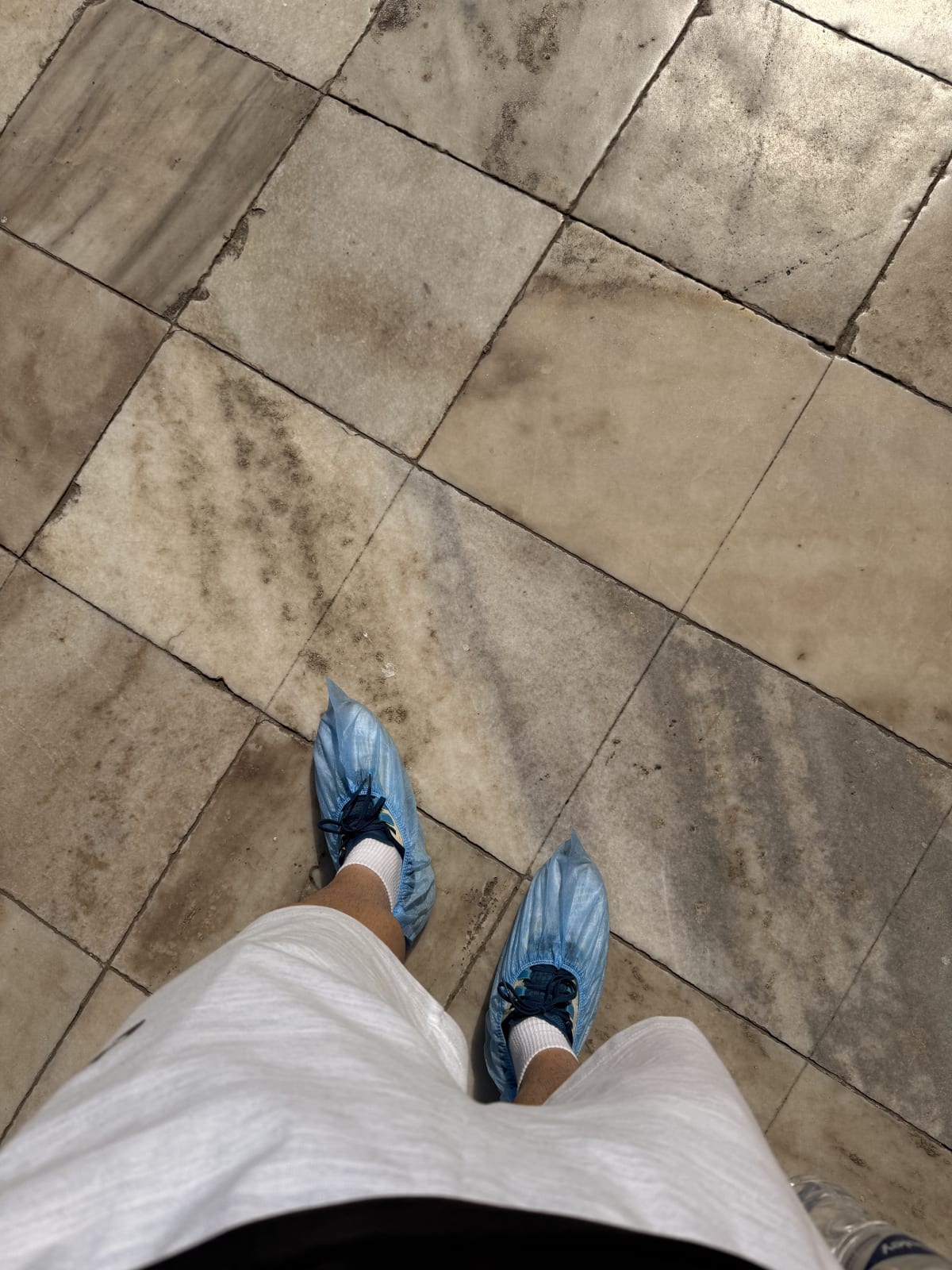
And the guard-looking man took me along and handed me blue overshoes to cover my shoes, and water to drink.
He said the shoe covers had to be worn in certain areas.
And sure enough, the man told me he would guide me himself.
The guides who attach themselves to you inside are very expensive, he said, so he would do it.
He seems to be someone who works here officially, and they apparently just let such people charge foreigners a lot of money to guide them.
I could guess that the price he was quoting was high, and since I do not particularly like having a guide attached to me anyway, I said no thank you and moved on.
The Gate of the Mausoleum
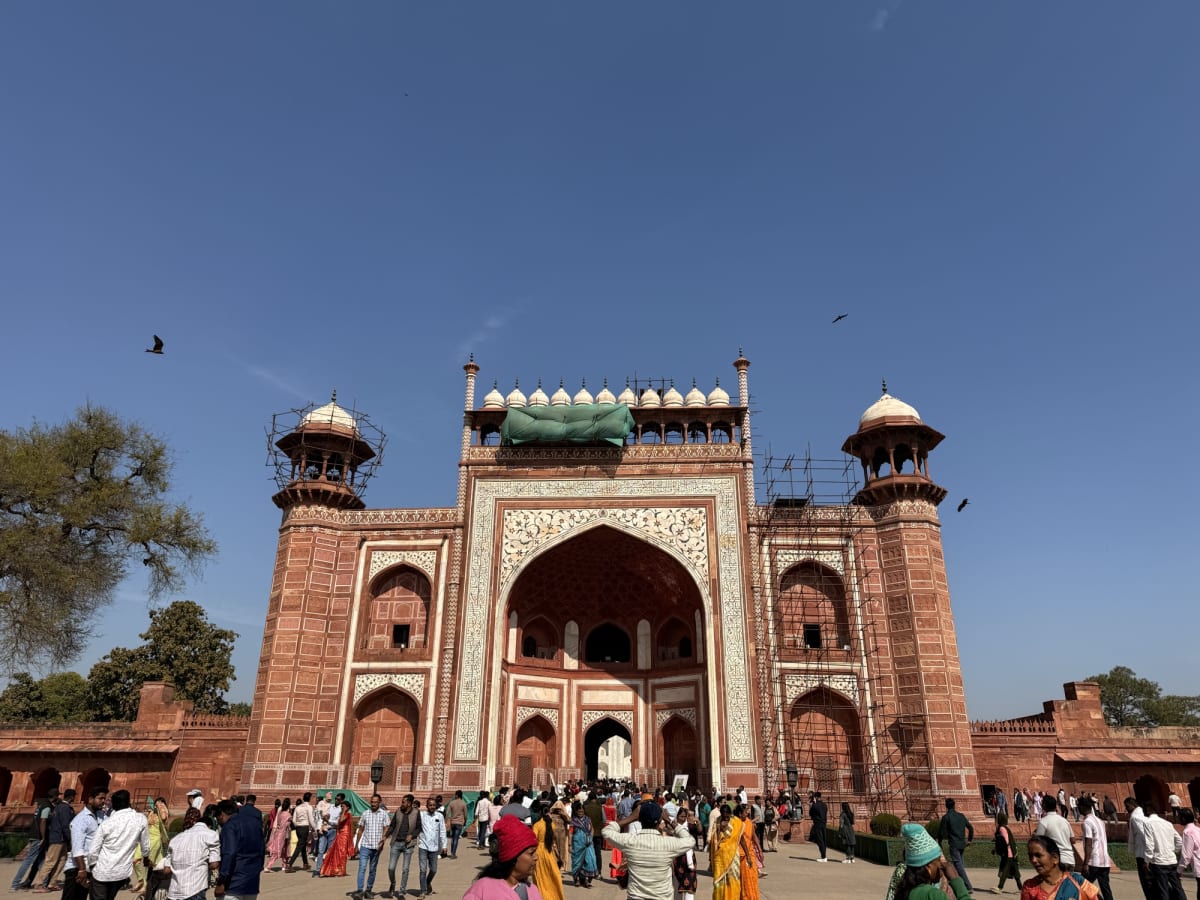

I have not yet been to the Red Fort in New Delhi, but red buildings that somehow made me think this is what the Red Fort must be like were what greeted me.
Here and there stood enormous trees that looked very old, and they added to the atmosphere.
It was a fairly wide, plaza-like courtyard.
This courtyard is a ceremonial forecourt called the jilaukhana.
And the main gate in the photo above is the great gate called the darwaza-i-rauza, which means ‘the gate of the mausoleum’.
The gate is built mainly of red sandstone, with white marble and black calligraphic inlay.
Going in through the gate, you pass into a dark interior, and from within it the bright garden and the white mausoleum are staged so as to come into view.
Through Darkness into Light

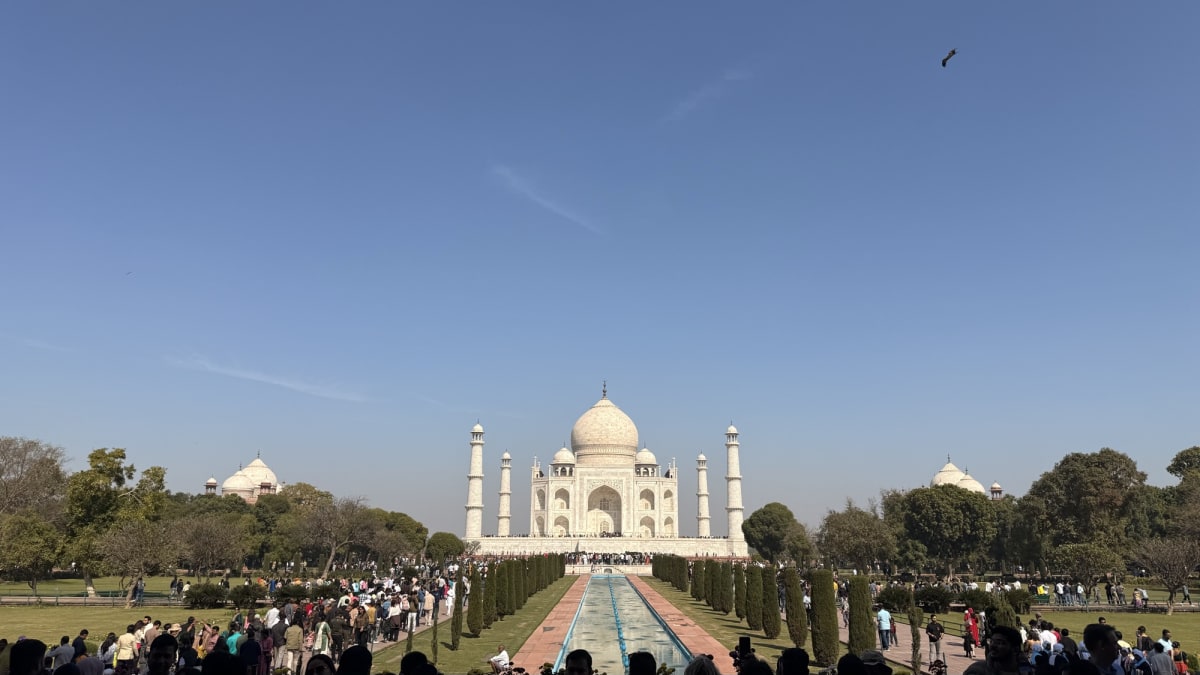
Coming out of the gate of the mausoleum, you are in the garden where the famous Taj Mahal is in view.
It is called the ‘charbagh’, meaning four square gardens.
The moment I came out, the image of India I had longed for so much opened up in front of me, and it was astonishing.
The reality of a tout latching on beside you offering to take your photo hits you round the back of the head.
Even so it is a view beautiful enough to leave you senseless.
Smog or no smog, the Taj Mahal is the Taj Mahal.
I understand why it is counted the most beautiful building in the world.
In the charbagh, two great cross-shaped walkways and water channels divide the garden into four quarters.
Each quarter is subdivided again, making sixteen small plots in all.
At the central crossing sit a white marble platform, a pool and a fountain.
Water, shade, flowers and trees represent the image of paradise in Islamic writing.
In a typical Mughal imperial tomb, the grave sits at the centre of the charbagh.
At the Taj Mahal, though, the mausoleum stands at the northern end of the garden, on the bank of the Yamuna.
Because of that, seen from the great gate, the whole garden creates a long perspective running toward the mausoleum.
A Symbol of Devoted Love
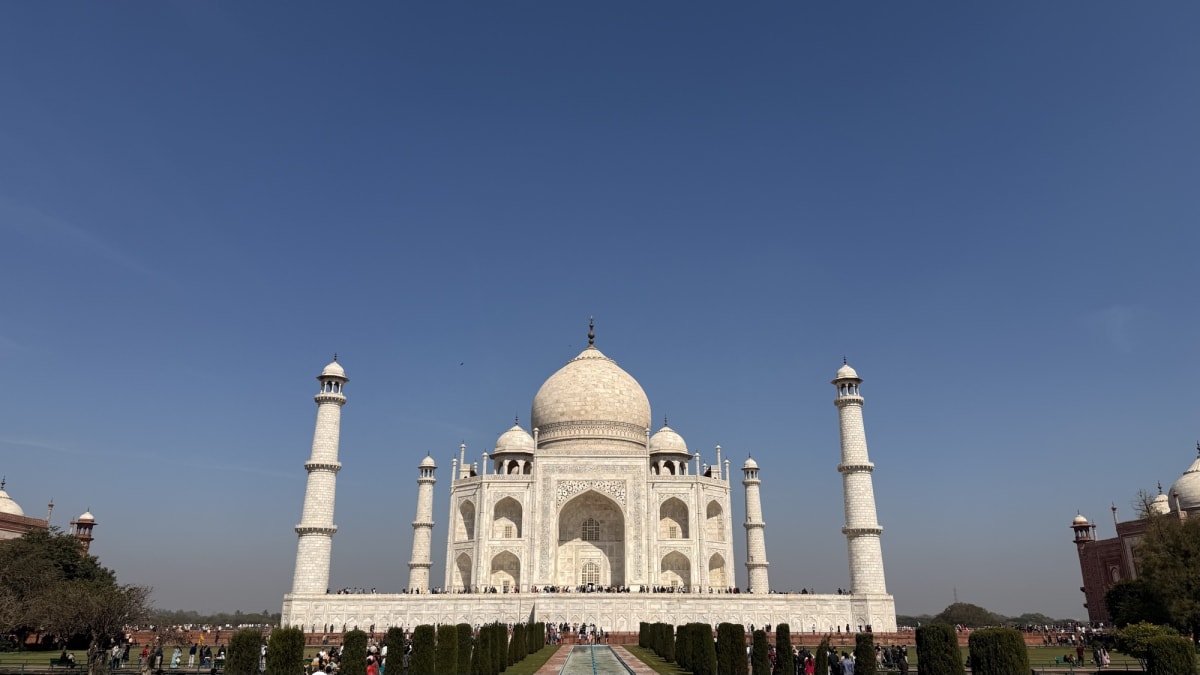
The Taj Mahal holds the love story of the Mughal emperor Shah Jahan and his queen Mumtaz Mahal.
Mumtaz Mahal’s birth name was Arjumand Banu Begum.
She married Shah Jahan in 1612 and was later given the title Mumtaz Mahal, meaning the jewel of the palace.
Shah Jahan had other wives, but Mumtaz Mahal was the most favoured, and in nineteen years of marriage they had fourteen children.
In 1631, while Shah Jahan was on a military campaign in the Deccan, Mumtaz went with him.
There, giving birth to their fourteenth child, she died of complications at about thirty-eight.
Sunk in excessive grief, Shah Jahan resolved to build a mausoleum for Mumtaz Mahal, and that is the Taj Mahal.
Of course it was not for love alone; it is also imperial architecture displaying Shah Jahan’s power and wealth.
Shah Jahan planned his wife’s mausoleum not as a simple grave but as a space reproducing Mumtaz’s house in paradise here on earth.
So the whole of the Taj Mahal is full of the imagery of paradise rather than of death.
The charbagh garden, with its four branching channels, symbolises the four rivers of heaven.
The marble inlay in full bloom expresses the plants of paradise, which never wither.
The pure white marble mausoleum looks like a transcendent space set apart from the real world.
The Quranic verses on the gate and the mausoleum speak of the rest of the soul, resurrection, judgement and paradise.
The very path of passing through the red great gate and approaching the white mausoleum is composed like a process of entering paradise from the secular world.
Construction began around 1632.
The central mausoleum was completed around 1648, and the entire complex — gate, garden, mosque, guest house and outer buildings — was finished around 1653.
The last scene that completes the love story is Shah Jahan’s death.
In 1658, Aurangzeb won the war of succession among the sons, and Shah Jahan was deposed and confined for about eight years in the nearby Agra Fort.
Shah Jahan died in 1666 and was laid beside Mumtaz’s grave inside the Taj Mahal.
Mumtaz’s cenotaph had originally stood at the exact centre of the central axis.
With Shah Jahan’s grave added beside it, the symmetry was broken at the one and only point inside the perfectly symmetrical Taj Mahal.
And so this asymmetry is sometimes read poetically, like this.
More than the perfect order of the architecture, lying beside his wife — even in death — mattered more.
Further In
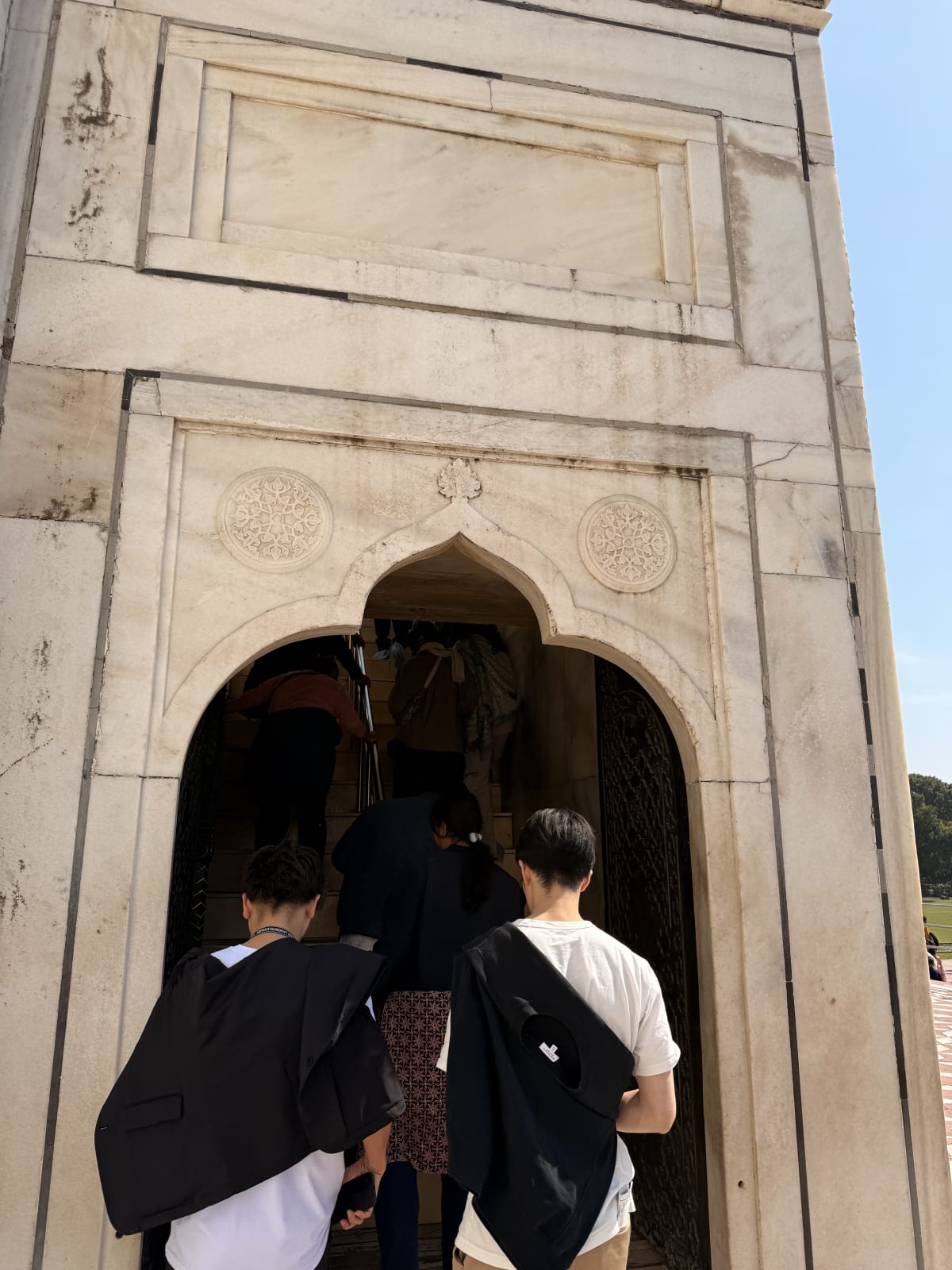
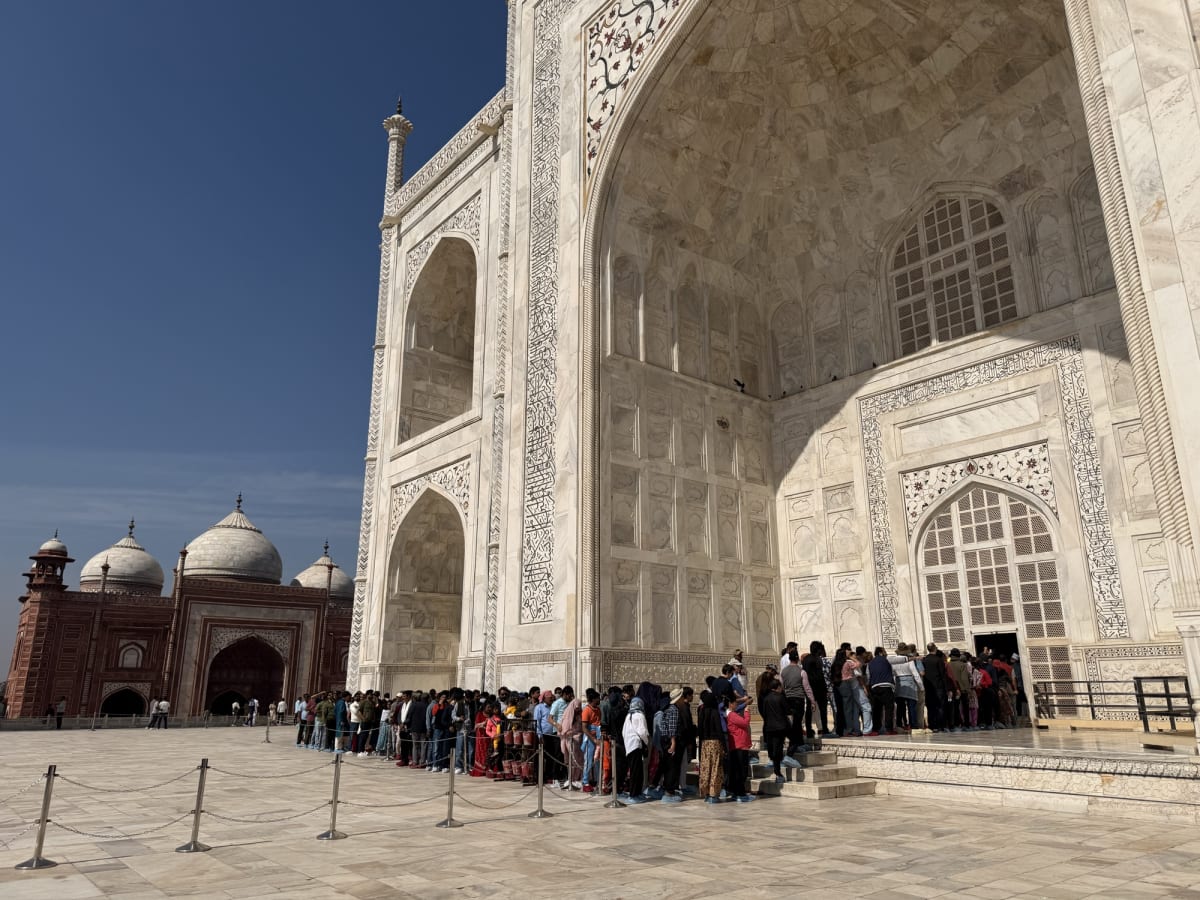
Romance is romance, but as India’s foremost tourist site it was so crowded that moving forward was hard.
I put on the blue overshoes handed out at the ticket office, gave in the token and went in.
There was a bit of a queue and I worried it would take long, but it went quickly.
There were plenty of foreigners, but really a great many Indian locals.
You have to climb the steps to reach the entrance of the Taj Mahal.
The Mosque
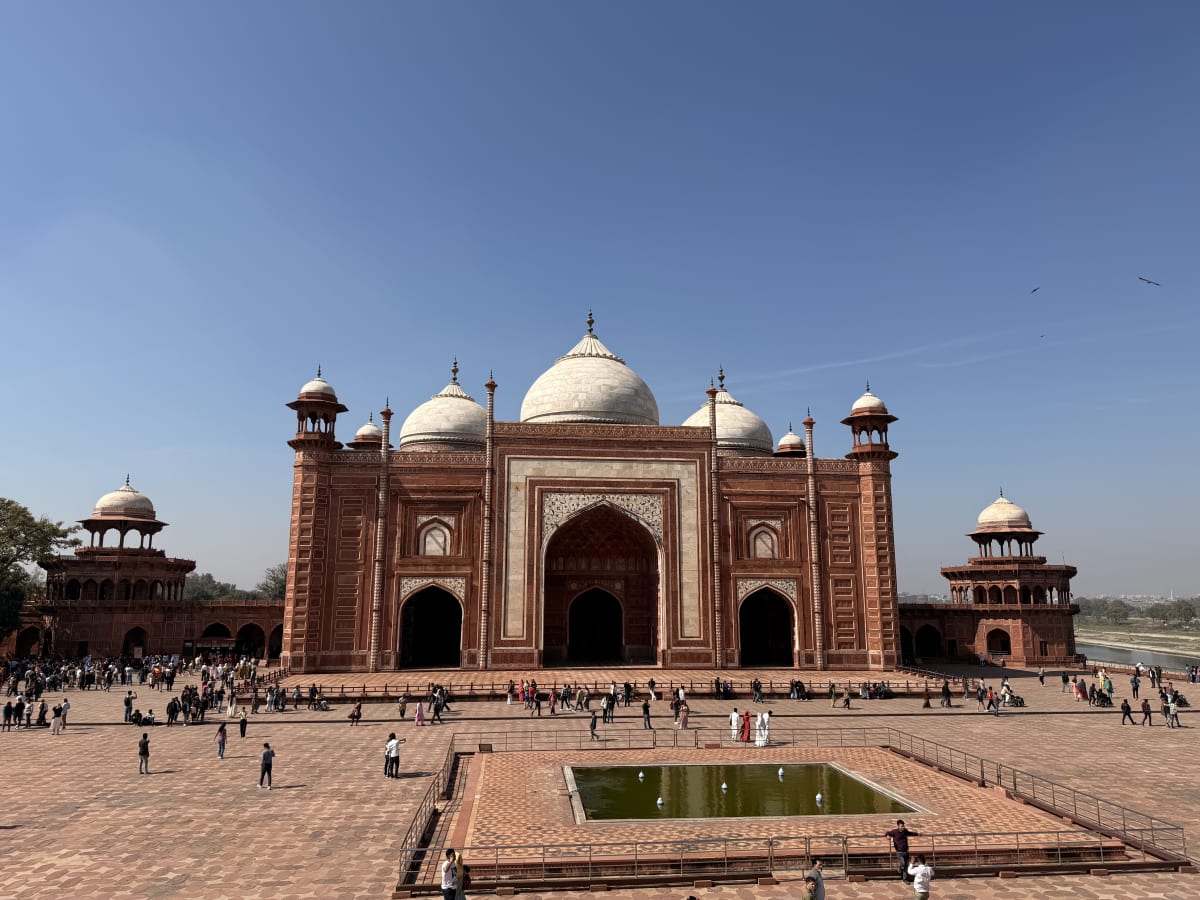
After climbing the steps, the red sandstone building to the west is the mosque.
It holds an actual place of worship oriented toward Mecca, the holy city of Islam.
To the east there is a red building almost identical to this mosque.
That is a guest and assembly hall called the ‘mihman khana’.
Rather than for their own functions, identical buildings were made to the west and the east to complete a perfect bilateral symmetry.
The Mausoleum
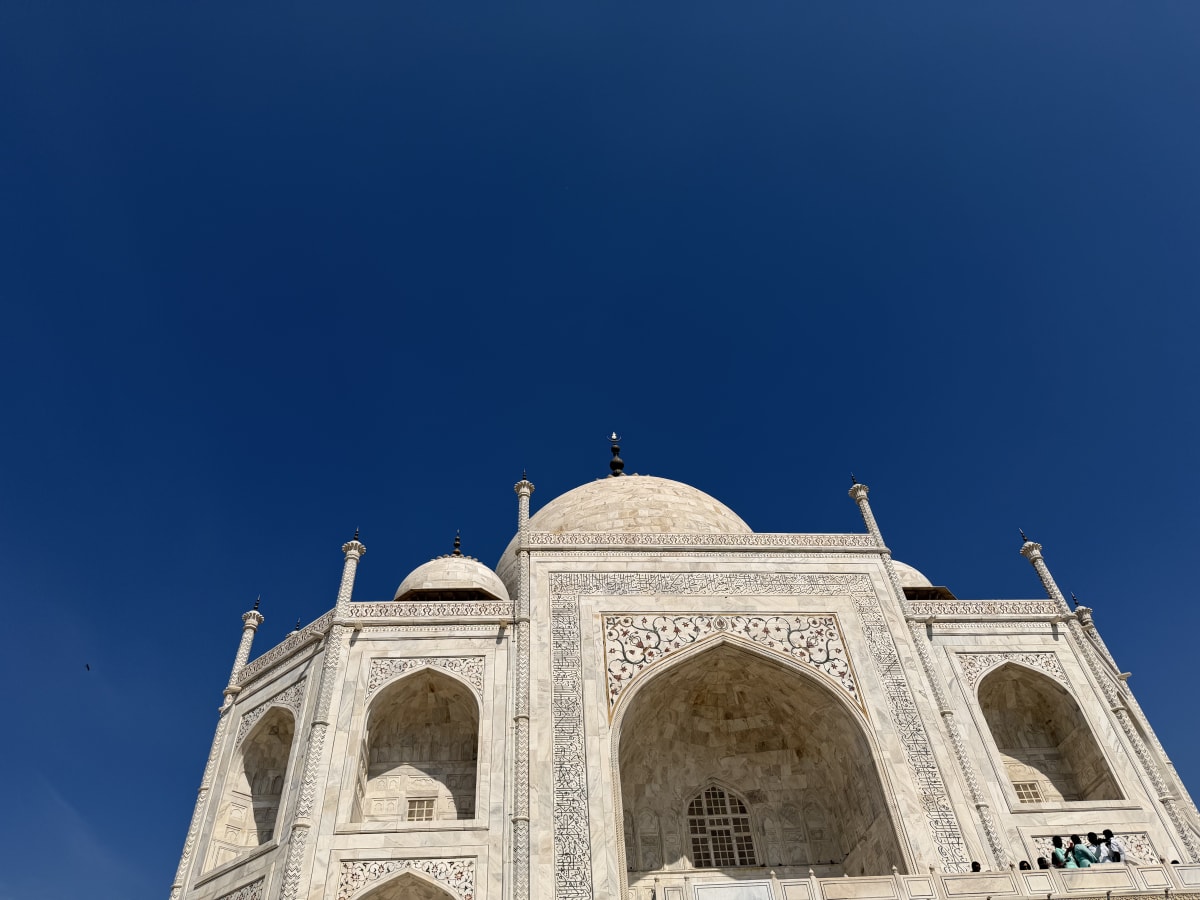

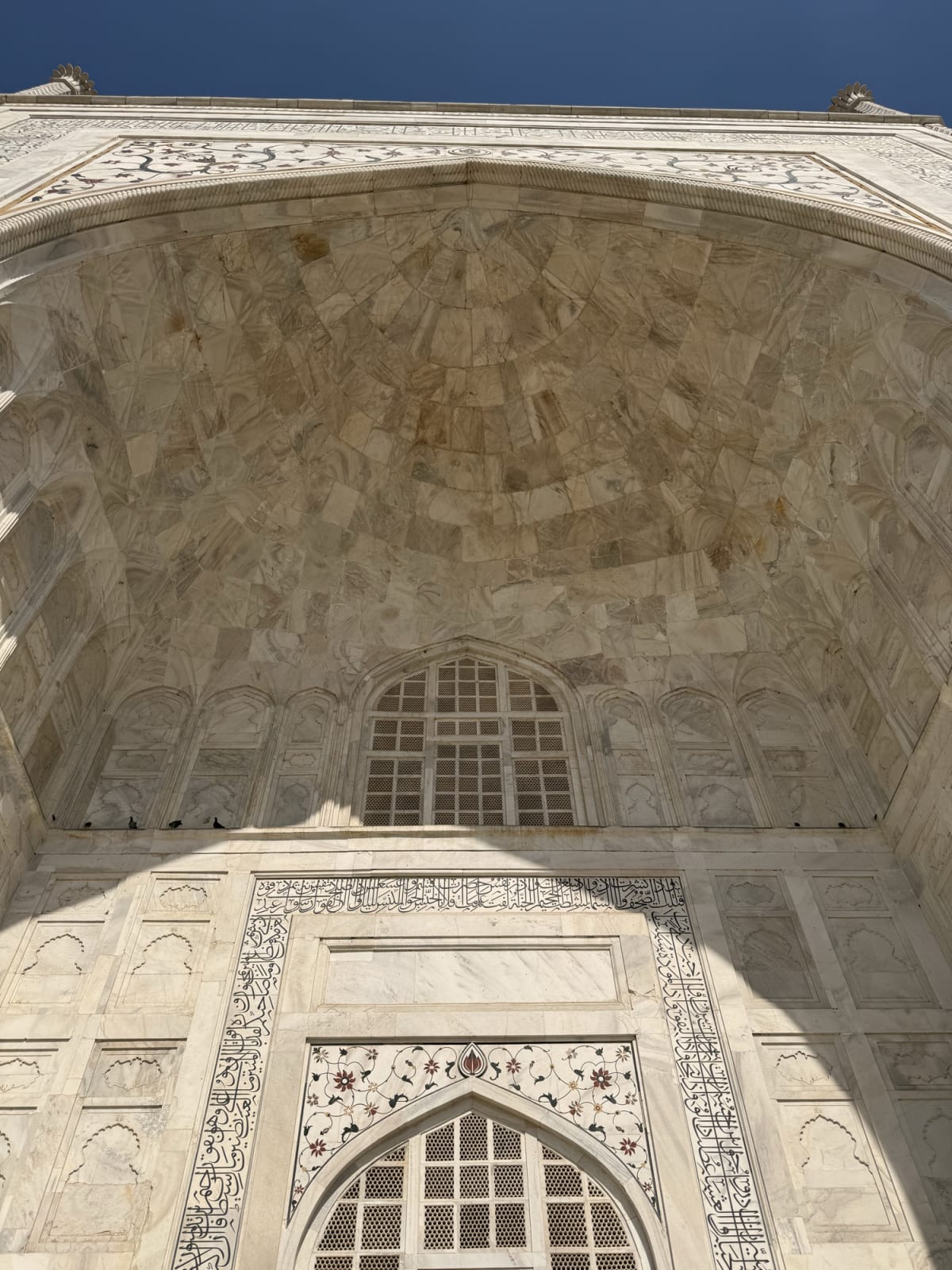
Seen up close, the Taj Mahal was far more enormous than I had expected.
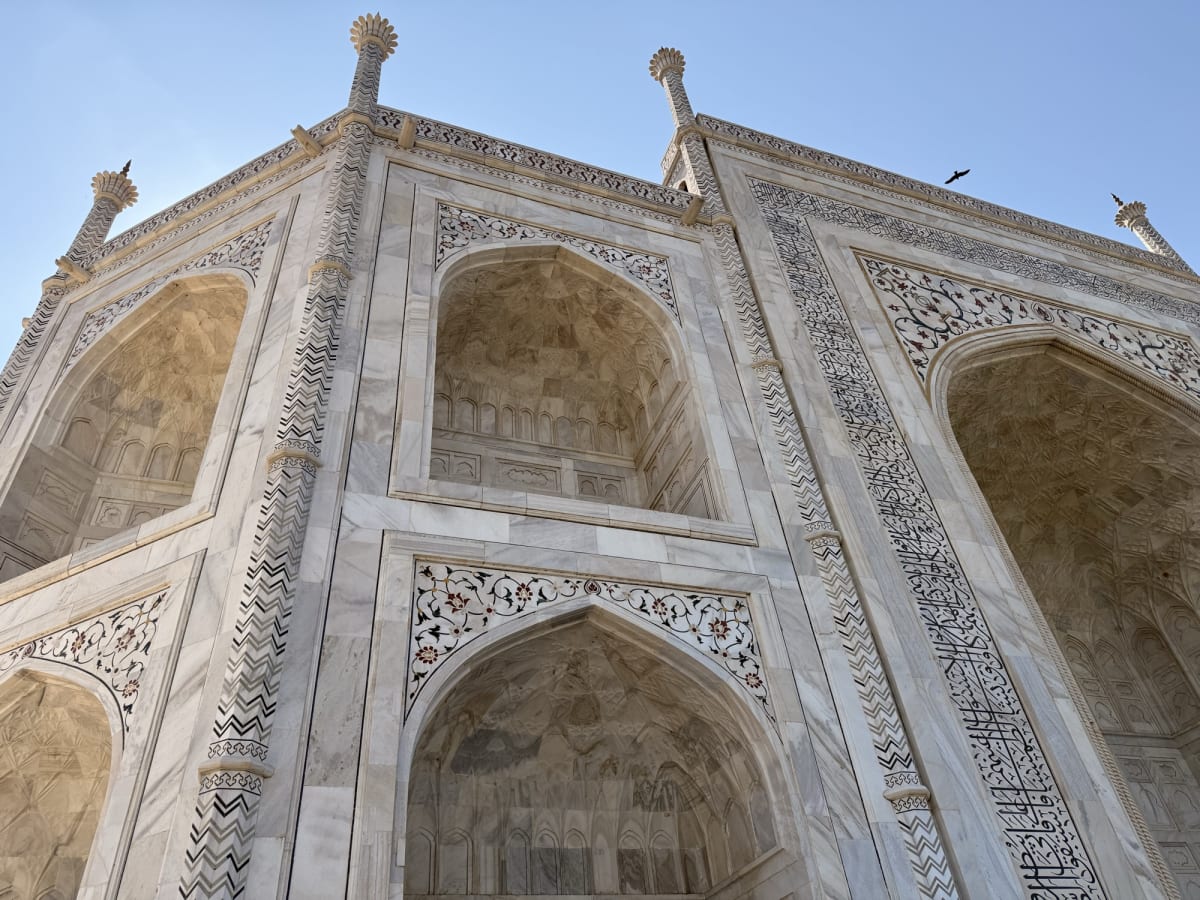
And close up, all sorts of details came into view.
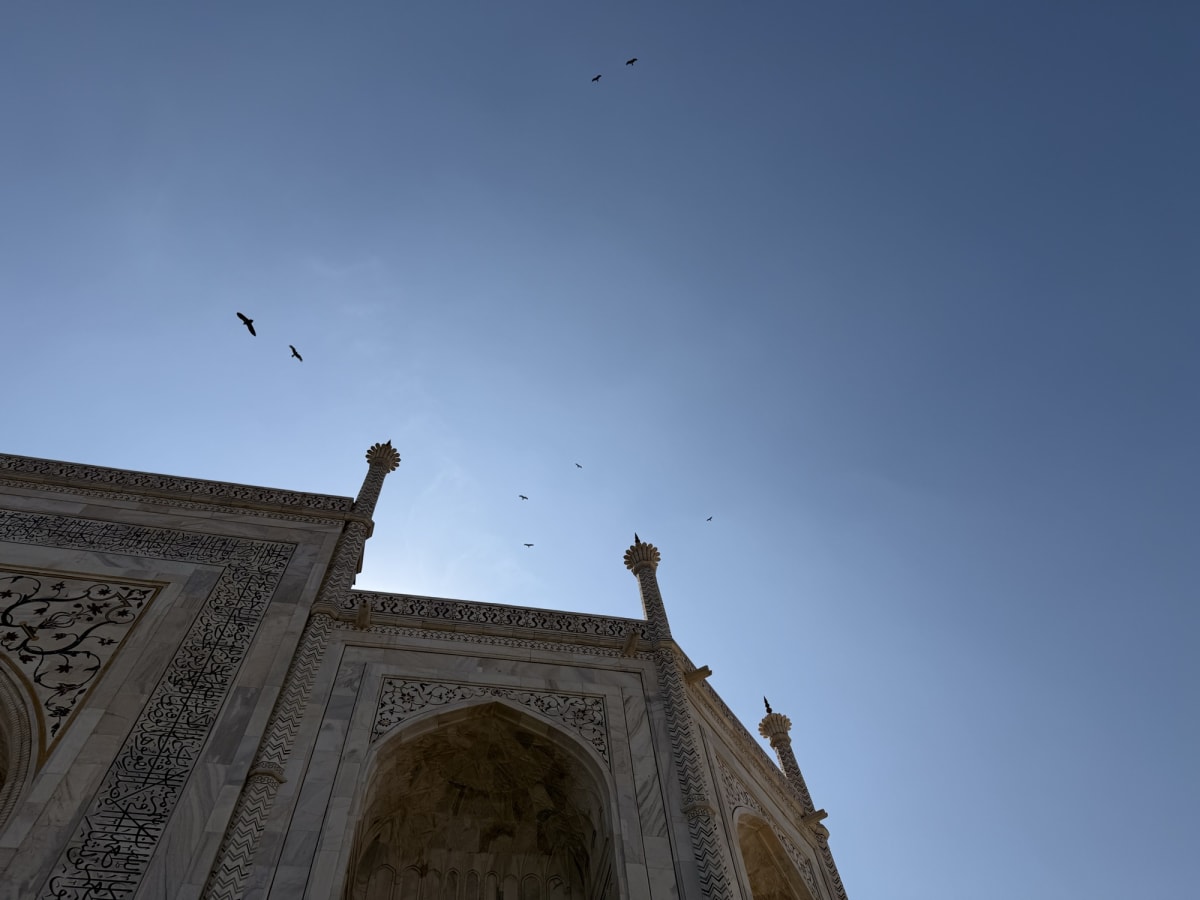
The minarets at the four corners of the Taj Mahal stood out, and so did the gracefully drawn patterns across the middle.
This white marble mausoleum, the Taj Mahal, is made up of these elements.
A square exterior with the corners cut away
A perfectly octagonal tomb chamber at the centre
Huge pishtaq arches on all four sides
A large double-shelled onion dome
Four small chhatris surrounding the dome
Minarets at the four corners of the high marble plinth
The white marble comes from Makrana in Rajasthan, and the surface uses an inlay technique of cutting coloured stone into flower patterns and setting it in — parchin kari, commonly called pietra dura.
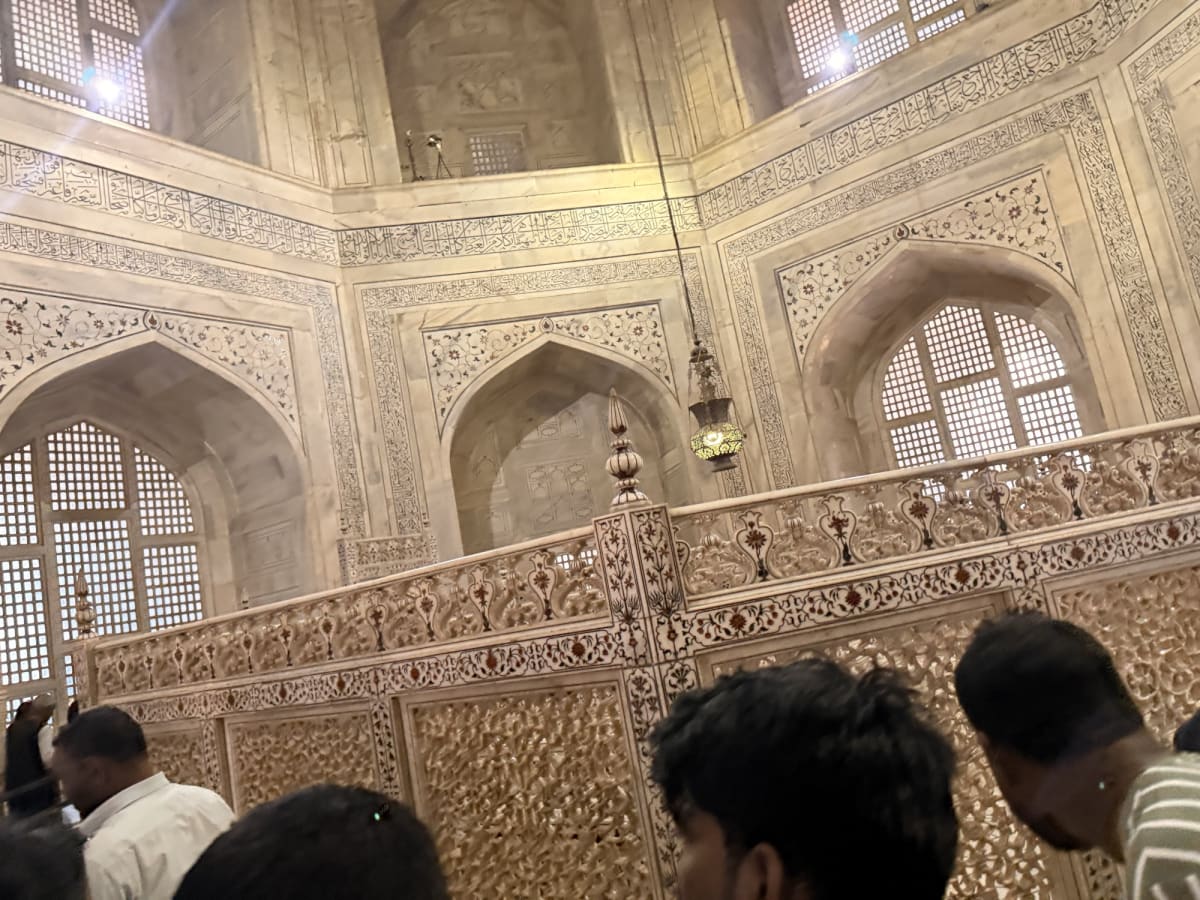
Going inside the Taj Mahal took a while because people were packed in.
Inside are the coffins of Shah Jahan and his wife Mumtaz Mahal.
The real coffins are underground, and these are said to be for show.
In a word, false graves, or cenotaphs.
It is beautiful, but I am not sure whether it is a good thing or not that the resting place of the dead is shown to tourists from all over the world.
Being famous has its gains and its losses.
The strong may go on displaying their strength even after death, but there are also things one cannot help in the face of death.
And being famous is not all one thing — being highly regarded in your own field is different from being famous for what you did badly.
Shah Jahan was the fifth Mughal emperor and led the empire at its height.
The Mughal Empire was also the largest economy in the world at the time.
In that respect he was an outstanding ruler, but Shah Jahan was also an emperor closed off in religion and lavish enough to drain the treasury.
You can see it at its peak in the Taj Mahal alone, built to honour his wife.
It has remained the building counted the finest in history right down to today, which says it all.
Shah Jahan is a figure who receives mixed assessments and matters historically, so his fame is only natural.
But the fact that his resting place is crowded day after day — and crowded not by visits to honour him but by people who came to see a building called the Taj Mahal — feels like something he would not have wanted either.
Leaving the Mausoleum

Coming out of the Taj Mahal, across the Yamuna you can see a garden called ‘Mehtab Bagh’.
It means the garden of the moon.
The Taj Mahal seen from there under the sunset is famous too, but I did not particularly want to go all that way to look at the Taj Mahal.
I had considered that plan and cancelled it.

On the Way Out

Walking out, I felt my heart had grown lighter.
I had been thinking that visiting the Taj Mahal was one of the closest things to a highlight among all the travel I would ever do — not just this trip to India, but a lifetime of it.
So although half the itinerary was still ahead of me, it felt like I had got the biggest thing out of the way.