India 3-3 · Akbar's Tomb
To Akbar's Tomb
Next I headed to Akbar's tomb.
Out on the road there were brutally many touts and insanely many cars, and shaking off the touts while eating exhaust was miserable.
I was trying to get an Uber but the data barely came through, and I thought if this went wrong I might have to take a tuk-tuk.
Akbar's tomb looked like a twenty to thirty minute drive even by car, so taking a tuk-tuk would have been a disaster.
Because you eat all the exhaust, your face turns black, and the ride is as bad as it gets.
On top of that the price difference from an Uber is small.
The Uber did get matched somehow, but in case a tuk-tuk turned out to be far cheaper I stopped shaking off the touts and started haggling.
I showed them the Uber screen and said anything more than this was nonsense.
The touts held out like people who had done this more than once or twice, and since I had nothing to lose I just found it frustrating.
But the Uber I had booked arrived and I could not see it anywhere, so I did get a bit tense.
Then a car came up honking, and on the off chance I showed him the screen and he said it was him.
The plate was different and so was the face, and while I was wondering what the situation was, he said it was his older brother's Uber account.
An odd situation in any case, but thanks to a kind driver who drove well I arrived at Akbar's tomb.
About Akbar
Akbar was the third Mughal emperor, and the man who actually made the empire an empire.
He is also the one who rebuilt Agra Fort entirely in red sandstone, as above.
And he was the grandfather of Shah Jahan, who built the Taj Mahal.
What he is particularly remembered for is not conquest but his attitude toward religion.
A Muslim ruler, he abolished the poll tax levied on non-Muslims, took a Hindu wife, and brought Hindu, Jain, Zoroastrian and Christian scholars to court to debate.
Late in life he even made a faith of his own, Din-i Ilahi, mixing elements of several religions.
That is also why his tomb does not fall neatly into one style.
Hindu, Islamic, Jain, Buddhist and Christian elements are mixed together in one building.
The building itself resembles the way he lived.
Another Guide Attaches Himself
I arrived in front of Akbar's tomb and the moment I went near the ticket window a tout attached himself.
There are guides who very kindly walk you all the way through buying a ticket and stick to you as if they will tell you anything for free.
This guide was that kind of guide.
He starts explaining at length on his own, and when you hand over your ticket and go in he goes in with you as if he works there and starts explaining at length again.
I said firmly that if he was doing it for free I was grateful, but I would not pay.
Then he started bargaining with me and pleaded hard to be allowed to guide me for money.
I refused all the same.
Because I wanted to take it in alone, at my own pace.
Building the Tomb
Akbar designed his own tomb and broke ground on it before he died.
After his death in 1605 his son Jahangir took it over and completed it in 1613.
The cost is said to have been 1.5 million rupees.
The place name here, Sikandra, is the name of a village on the outskirts of Agra.
The walled enclosure alone covers 119 acres, a square area 105 m on a side.
Darwaza

India's great buildings, the Taj Mahal and Agra Fort and the rest, have enormous gates.
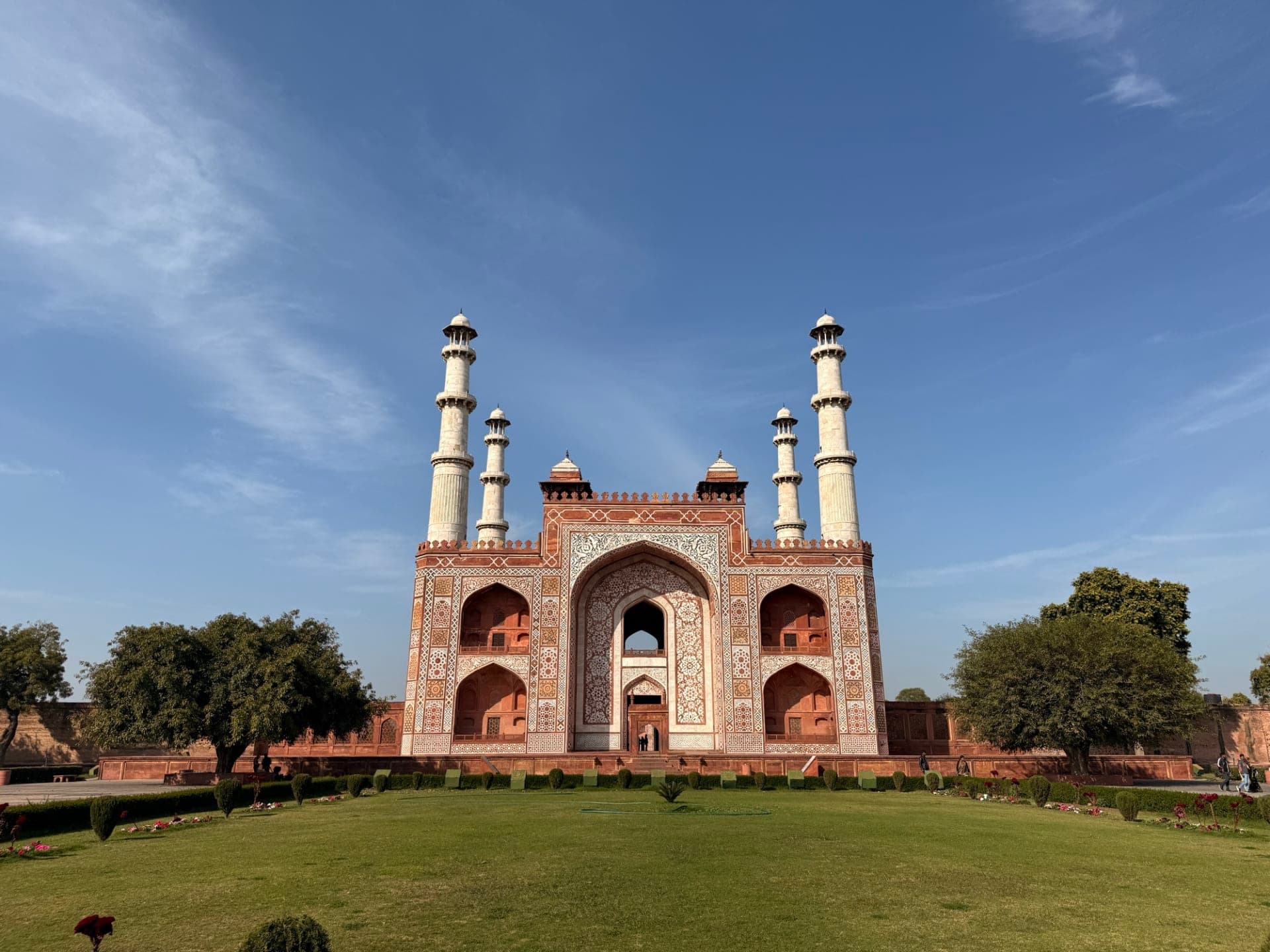
Akbar's tomb too was met by a gate with four minarets.

I asked a couple sitting on a bench in the distance, who looked like high schoolers, to take a photo.
The boy took it, and it was not bad, but he tilted it slightly to the right.
A shame.
This gate apparently has a name, 'Darwaza', which means 'gate' in Hindi and Persian.

These darwazas are graceful everywhere you go.

This southern main gate follows the form of the Buland Darwaza.
Three storeys high with a white marble minaret at each corner, and on the red sandstone ground, blue, yellow and white marble set in to draw geometric patterns and arabesques.
Four Gardens


Past the darwaza a broad path opened up, with a water channel running down the middle of it, like the Taj Mahal.
And there were trees along both ends of the path, with fields spreading wide beyond them.
The scale was enormous.
This channel is part of what is called the Chahar Bagh, the four gardens.
It is a structure that gives form to the Islamic paradise, made up of a garden divided into four quarters with a central channel and fountains.
The channel stands for the rivers of heaven.
In the Quran, paradise has four rivers running with honey, milk, wine and water, and this channel splitting in four directions is an expression of exactly those four rivers of paradise.
Functionally it also cools the air and regulates humidity.
This charbagh is the same form as the Taj Mahal's garden, and in fact this one came first.
The Tomb in Red Sandstone


This building too was done in red sandstone.
The tomb building is a five-tiered pyramid.
The lower four tiers are built in red sandstone, and only the topmost tier is raised in white marble.
The white marble tier is carved with geometric and floral patterns, and with calligraphy.
The strangest thing about the structure is that the top tier has no roof.
The uppermost level, where the false tomb lies, is open to the sky.
It reads as meaning that nothing should stand between God and the emperor.


Off to the right of the central entrance there was something, so I went over and found a tomb left as if abandoned, with no attendant anywhere.

In the rooms flanking the central entrance there are four more gravestones.
Akbar's two daughters Aram Banu Begum and Shakr-un-Nissa Begum, Mirza Suleiman Shikoh the son of Shah Alam, and one gravestone whose occupant is unknown.
Going back to the central entrance, I took off my shoes and went inside, and a tout immediately attached himself and started explaining this and that.
When I told this guide firmly that I could not give him money either, he said I did not have to, but to tip him afterwards if I was satisfied.
It was the best pitch of any guide I heard.
Because after a guide has put on his whole show, few people give nothing.
Cobalt Blue

Something in the middle was under construction, but looking at the ceiling and the right-hand wall, they were decorated with extraordinarily flowing carving.
And the cobalt blue stood out.
Islamic buildings and carving are just too beautiful.
The guide, having evidently photographed plenty of tourists or Koreans, turned the camera this way and that and took very good photos with flattering proportions.
He earned some points with me there.
Going further in, Akbar's coffin lay in a very dark, snug space.
As I remember it, he said the real coffin was below this and that this one was left there symbolically.
The same goes for the Taj Mahal and for Humayun's tomb in Delhi, apparently.
The place where the coffin lies is so deep and dark that speaking made the sound echo.
Pigeons were perched on something like a railing up above.
Photographs were forbidden.
That dark room you reach deep inside, though, is the taikhana, the underground burial chamber.
Beneath a plain marble slab is where Akbar's remains actually lie.
The cenotaph is separate, up on the topmost tier, in that spot open to the sky.
On the way out I tipped the guide.
I gave 20 rupees as a tip, not knowing whether that was the right amount, just giving what I felt like giving.
I was in fact fairly satisfied, but there was not much to explain inside, so I just gave that.
It comes to about 300 won, and I do not know whether that is an amount a guide would be happy with.
There is one more bitter piece of history to this tomb.
In March 1688, under Aurangzeb's reign, the Jats led by Raja Ram raided this tomb.
They looted everything of value, opened the coffin, took out Akbar's bones and burned them.
Aurangzeb shutting his father Shah Jahan up in Agra Fort, and his great-grandfather's tomb being dug open, belong to the same era.
Round the Back

While I was putting my shoes on: wherever you go there are always old men pretending to guard or look after your shoes.
There was one such old man and he asked for a tip.
I just pretended not to hear, turned left and went round the back.
A woman was walking with two children and another woman who looked like her younger sister.
The one who looked like the younger sister was taking selfies by herself, and she screamed when she saw me.
I ran into reactions I could not make sense of like this several times.
I thought it was embarrassment at being caught taking selfies, but it was not that either.
It was absolutely not disgust.

The building is arched, with corridors opening inward here and there, and it was worth seeing.
And the minarets at the four corners of the building were impressive too.
India's historic buildings really are too beautiful.
And as at the Taj Mahal, there are darwazas on all four sides at the outer edge of the garden.
But their function and symbolism differ.
The southern, or front, gate is usually the largest and most ornate, richly decorated.
Because it is the actual entrance and the one the most people pass through.
The remaining gates to the north, east and west are often restricted or closed in practice.
Because they are built mainly for formal and symbolic purposes, or for the sake of symmetry.
Having gates on all four sides stands for the four Gates of Paradise.
Turning right to head back the way I had come, there were unusually many monkeys and they looked vicious.
I went back along the path I had come, trying to stay as far from them as I could.
The Old Woman Selling Souvenirs
I came right out of the entrance and sat near the ticket window to get an Uber.
Dinner was all that was left of the day's plan.
I could not find anywhere in Agra I particularly liked to eat.
The best of what there was seemed to be The Salt Cafe, so I set that as the destination and booked an Uber.
An old woman in very worn clothes, selling souvenirs, came and stood in front of me and kept trying to sell me something.
They were worth a look, but since I am a minimalist who does not buy souvenirs to put in a room, and the prices were absurd, this time too I just pretended to be interested.
When the old woman had talked for more than five minutes and tired herself out and dropped away, I went out to the main road to meet the Uber.
Those five minutes of feigned interest, with no intention of buying, were five minutes she simply lost.
Among them I spotted a tuk-tuk with several tourists in it and thought sharing it might be cheap, so I asked how much.
The driver seemed to give an answer I was not happy with, so I said straight away it was expensive, and the Uber I had been waiting for came and I got in.
The Salt Cafe

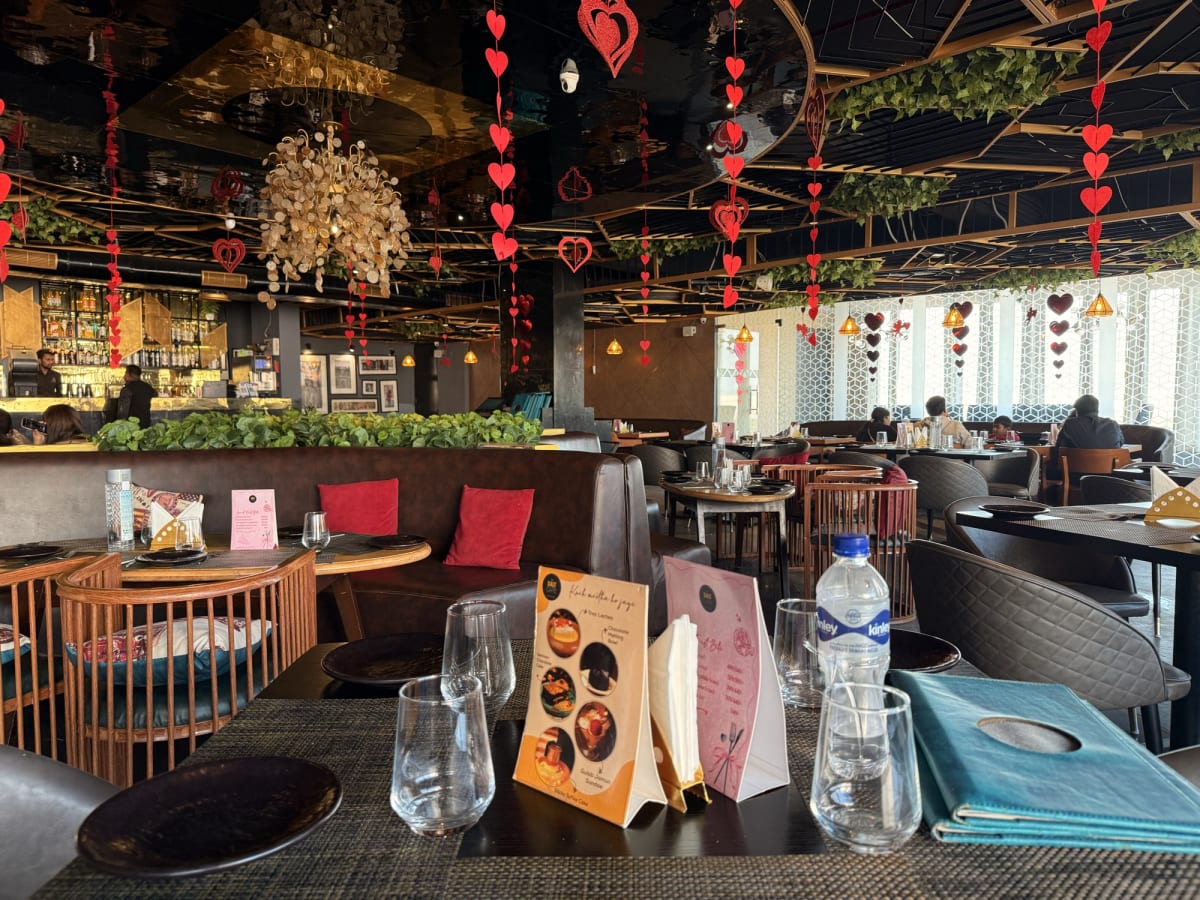
It was the hour when traffic builds, so it took about thirty minutes before I arrived in front of the restaurant.
From the photos on Google Maps it had looked like a fairly stylish restaurant, but the building looked like one under construction.
It is just that the building is shabbily designed; looking closely, the whole building seemed to belong to this restaurant, and it was not bad.
And inside there was a lift I had not expected at all, so I took it up to the third floor.
The interior was spacious, pleasant enough and sleek.
I arrived around 4:30, and whether it was too early for dinner there were few customers, and the ones there looked like people in for a light drink.
I had not had a proper meal all day and was starving.
My battery was down to 24 per cent.
There were several staff.
All of them kind and well-mannered.
The Oreo shake I had ordered came out first.
I ordered butter naan, murgh makhani and a half tandoori chicken.
And since it was hot, I added a cocktail called Deep Ocean.
Partway through I ordered garlic naan as well.
Water costs money here anyway, so I ordered plenty of other drinks with a mind to carrying one out.
Oreo Shake

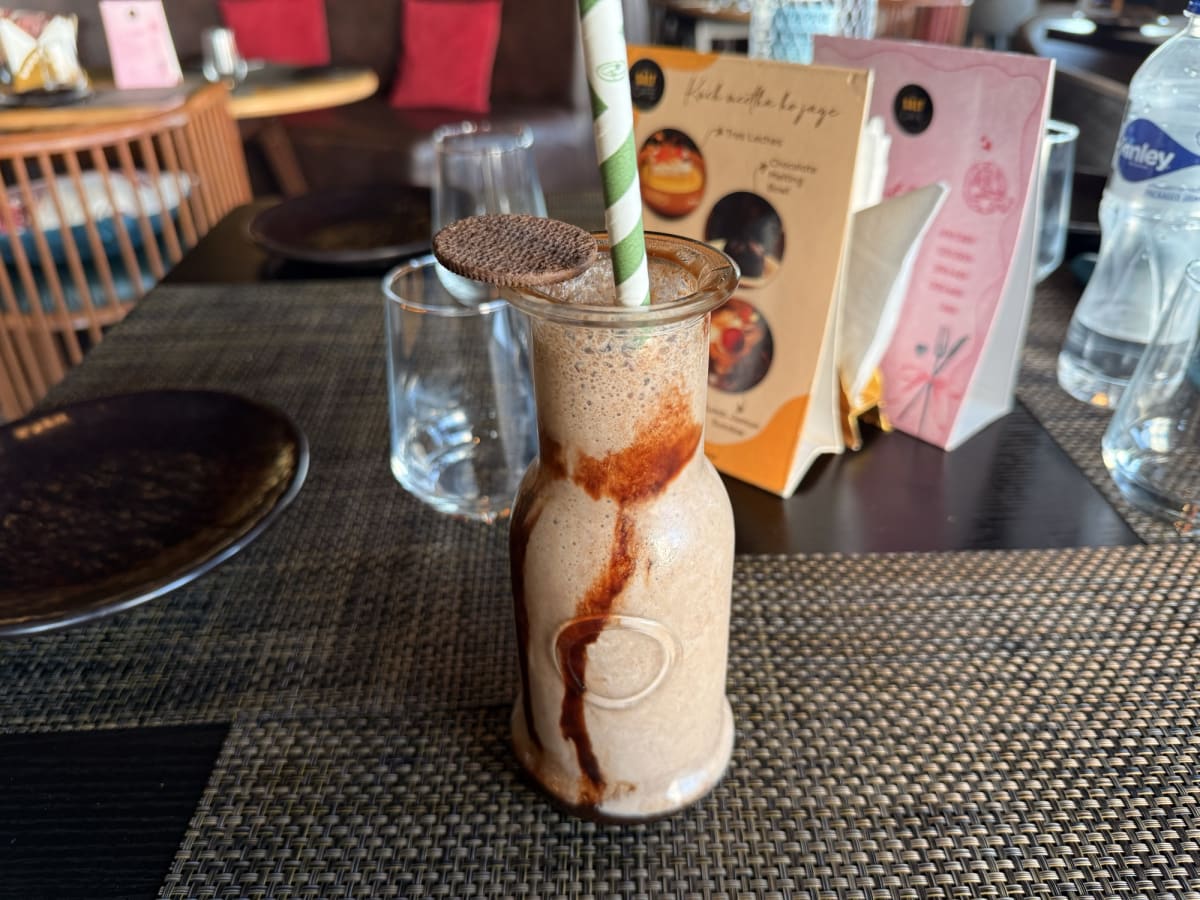
The Oreo shake came out first.
Chocolate-coloured, with what looked like chocolate syrup poured in and running down inside.
On top sat a single Oreo lid cookie.
Drinking it, it was extremely sweet and good, but the water smelled of the same stale tang as the shower water at my guesthouse.
I swore inwardly.
I worried that one sip of this might upset my stomach.
Still, I had been short on sugar, so the top-up was welcome.
Tandoori Chicken


Next came the tandoori chicken and the murgh makhani.
They brought a small brazier over and moved the tandoori chicken onto a plate.
There was bright red chicken, naan fried and charred like nachos, and onion seasoned red as if it were tandoori chicken too.
Pulling the chicken apart first, there was no undercooked part anywhere.
The smell alone was perfect.
One bite and, maybe because I was hungry, the taste was staggering.
Good char, perfect seasoning.
Cooked beautifully, and not dry at all.
Even the onion was good.
In a word, it was insane.
The best tandoori chicken I have ever eaten.
Murgh Makhani

The murgh makhani was very fine-textured.
The colour and the texture were fine enough to make me think so this is Indian curry, and even with yogurt swirled over it any old way it was beautiful.
Being the real thing, it barely tasted of tomato sauce and the spice of butter chicken curry came through more strongly.
It was so good it put me in a great mood.
There was heat to it as well, and the chicken inside had even been through the tandoor once.
No, it was simply tandoori chicken.
Eating this curry taught me that murgh makhani takes tandoori chicken by default.


The naan was very good too, but naan being so good in the first place, I ate too much of it and got full.
The tandoori chicken and the murgh makhani had been so staggering that it did not move me much.
The cocktail was an ordinary one that just tasted of liqueur.
Whether they add the service charge as they please, I only found out after paying and getting back to the guesthouse.
Murgh makhani, the curry usually called butter chicken, was invented in the first place to use up leftover tandoori chicken.
It is said to have started in the 1940s at a restaurant in Delhi called Moti Mahal, where unsold tandoori chicken that had dried out was revived in tomato, butter and cream.
So it is not that tandoori chicken goes into it; it is a dish that only exists because tandoori chicken does.
Back to the Guesthouse

The walk back to the guesthouse still had heavy exhaust and was full of traffic.
Seeing the metro nearby, I got the sense that this was a busy part of town after all.
After showering and sorting my bags I found some motorbike helmet sitting on the bed.
Someone suddenly turned up asking if I had seen a helmet, and I was a bit short with him, but he came straight back and apologised.
He spoke very good English, and talking to him turned out to be interesting.
He said Varanasi was his home town.
When I said I had been to Varanasi the day before, he asked me to answer honestly what was good about it and what was not.
I said I had only been there about five hours so I was not sure.
He looked like a university student so I asked him various things; he was born in 1996 and wanted to study business in Lithuania.
What made it interesting was that when I asked where else he wanted to go besides Lithuania, he played it close to his chest and said he could only talk about it after going there himself.
No, he was a man who kept his own counsel.
I told him that was wise and asked what books he read, and he liked that.
He asked if Squid Game was a Korean series and showed me that he was wearing a Squid Game T-shirt.
I had not noticed at all until then.
He said he had one question: why had Indians at the tourist sites wanted photos with me?
Answering 'because you're handsome' straight off, he had a good sense of humour too.
When I said seriously, he said that was the reason.
When I asked what else he thought it might be, I carefully brought up racism, and he said no.
He said he would get up in the morning and take me to the bus station on his motorbike.
I said there was no need, and he said he would do it anyway.
A kind friend.
The Mosquito Raid

I went to bed at 8:40 and woke up bitten in about ten places, with barely two hours gone.
I got up thinking I was really in trouble.
I went to the counter and they did give me mosquito repellent.
The dogs barked all night.
Thinking back on how many dogs I had seen, I decided there was no way I was going to sleep.
I had survived the sleeping bus, and under the mosquito raid I found myself desperately wanting to go home.