India 4-1 · Fatehpur Sikri
Awake Before Dawn
I got up at 5:50, showered and got ready.
The friend who had said he would take me was snoring away, so I just left.
Offering to take me even if it came to nothing seems like the mark of someone who knows how to get on with people.
Around four in the morning religious music rang out across the whole neighbourhood and I kept waking and dropping off again.
So I was extremely tired.
I simply cannot get used to it.
Agra in the Morning

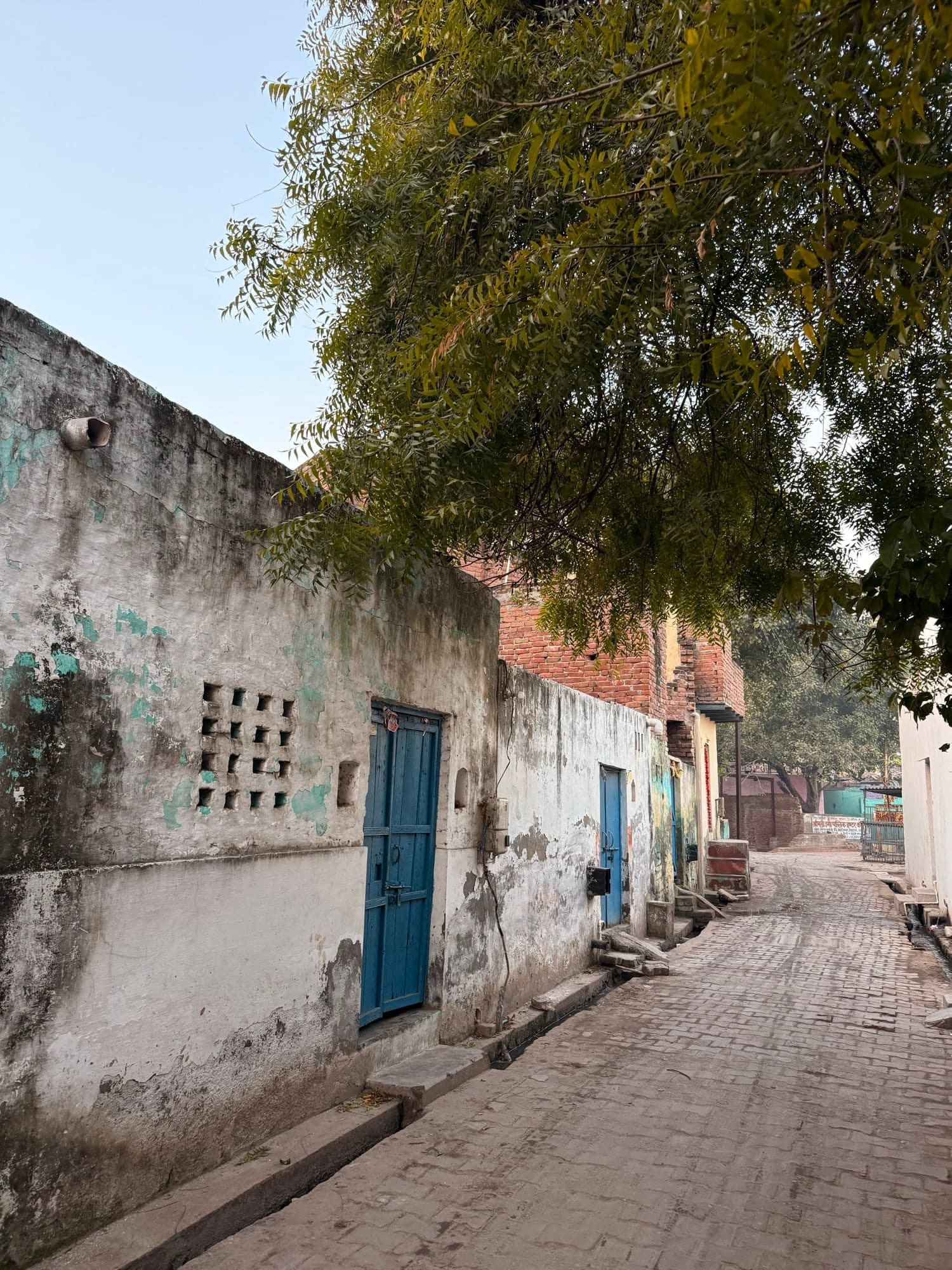
I came out at 6:50 and started walking.
The morning scene had an entirely different feel again.
There were small kids up early too.
Greeting you warmly and then asking for money straight away is probably something learned from bad adults.
Education really does matter when you are young.
Children finding a traveller who looks different strange, saying things and laughing at him, is something they should not do even if they are too young to be aware of why they are doing it.
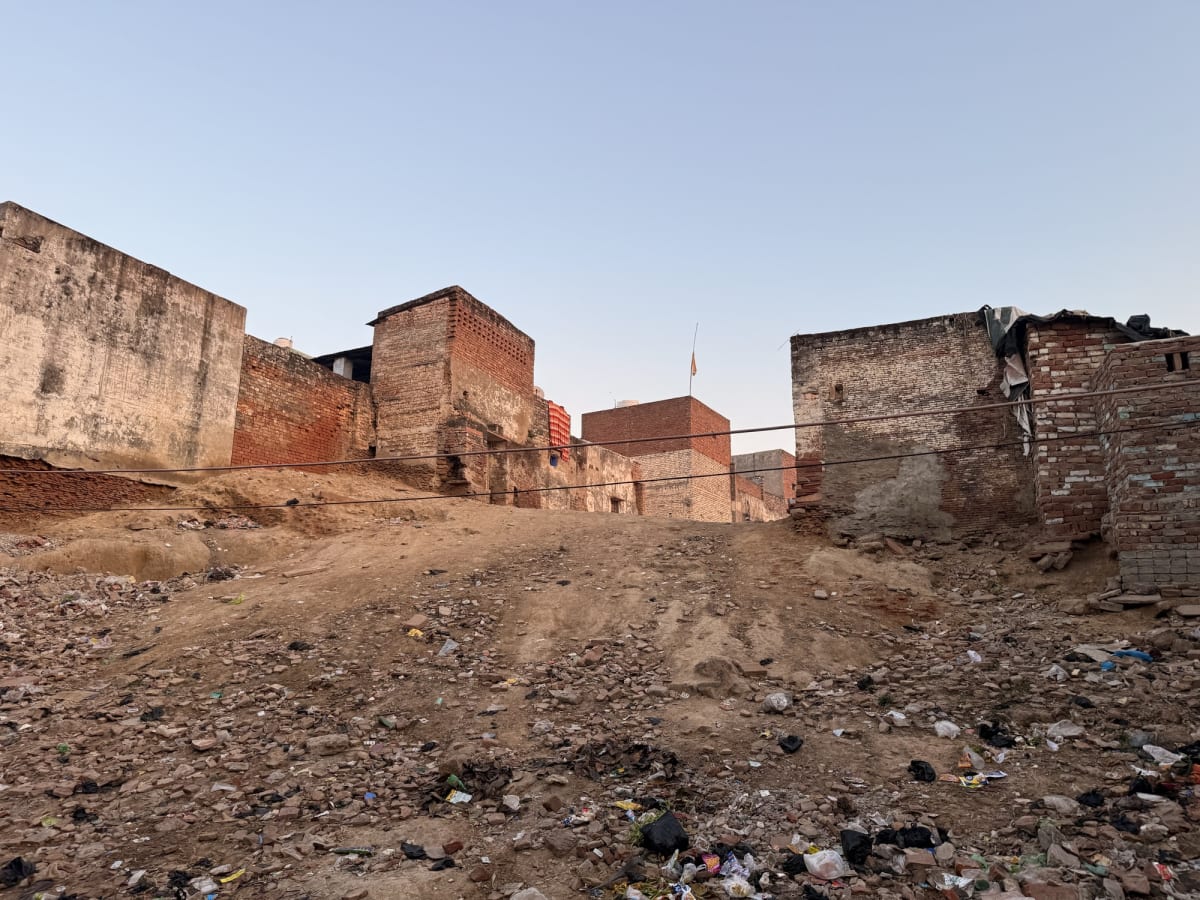
There were fewer dogs and fewer people than yesterday afternoon.
But there was a man letting a guard dog, on a different scale entirely from the strays, relieve itself on a lead.
The dog growled at me and the man grabbed its neck and calmed it, and it is horrifying to think what would have happened if a dog like that had been a stray.
A Half Marathon
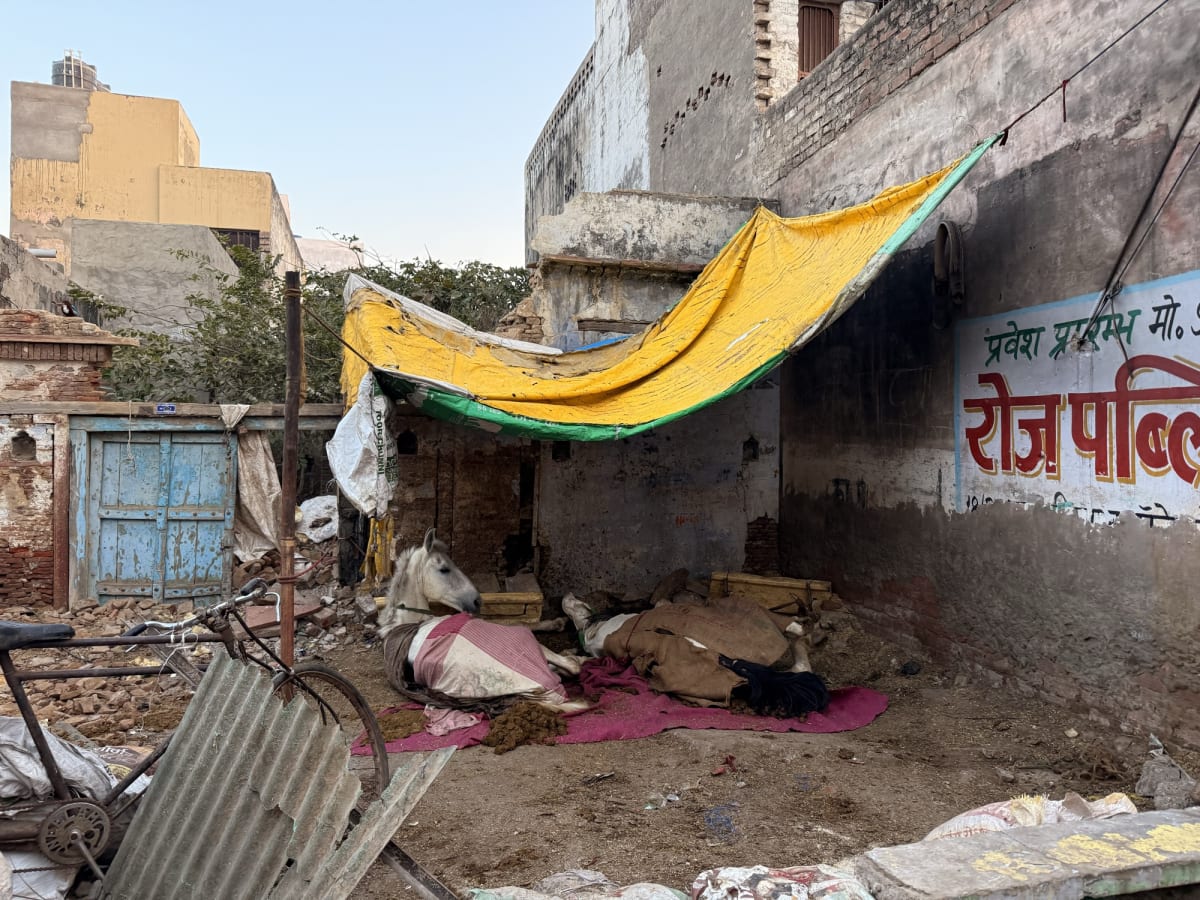
Goats, cows, horses, all sorts of animals everywhere.
There are stables on the street that are more or less rubbish tips, and it was the first time I had seen a horse sprawled out having dumped a pile of dung.

Walking on, traffic had been closed off, because a half marathon was being held.
The good runners had already passed through in a group long before.
Some were jogging along casually, and some were running hard but so poorly that I could catch up on foot.
Seeing a half marathon in central Agra was rather remarkable.
It kept going the same way I was, which meant no annoying honking cars, which was good.
Even so there were plenty of motorbikes and cars darting in from somewhere and coming the wrong way.
They honk at the slightest thing from behind, and one car nearly hit me, which made me glare at it instinctively.
But strangely my anger cooled quickly.
It must be because I had reached a state of expecting nothing at all.
Waiting for the Bus

This was a bus company called nuego.
Here too they chatted among themselves and made phone calls, with no apparent interest in making money.
Let it be what it will be.
They are different from the ones who tout with enough zeal to wipe your backside at a tourist site.
The saving grace, as ever, is fellow passengers who speak English.
There was a French couple who greeted me first and were kind.
The woman said she was getting a chai and would buy me one too if I wanted.
I declined politely, though I did find myself wondering again whether to try one.
I am too afraid of an upset stomach to dare.
The couple were headed to Jaipur.
They said they were travelling for three months.
Young Westerners seem to have a fantasy about India.
Most of the Westerners I met travel for several months at a time.
It said boarding at 8:20 and nothing came, so I asked and was told the bus would come at 25 past.
When I showed them on my phone that it was 35 past, they went oh~ and brazened it out.
I did not even get angry.
The reason I was relaxed was that we would leave at nine and Fatehpur Sikri was about fifty minutes away.
I had to catch the bus from Fatehpur Sikri to Jaipur by two, so I had four hours of slack.
I told myself an hour late would still be fine, and at nine we at least took a tuk-tuk to where the bus was.
I had already guessed we would not be boarding here.
I rode the tuk-tuk with the French couple.
It was my first time sitting on the edge, and when it moves about, your shoulders knocking together hurts.
Fifty Rupees
We arrived where the bus was, and the man running the bus said we should each give the driver 50 rupees for the tuk-tuk.
I had already paid for the bus, so what tuk-tuk fare.
They gave us the wrong place, they put us in a tuk-tuk, they are running late, and now they want money too.
I was about to ignore it completely as I had all along and get on the bus, but the French couple had already paid and even handed me 50 rupees, offering to cover mine.
I took the money the man handed me and gave it to the bus operator, then sat right in front of the couple, took out 50 rupees and gave it back to them.
They seem to be the sort who think positively about everything and would rather pay than get into an argument.
Handing over money indiscriminately is one thing, but there is no need to be so guarded either.
Letting everything go calmly and positively, as if beyond it all, seems like the best attitude for travelling India.
When you work it out, one rupee is 16.6 won and 50 rupees is only about 830 won.
For a tuk-tuk with a ride that bad I think that is fair or slightly expensive, but in today's money it is really very little.
I am frugal to the bone and hate being given things for free, so my attitude is mostly to fend for myself and to turn things to my own advantage somehow.
Though in India, after the sleeping bus, I became entirely detached about it.
At any rate, this detached state is satisfactory for now.
The bus operator came over to apologise and explain what had happened.
He said he had told everyone else where the bus was and they had all boarded long before, but with our foreign numbers he could not get through to us.
He apologised politely, spoke good English and was kind, so I thought nothing of it.
To Fatehpur Sikri
Fatehpur Sikri took about thirty minutes.
We arrived before ten.
I worried that the location of the bus to Jaipur later would be uncertain too.
I asked the bus operator and he assured me it was the same place where we had been dropped off.
The man was asleep, so I said have a nice travel to the woman and got off.
You cannot know much about someone you have just met and spent only a few hours with.
But if they treat you kindly and leave a good impression, your guard comes down and even that short time can stay with you as a good memory.
The French couple seem — and I know it is an odd thing to say in Korea — like people who were brought up very well.
But in describing my impression of these two, that is how I want to describe it.
And that is the impression I want to leave in most of my own encounters.
Two Kilometres on Foot

The moment we got off the touts latched on again.
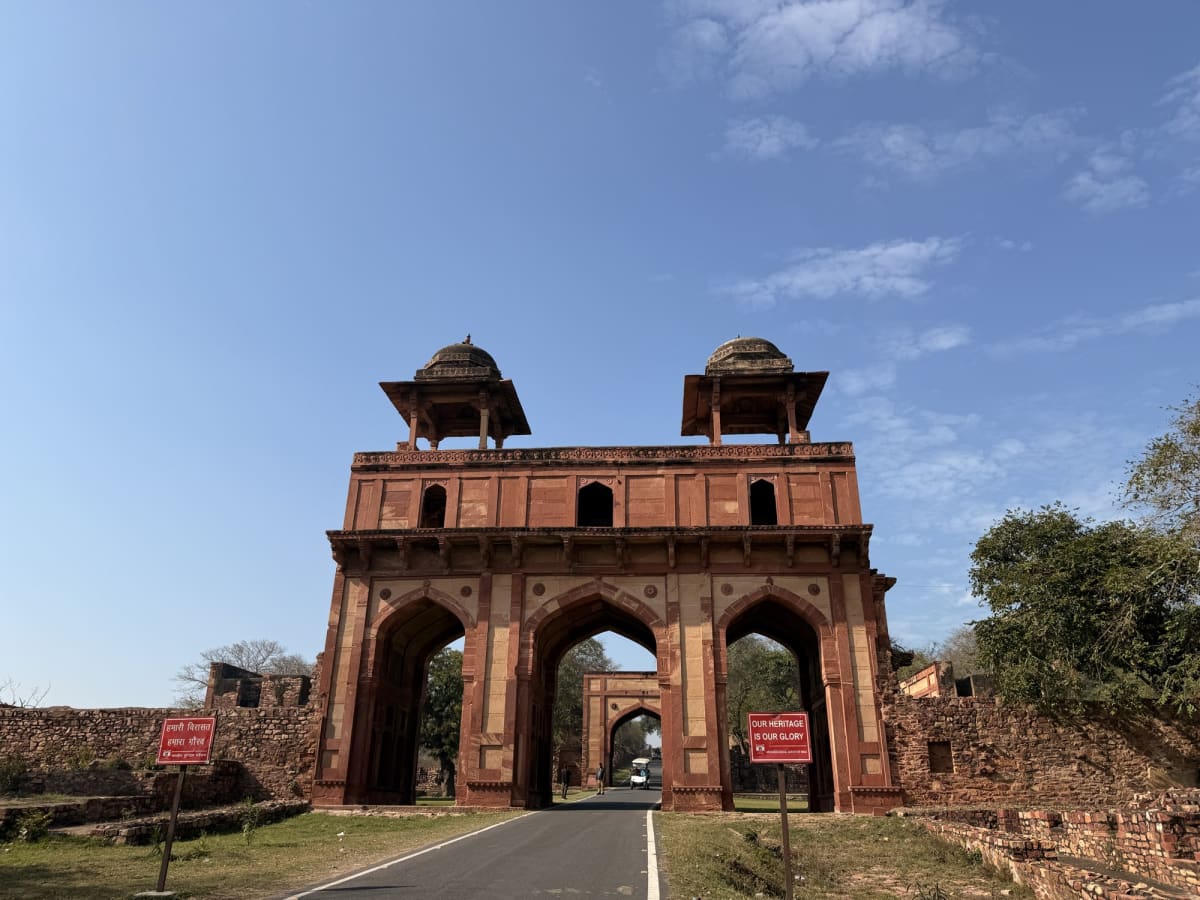
It turned out you had to walk about 2 km to the entrance.
Walking past a gate called the Agra Gate, only golf carts and motorbikes were allowed in at the entrance.
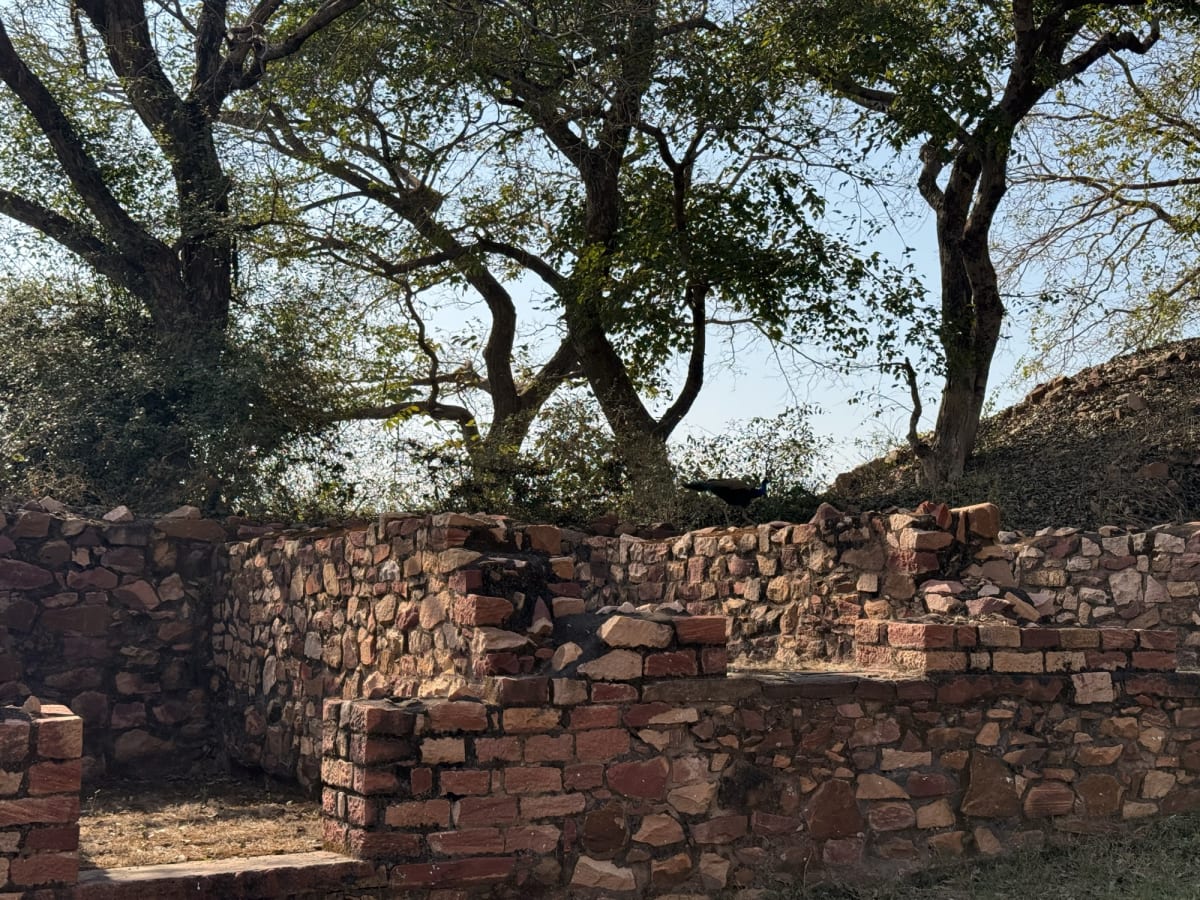
There was a fork on the way and I briefly took the wrong one.
Beside it was an entrance leading to what looked like abandoned ruins, and the other was a main road, and the entrance to the ruins rather than the main road was the way into Fatehpur Sikri.
Passing through several gates of uncertain purpose, I could see animals beside them.
I saw a peacock too.
A peacock that ornate did look out of place somewhere this shabby, but seeing a wild peacock was remarkable all the same.


Reaching the entrance, on the left was a building with something like a garden, and on the right a long Islamic building.
Later, after I had seen all of Fatehpur Sikri and come back out and gone in, both turned out to be museums.
The left one a relatively simple museum.
The right one a museum that explains the history and identity of Fatehpur Sikri well.
Fatehpur Sikri is a capital Akbar built himself.
From 1571 to 1585, for fourteen years, it was the capital of the Mughal Empire.
The reason Akbar chose this spot was the Sufi saint Salim Chishti.
The saint who foretold the birth of a son to a man without an heir lived in the village of Sikri, and when the son was born as foretold, Akbar built a city on that spot.
And after fourteen years it was abandoned.
The commonly known reason is water.
It was a city built on a dry ridge with no river, depending entirely on an artificial lake, tanks and rainwater collection, and as the population grew that could not keep up.
Historians, though, see the greater reason as Akbar moving the capital to Lahore in 1585 for military campaigns on the northwestern frontier.
It was inscribed as a UNESCO World Heritage Site in 1986.
Another Guide
First I went to the toilet, and when I asked the young man who seemed to be the attendant whether it cost money, he said as you wish.
So I used it and came out, and the man had vanished without a trace.
So I thought that at least here I could be relaxed about using the toilet.
I paid the 610-rupee entrance fee in cash and the moment I went in there was a large garden.
And sure enough a guide tout attached himself.
He was already explaining away on his own, and I started listening as if I were used to it by now.
Since I will say I am not paying when I say it, there is no harm in listening up to that point.
But I soon made sure he knew I would not be paying.
At that the guide said to give whatever I wanted.
I really like this strategy, because I think it is win-win.
If I genuinely did not like it, I could simply not pay.
Making a fuss at that point gets you nowhere; against someone callous enough to pay nothing, a guide can do nothing either.
Knowing that, these people try it anyway.
And in exchange they explain with everything they have so that they do get paid.
Then most reasonable people end up giving something out of gratitude for a solid explanation.
Ahead of me an elderly Western couple already had a guide and were listening intently.
Listening to the guide who had attached himself to me, he explained more substantial material than I expected and had me take photos in spots where they came out well.
The Most Beautiful Pillar
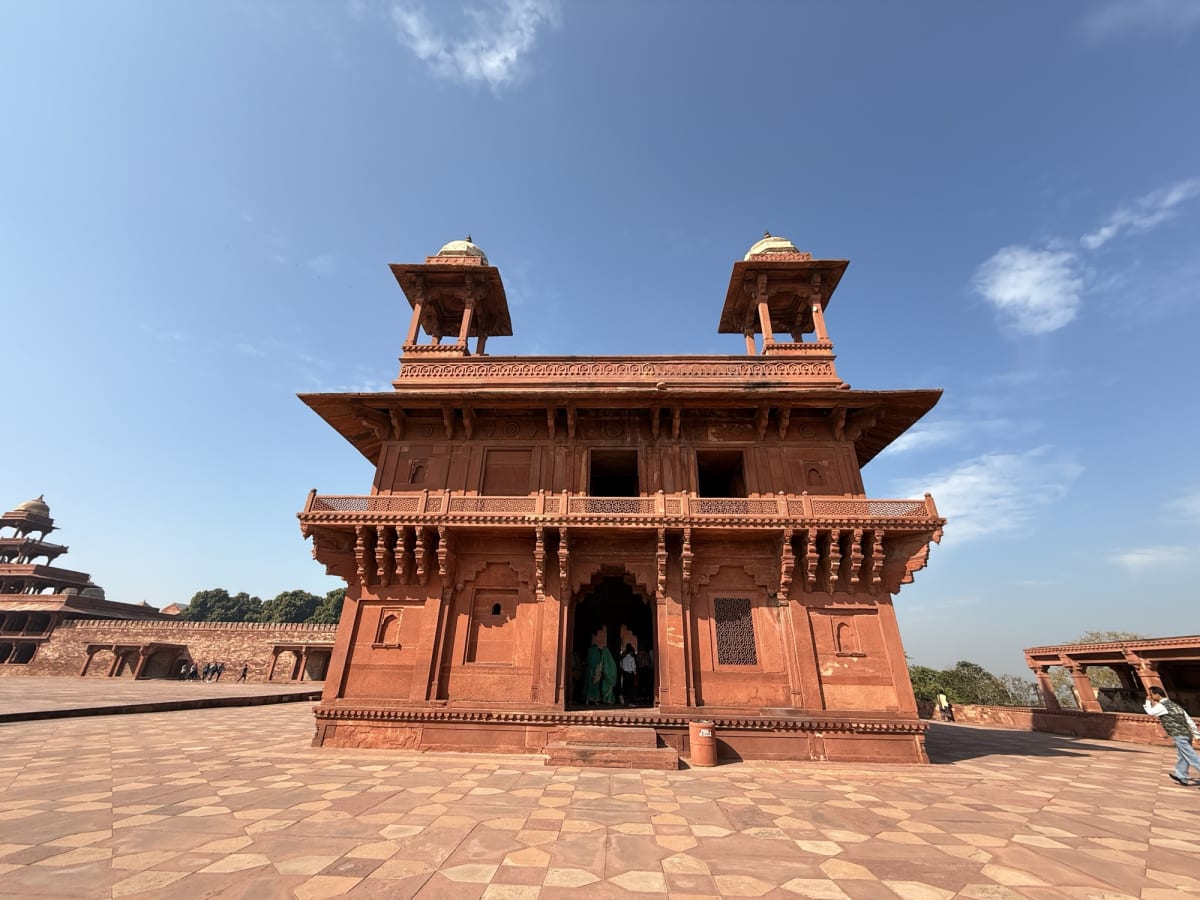
Past the garden, going to a larger area, there was a bigger courtyard with sandstone buildings gathered here and there.
The first building I came up against looked like a horned goblin.

Going inside, there was a remarkable and beautiful pillar right in the middle, and it had an unusual form combining Indian and Islamic architecture.
The patterns carved into the pillar itself are Islamic, while the huge second pillar with the serpent pattern joined above it is said to be Indian architecture.
It was so beautiful, and the guide took photos for me.
It may well be the most beautiful pillar I have ever seen.
The building that pillar stands in is the Diwan-i-Khas, the hall of private audience.
It is where Akbar brought scholars of various religions to debate.
The pillar sets an octagonal shaft on a square base, banded with geometric and floral patterns.
Above, thirty-six serpentine brackets reach out to support a circular platform.
That platform was where Akbar sat, and stone walkways running in four directions connect it to the four corners of the upper floor.
A widely known reading holds that the styles of several religions are mixed into this one pillar.


Panch Mahal and the Board


The serpent pattern could be seen in many other places too.
And you could also see the chaturanga board that was the origin of chess.


Then I saw the queen's living quarters as well.

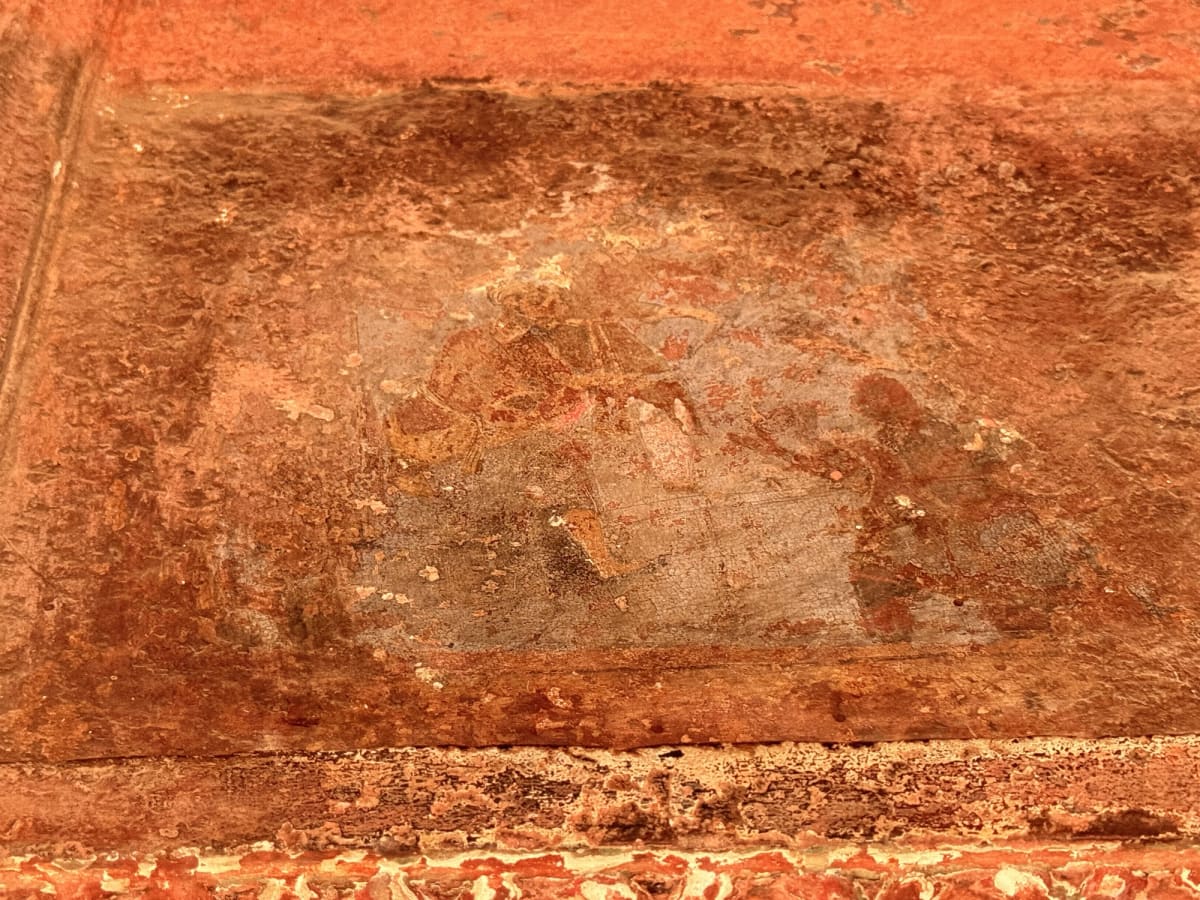


The space holding what looked like a pond is said to have been used as a stage for performances.
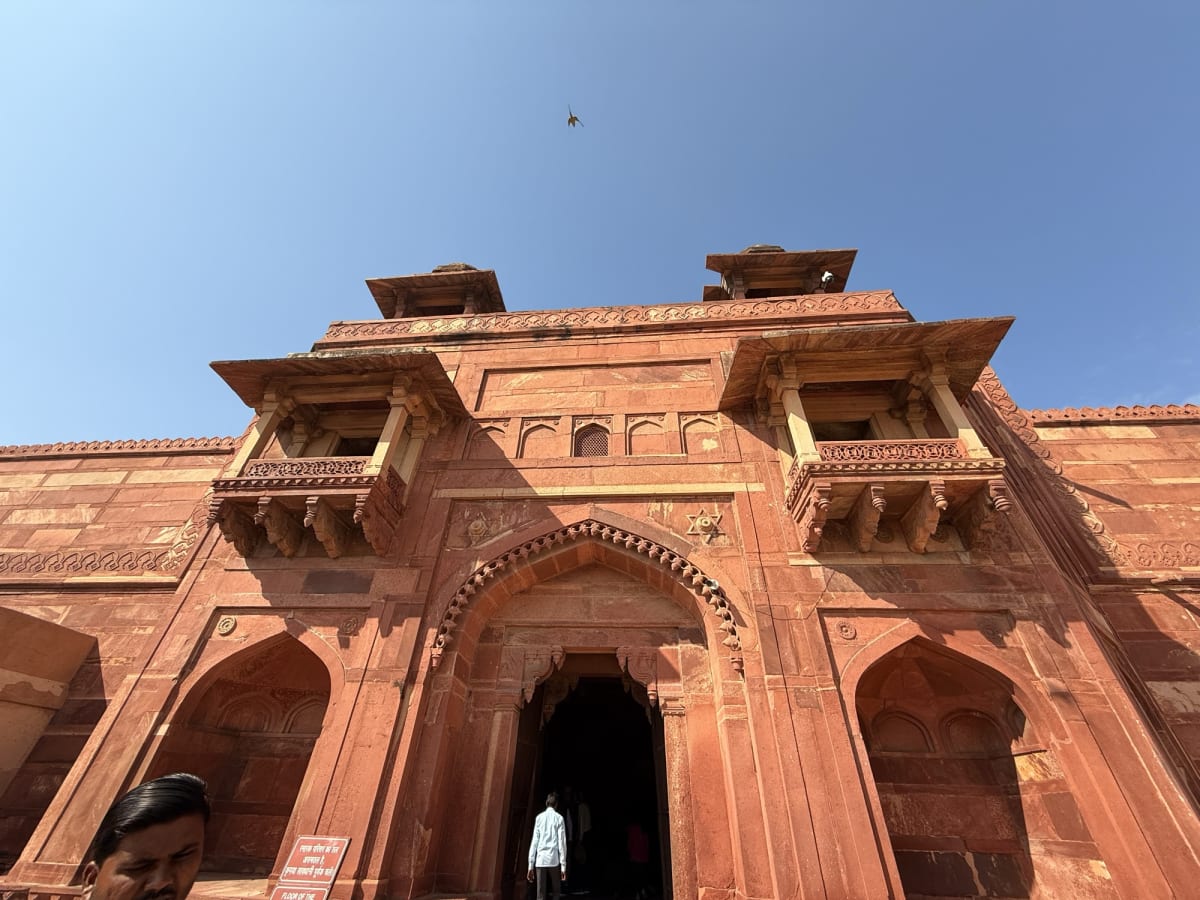


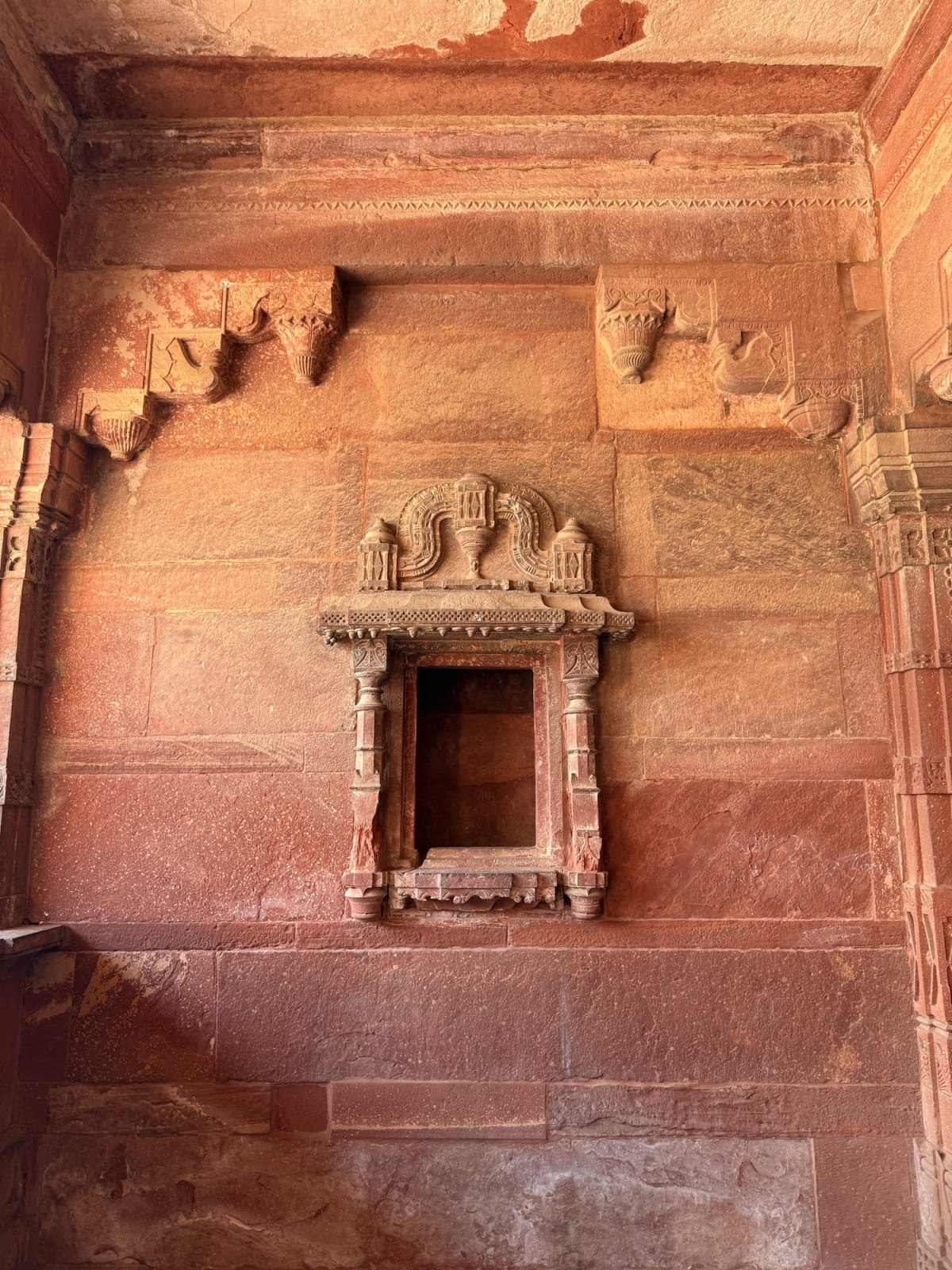
That building stacked five storeys like steps is the Panch Mahal.
It is a pyramid form growing smaller as it rises, supported by 176 columns, each one carved differently.
Being right beside the harem quarter, it is taken as a space where the emperor and the royal women rested.
That huge board on the ground is known as a pachisi board.
It is a different game from chaturanga, the one counted as the ancestor of chess: a traditional Indian board game in which pieces move round in four directions.
The story goes that Akbar played it with people standing in as the pieces.
Jama Masjid
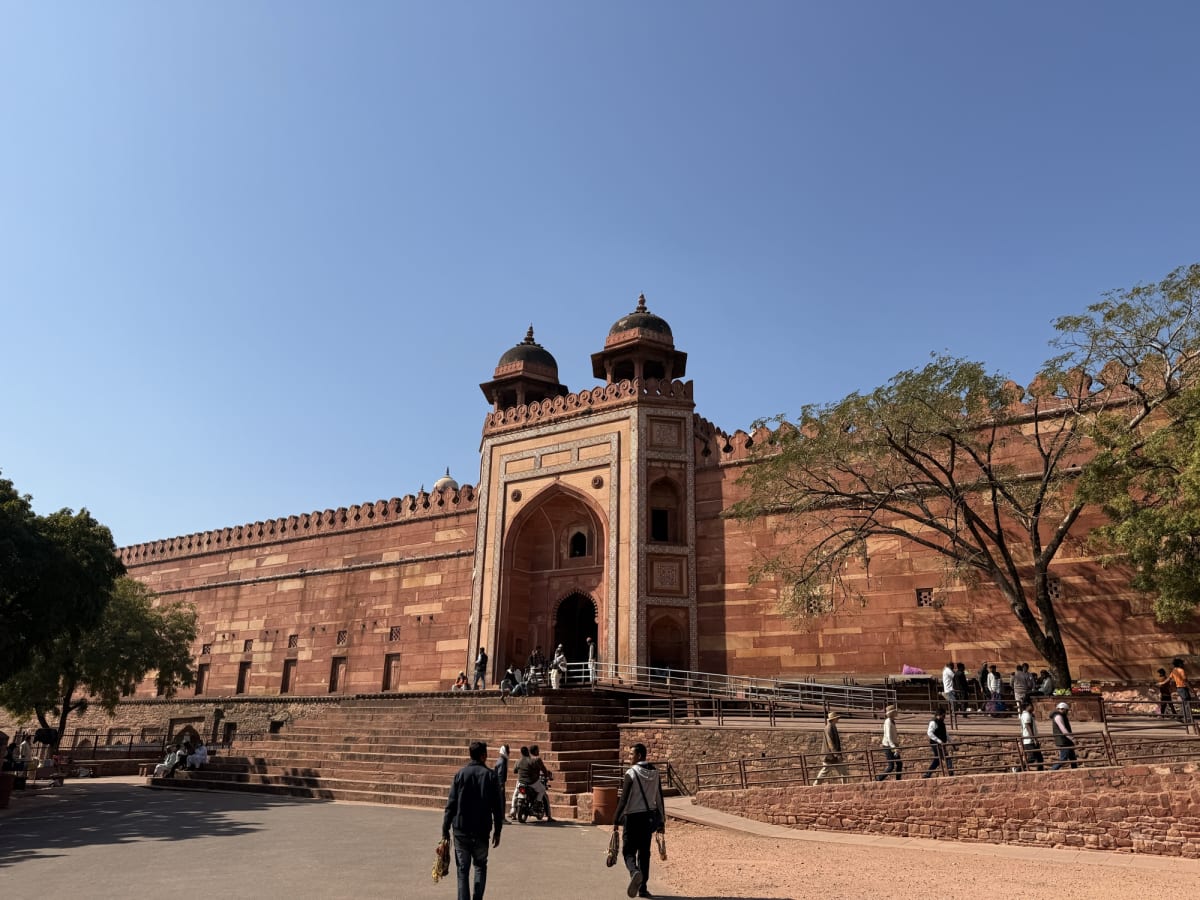

After that I moved on to the mosque called Jama Masjid.
To go in there you had to take your shoes off.
And since shorts are not allowed in, they hand out cloth to wrap round your waist and cover your legs.
I was given an orange cloth and the guide tied it round my waist.
I was uneasy about someone stealing my shoes, but the guide said it was fine, so I had no choice but to trust him.
In front of the big gate you could see young men hovering intently, arranging shoes this way and that and putting them into a net.
I knew the plan was to take money for it later, but I had no intention whatsoever of paying once I had my shoes back.


Inside Jama Masjid is like a huge plaza.
There are several buildings within it, and the most striking is the tomb of Salim Chishti.
Salim Chishti is the Sufi saint who foretold the birth of a son to the emperor Akbar, who built Fatehpur Sikri.
In a Fatehpur Sikri where every building is sandstone, it alone is built in marble, and that white form carries an air of mystery and refinement.
That enormous gate to the south is the Buland Darwaza, the lofty gate.
Akbar began building it in 1573 to commemorate his victory in the Gujarat campaign.
About 54 m from the ground to the top, with forty-two steps leading up to it.
The Cloth Seller
Beside it the guide briefly leads you to a place selling various beautiful pieces of cloth.
He lies about how you can only enter the tomb if you buy one, or something like that, to make you buy somehow.
And they say a percentage of the proceeds goes to charity to feed children.
That beautiful, heart-wrenching show is meant to move you, but I have neither blood nor tears.
Still, the cloth really was beautiful, even allowing for all that.
So, thinking it would be a shame to buy nothing while I was here, and that holding out entirely would not help India's economy either, I asked the price meaning to buy one.
He named a price absurd by my standards, and I tried to haggle, but out of pride perhaps it got nowhere at all.
So I just said I would not buy it.
And the moment I was about to take issue with the guide about what he thought he was doing, the guide said it was fine not to buy.
The Tomb of Salim Chishti


And then I went inside the tomb of Salim Chishti.
I could see people laying down money and praying there.
I heard they pray for a safe delivery.
The man watching over the inside brazenly asked whether I was not paying either.
I just looked around and came out.
You could see couples tying on things like red or yellow thread.
The son born as foretold was given the saint's name, Salim.
That son was the future Jahangir, the emperor who hung the Chain of Justice in Agra Fort.
The tomb was built between 1580 and 1581.
The Uncle's Carvings
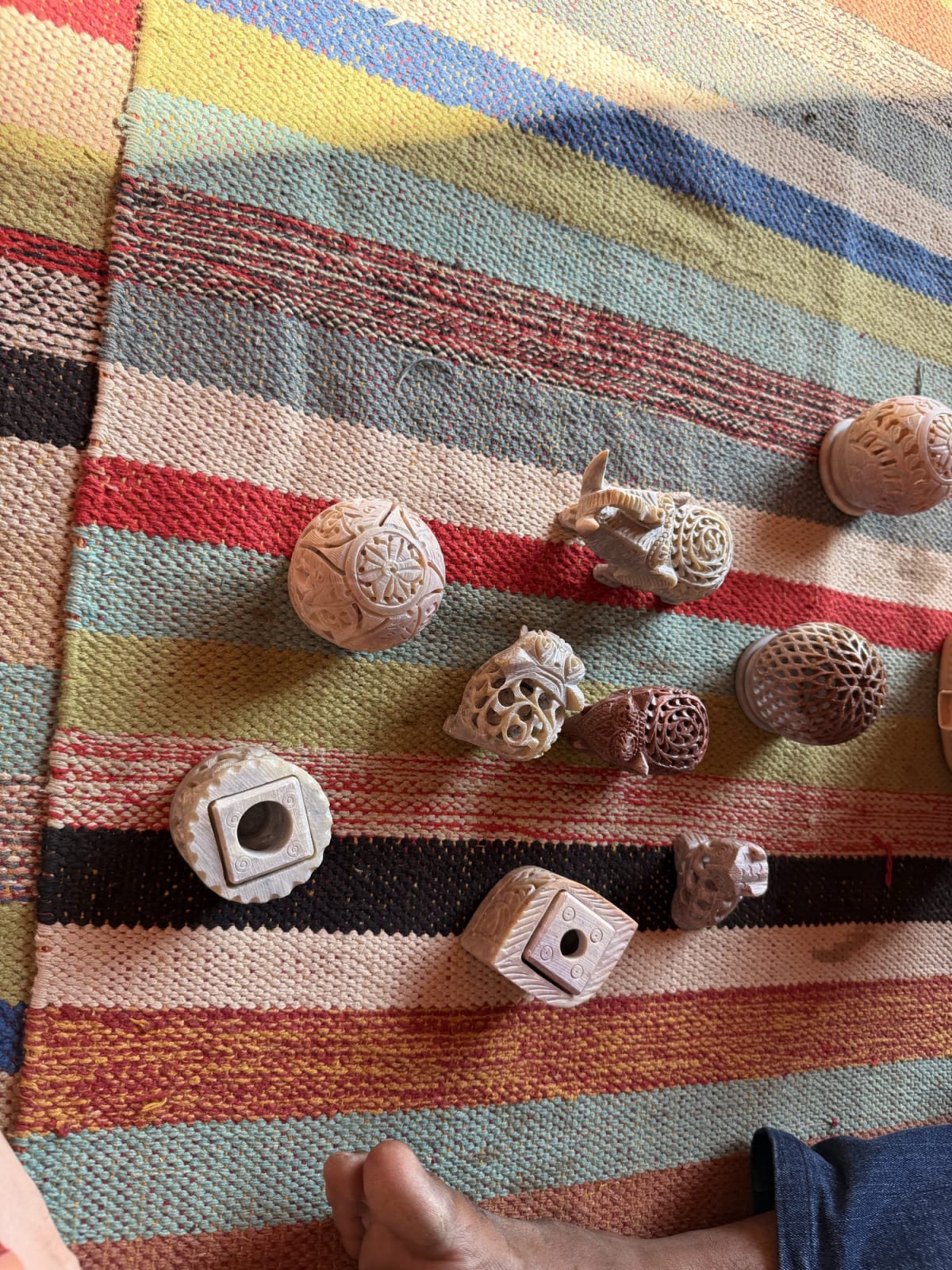

And lastly the guide led me off to show me carvings his uncle had made.
Just as when he took me to the cloth seller, he took me along casually and all but by force.
Being curious, and thinking the guide's explanations had been very solid, I followed him as if it were simply the natural order of things.
In a shaded spot he laid out a mat and sat me down where the carvings were piled up.

Sitting there, a kindly-looking old man brought out the carvings one by one, and they were so beautiful that they made me want to buy.
The colour changes with the light, and changes again if you pour water on it, which was remarkable.
And the quality of the carving was beyond words.
Turtles, elephants, spheres, cubes and more, and I have no idea how they carved them all hollow inside.
They were so full of interest and so beautiful that I looked at them that way, turning them over and asking whether there was anything else, as if I were going to buy.
Looking at the carvings was fun, but it was also very hot and the sun was harsh, so a strong part of my aim was to sit a long while in the shade.
I sat there easily for about twenty minutes, and all the while he kept pitching the pieces to me and playing on sympathy, saying his uncle and his uncle's children get up early every single day to carve.
This guide and the merchant, uncle or not, were pouring everything they had into me as if selling was all that mattered.
But they picked the wrong target.
If I had even had a hobby of collecting things for my room I would have bought one.
As a minimalist, however much I want something, I do not buy it if its purpose is unclear.
Which is why there is not a single ornament in my room.
Equivalent Exchange
In the end I judged it was about time to move, slowly enjoyed the shade a while longer, and then politely said it was too expensive and there was nothing to buy.
He tried to persuade me, offering a discount and saying I should buy for my family, but I said firmly that I was not buying and stood up.
At that the guide turned it round on me, saying I should have said so earlier and why had I let him keep talking.
The guide's temperament was so mild that he said it mildly, but it was a reproachful tone toward me for having enjoyed the shade.
But this is equivalent exchange.
For a guide who came at me with deception, deception is exactly right.
I said listen, listen to the guide, and made my point slowly and firmly.
That I had asked only for a guide, and whatever his uncle was selling had nothing to do with me.
Leaving the guide with nothing to say made him more amenable still.
That, and the fact that he had not yet been paid his guide fee.
When I asked the guide whether this was the last of it, he said that was the end.
There was nothing left to see besides Jama Masjid.
I had still not paid the guide, and I asked him for one last photo.
After the photo another tout latched on selling bracelets, saying his daughter made them, and I sent him off politely.
And honestly I liked the guide so much that I pressed 200 rupees into his hand.
After handing it over I could not read from his face whether it was good or not.
The guide said goodbye to me politely all the same and left.
Whether 200 rupees for about an hour of guiding is a fair amount or a lot by Indian standards, I have no way of knowing.
But from the fact that he took it readily, it was probably average or above.
A Little Longer, Barefoot

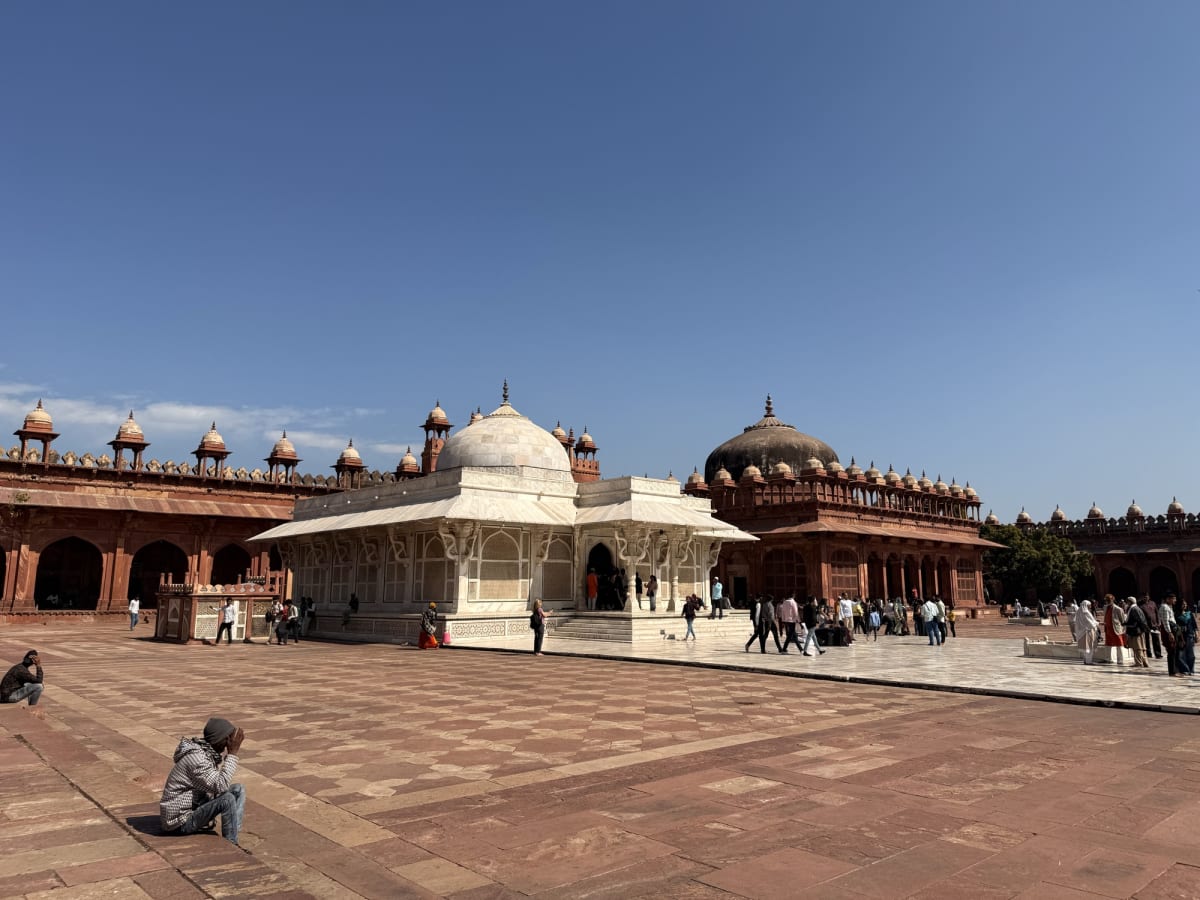

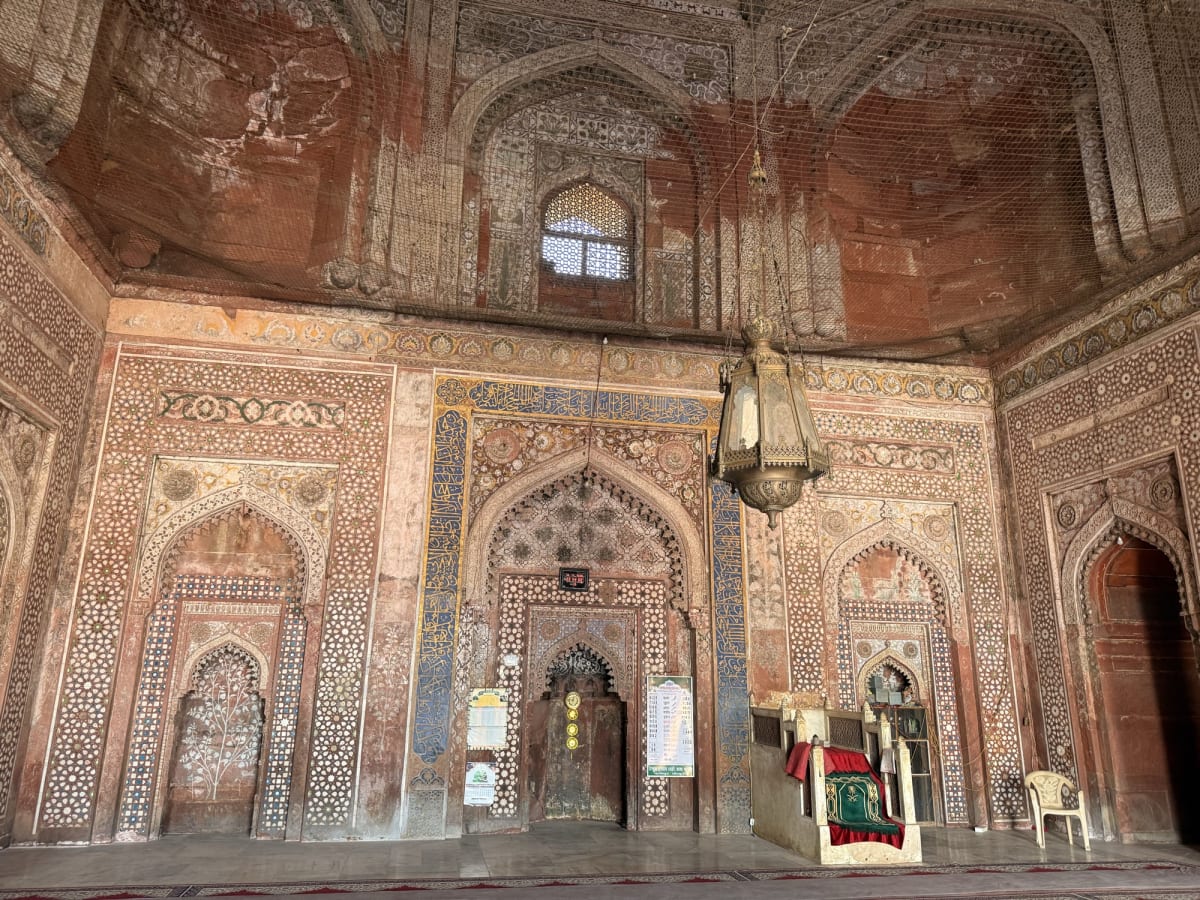


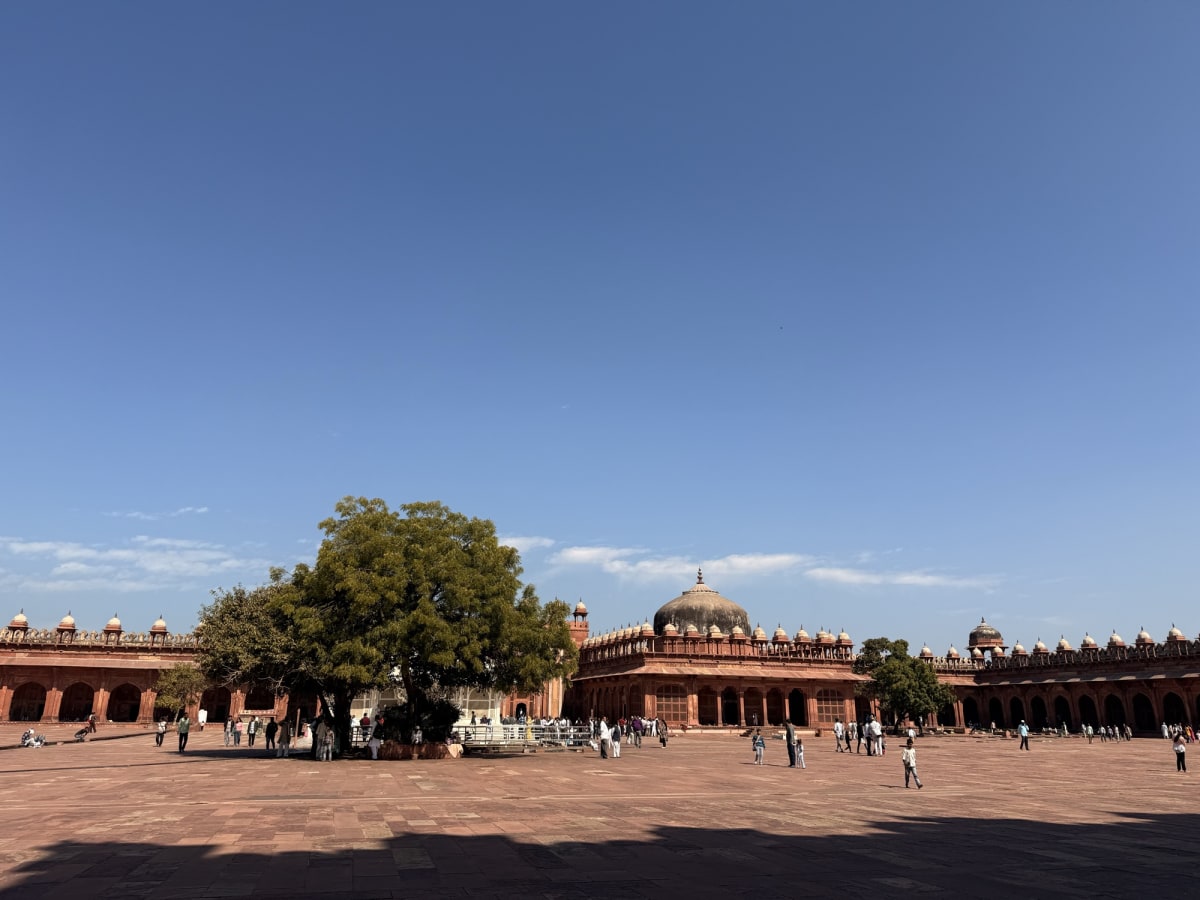
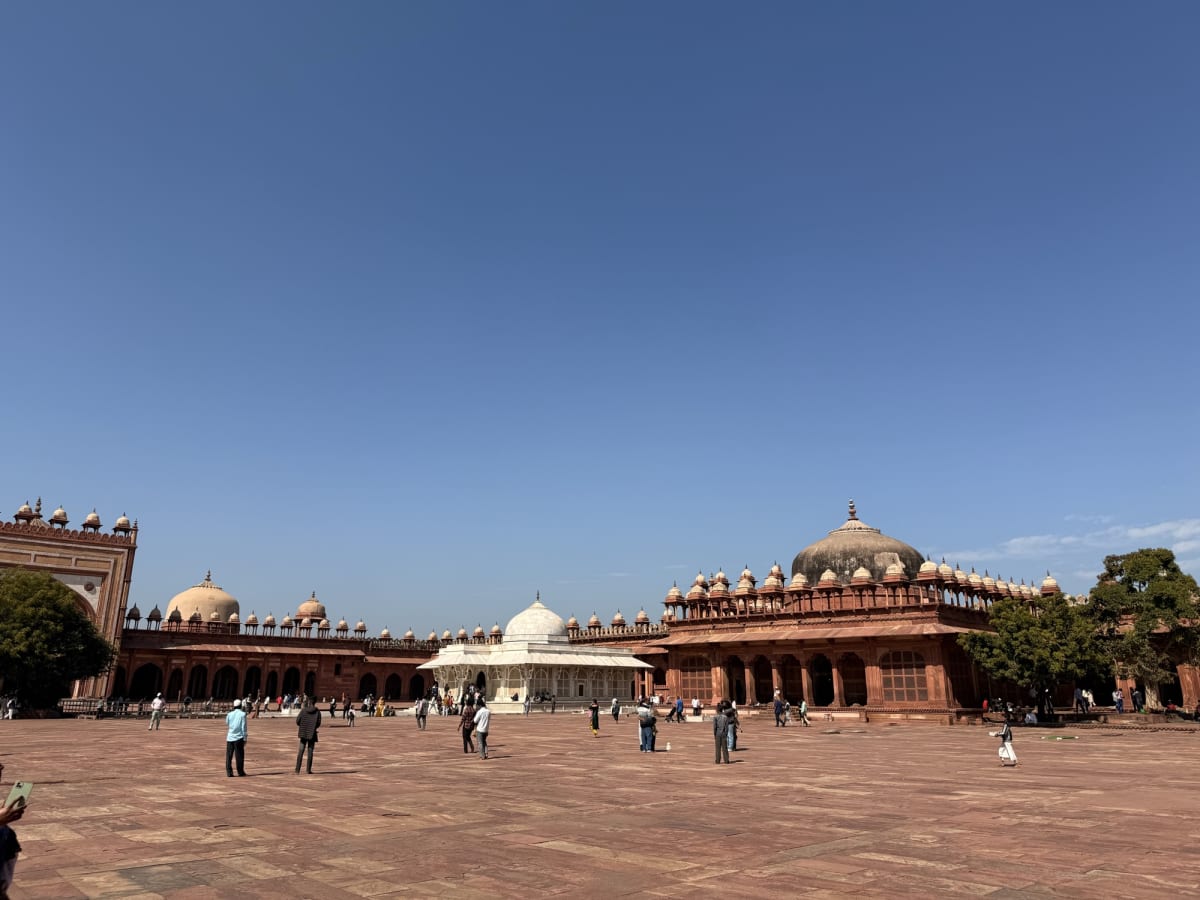
I looked around Jama Masjid a little longer barefoot, then came straight out, worried about my shoes.
The moment I was out, as if he had been waiting, someone brought me my shoes, having somehow remembered me.
And he whined for money, so once I had my shoes back I looked at him with an expression that said no money, get lost.
I fired the look hard enough that I wondered afterwards whether I should have, and I left the sulking kid behind and came into the shade.
I want to understand the position of kids trying to earn money somehow, but I also want to understand my own position as a tourist worn down by kids who whine too much.
And I wiped the soles of my feet with a wet wipe and put my shoes on.
There was still more than an hour until the bus to Jaipur, so I was in no hurry.
I came out slowly and stopped at the toilet, where this time someone demanded money.
I did not pay and simply left.
Earlier I had walked about ten minutes to the entrance, but plenty of shuttles had passed me, and on the way down the tourists had taken all the shuttles.
I asked a kind Indian man where the shuttle went and how much it cost.
He seemed to work here, spoke good English and explained it kindly.
Probably a guide.
And he showed me the way back to the entrance too, so I went back there.
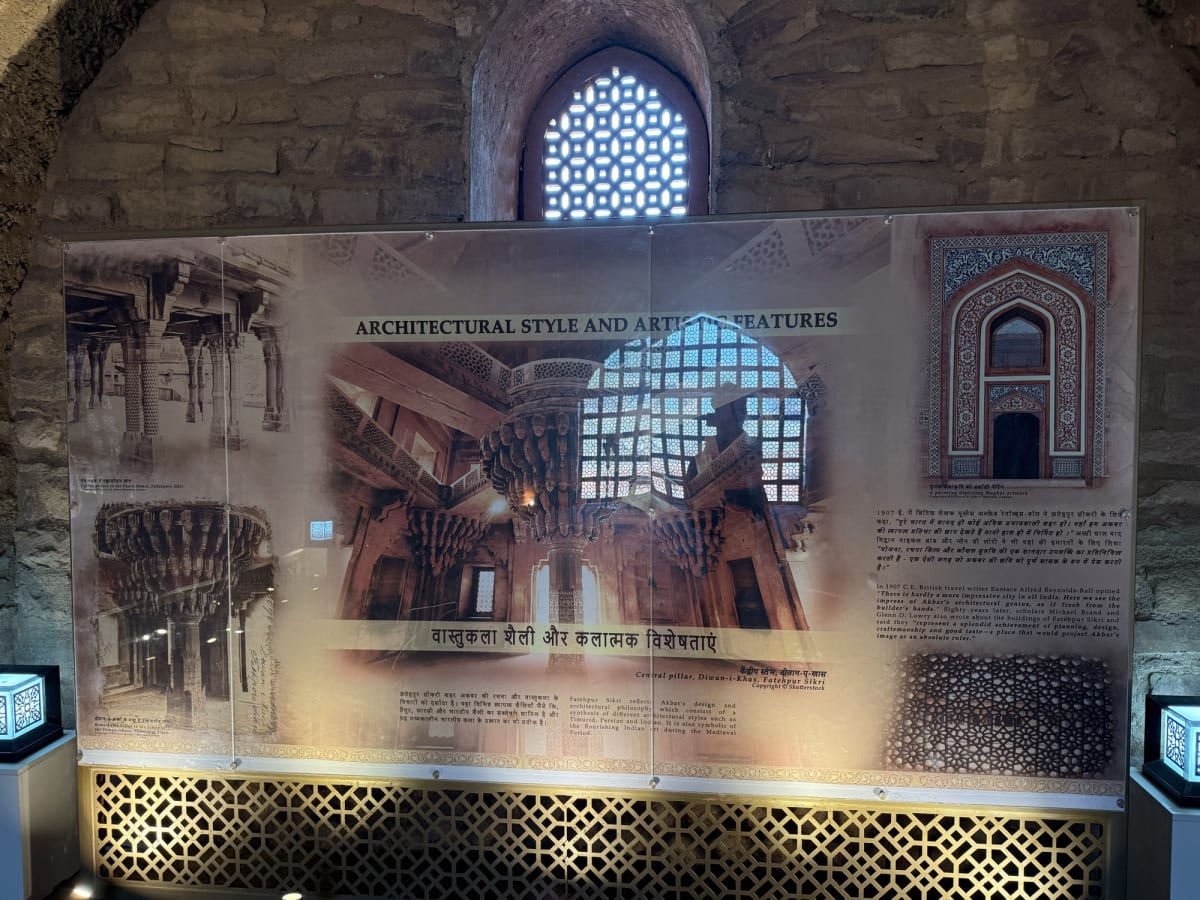
And I looked around the museums of uncertain nature I had seen at the entrance earlier.
The Museums You Should Not Miss

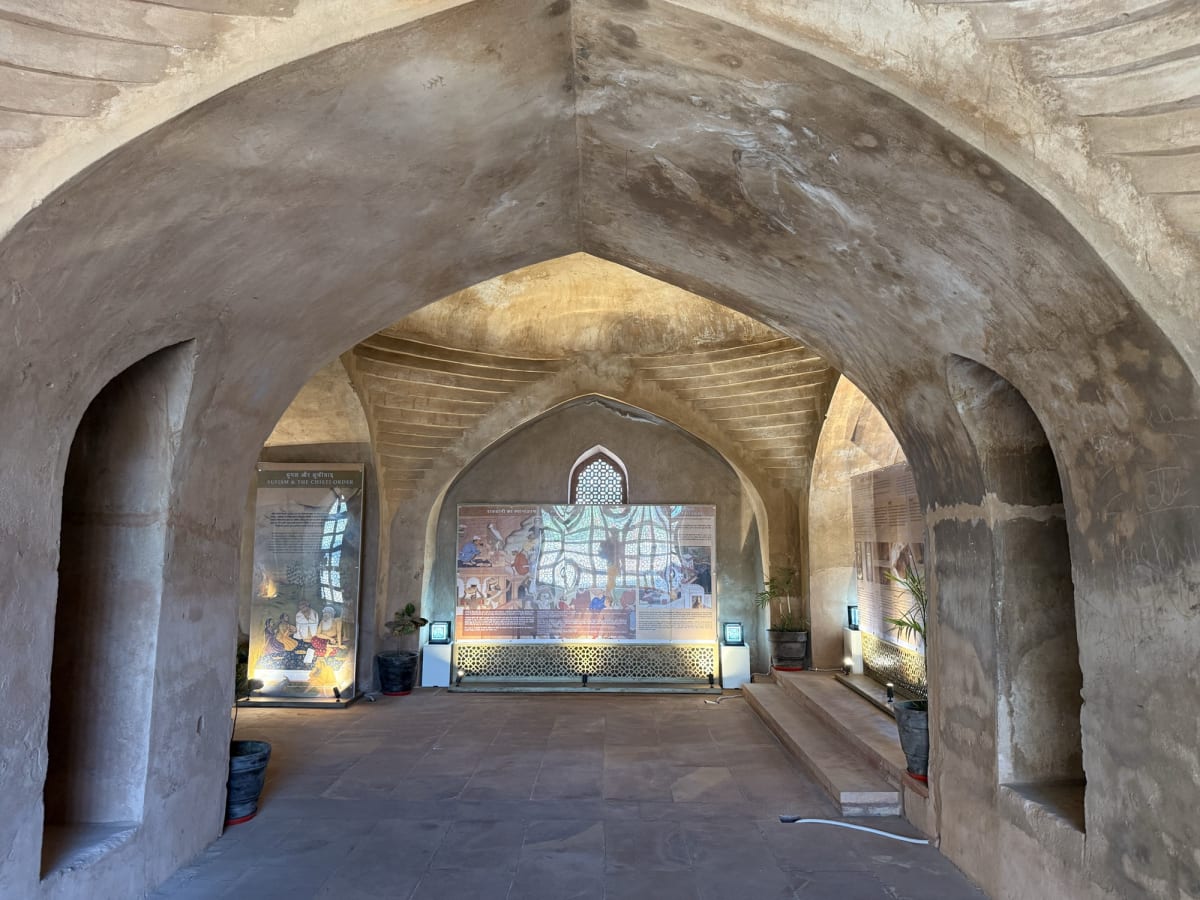
These museums were places you absolutely should look around, too good to miss.
But there is no large sign of any kind, so it is easy to miss them.
I imagine a great many tourists never look around these museums.


I had a great deal of time left, so I walked back down the same way I had come.
Walking down alone I was afraid of running into fierce monkeys, but I am the better fighter, so I went anyway.
The Kids and the Monkeys

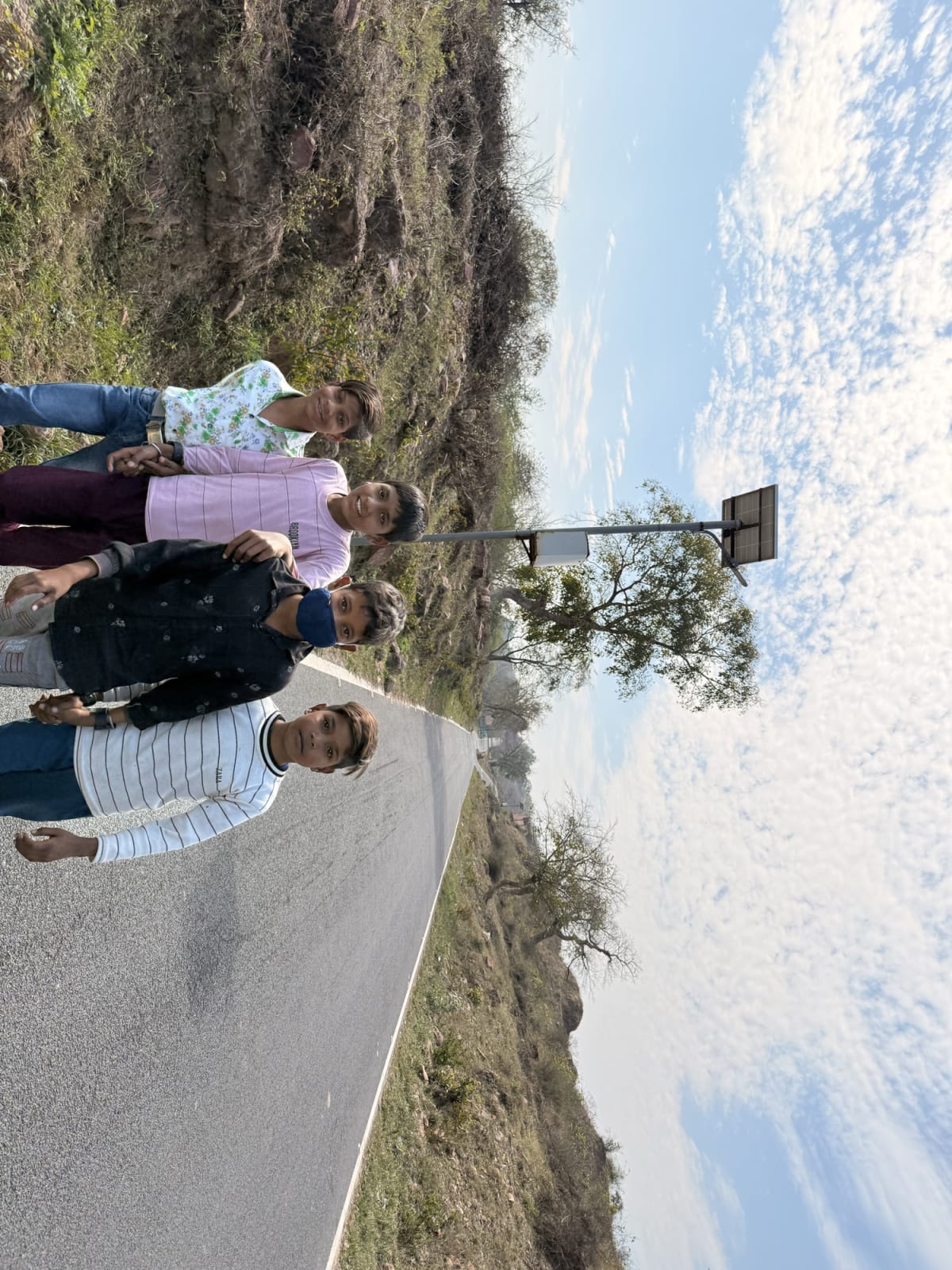
A little way on some small kids passed by and said hello, so I went along high-fiving them one after another in a row.
A bit further on, sure enough, four small kids came running up shouting brother, brother!
They came running.
They held out their hands saying ten rupees, so I held my hand out too and joked that they should give me ten rupees.
They have only learned the bad things; in themselves they are innocent.
I threw myself backwards like something out of the Matrix to take a photo, and caught the kids stepping back in surprise.
One of them went on ahead and picked a fight with a monkey and ran, which looked very dangerous.
And I was so afraid of the monkeys that I crossed straight over and walked on the other side.
I expected a monkey to leap onto a person and bite, quick as anything, but whether it was old or tired it only made threats.
Perhaps it had learned from being beaten soundly after going for a person.
Three Hours of Waiting


By 1:50 I was back where we had got off the bus.
I had to wait at least another hour, my battery was borderline and there was nothing to do, so I was bored.
Horns sounded constantly and the exhaust was so bad that my nose itched inside and scratching it brought out grime.
The exhaust was bad enough that breathing was painful.
I was sitting on a low wall, and behind it was so full of rubbish and filth that flies circling constantly made it miserable.
The drawback of the iPhone is that you cannot charge and use earphones at once.
So I just pulled the earphones out and charged it.
At first I put on Indian music, and when I could not hear it even at full volume I put on rock as loud as it would go.
I had my doubts, but it did come at three in the end.
If I had been off in my own world I would absolutely have missed it.
I had very nearly given up.
With them never keeping to a time and the place changing this way and that, I had even thought about booking an Uber and going back to Agra.
The data was completely out too, which had me in a panic, and I had decided that if the bus did not come I would simply go back.
To Jaipur
Getting on the bus I felt enormously at ease.
The destinations left were Jaipur and Agra.
Two-thirds of the way through the trip, I thought of India as a country that is far too hard to travel and at the same time one with too many treasures to skip.

I listened to music comfortably and slept a while, and we reached a rest stop.
We stopped at a plain, empty rest stop where I could not even tell where the toilet was.
Back on the bus I kept my wits about me so as to get off in the right place.
I kept looking at my phone, and this useless company Maaltalk's eSIM gives no data at all.
I wanted to swear at everything.
I filed enquiries with Maaltalk and got nothing but nonsense answers, which infuriated me.
I swore never to use that useless company again.

Only after the sun had gone down and it was dark did we reach Jaipur.
I got off earlier than where I had meant to, because that was better for reaching the restaurant I wanted.
Thali and More


After walking about twenty minutes I arrived in front of a restaurant called Tali&More.
It was on the second floor, and going up there were a lot of people waiting.
It was nearly nine at night, and I wondered whether this many people really eat dinner at this hour.
It was busy so I waited about fifteen minutes before being shown in.
I went in and sat down, and a man who looked to be in his fifties, from a family that came in behind me, sat down opposite me and kept staring at me.
I wondered what on earth the situation was.
He quite literally sat at my table, not his family's, directly opposite me, and kept staring.
I was thinking, enough now, move along.
The family sitting beside us were a mother, a father and two young men, and though he seemed to be their uncle they were paying no attention.
I called a server over and said what is going on here.
This man was either unwell in some way, or the rudest of all the people who had stared at me so far.
The server apologised to me on his behalf and moved the man to the family's table.
The Premium Thali
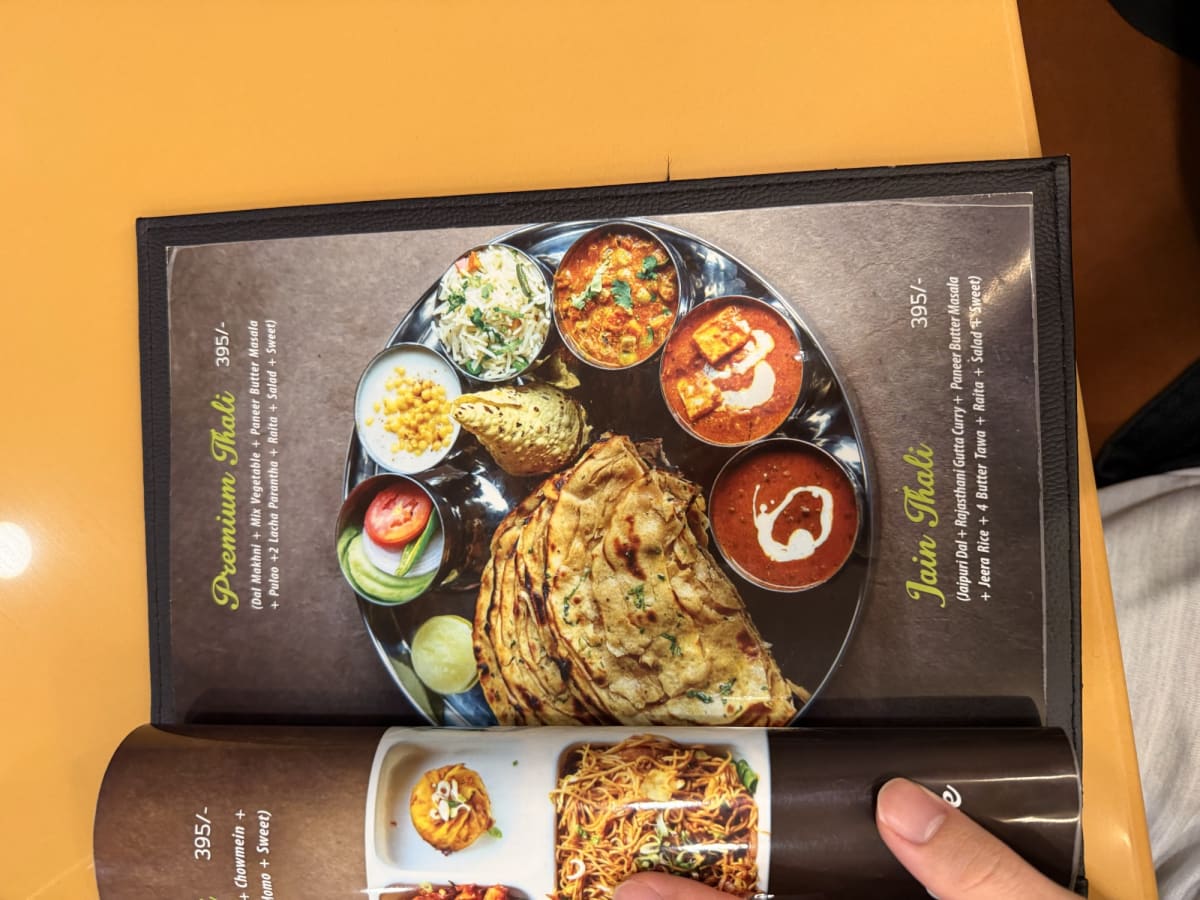

Not knowing what to order I just ordered the premium thali, which looked the best of them, and being very thirsty I ordered a cranberry mojito too.
I was served the thali, India's set meal, and from the look of it coming out like a school lunch tray it did resemble a set meal.
It seemed you dip the naan-like thing in the middle into the various sauces.
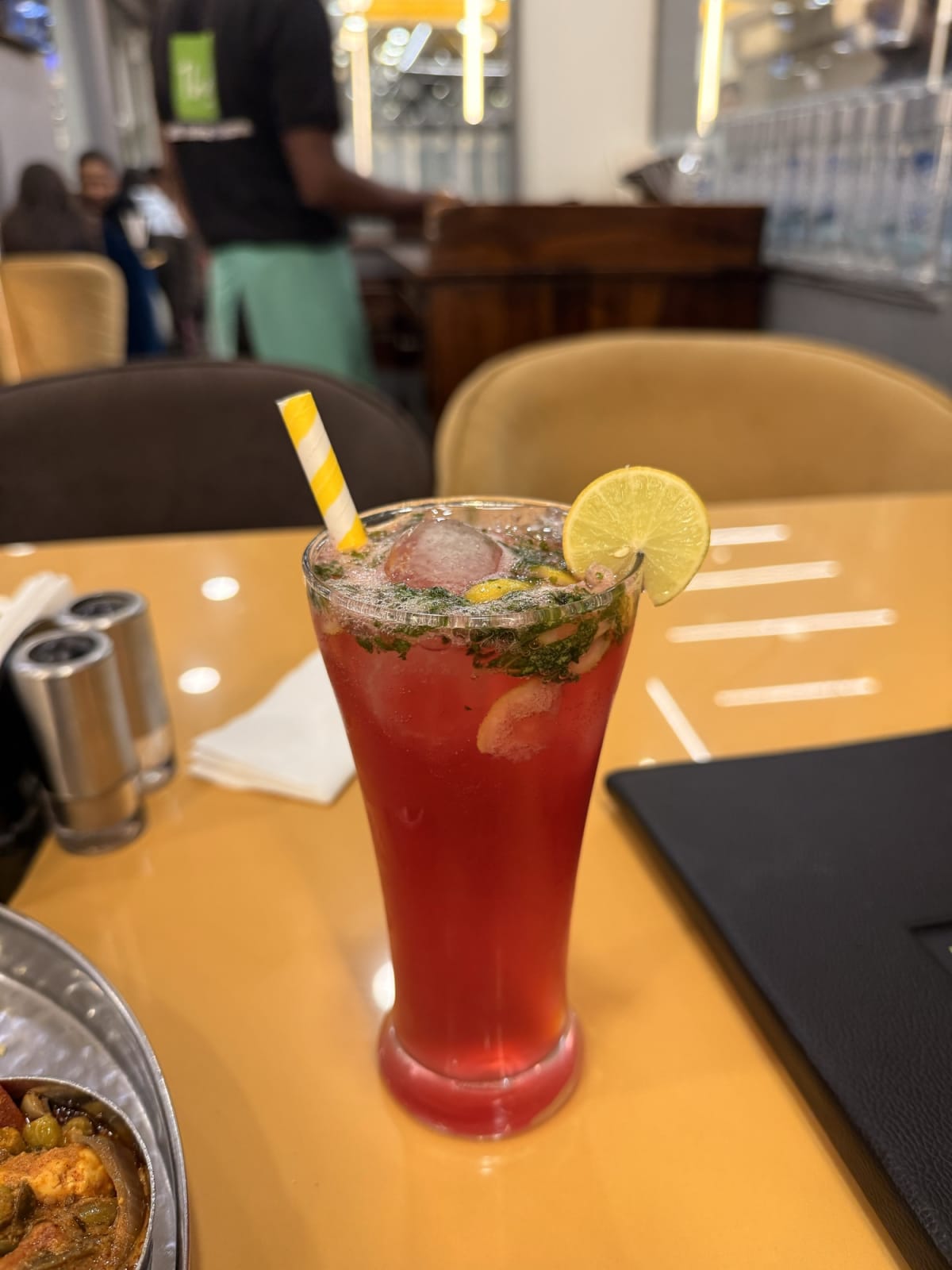

The cranberry mojito was really cold and good.
With the thali, the sauces divided opinion.
The orange one tasted of butter chicken curry but spicier, with a particular spice coming through more strongly.
Most of the sauces were no good, and this one was the best of them.
The white one just tasted of sour cream, and the brown one had a musty doenjang-like smell I strongly disliked.
The sauce with bell pepper in it was spicy and the best of them, so I just dipped everything in that.
The bread had a dry texture rather than the chewiness of naan.
Seeing that I had left everything except the bell pepper sauce and the bread, the servers laughed and exchanged words among themselves, as if they had entirely predicted it would not suit me.
It was not something to take offence at.
Because the servers were so kind and gentle.
In the end I spent the money all the same, but the thali was not to my taste.
Still, I was not hungry.
The Guesthouse

The walk to the guesthouse took about twenty minutes too.
I walked alone past ten at night through dim, unpleasant alleys that felt somehow dangerous.
You have to be careful, but it did not seem like a place where anything serious would happen.

Arriving in front of the guesthouse I saw a large building on two levels.
The door was locked, so I rang the bell and waited before going in.
I had already exchanged messages with the owner on Booking.com.
Wondering where the counter was, I kept climbing and ended up on the roof.
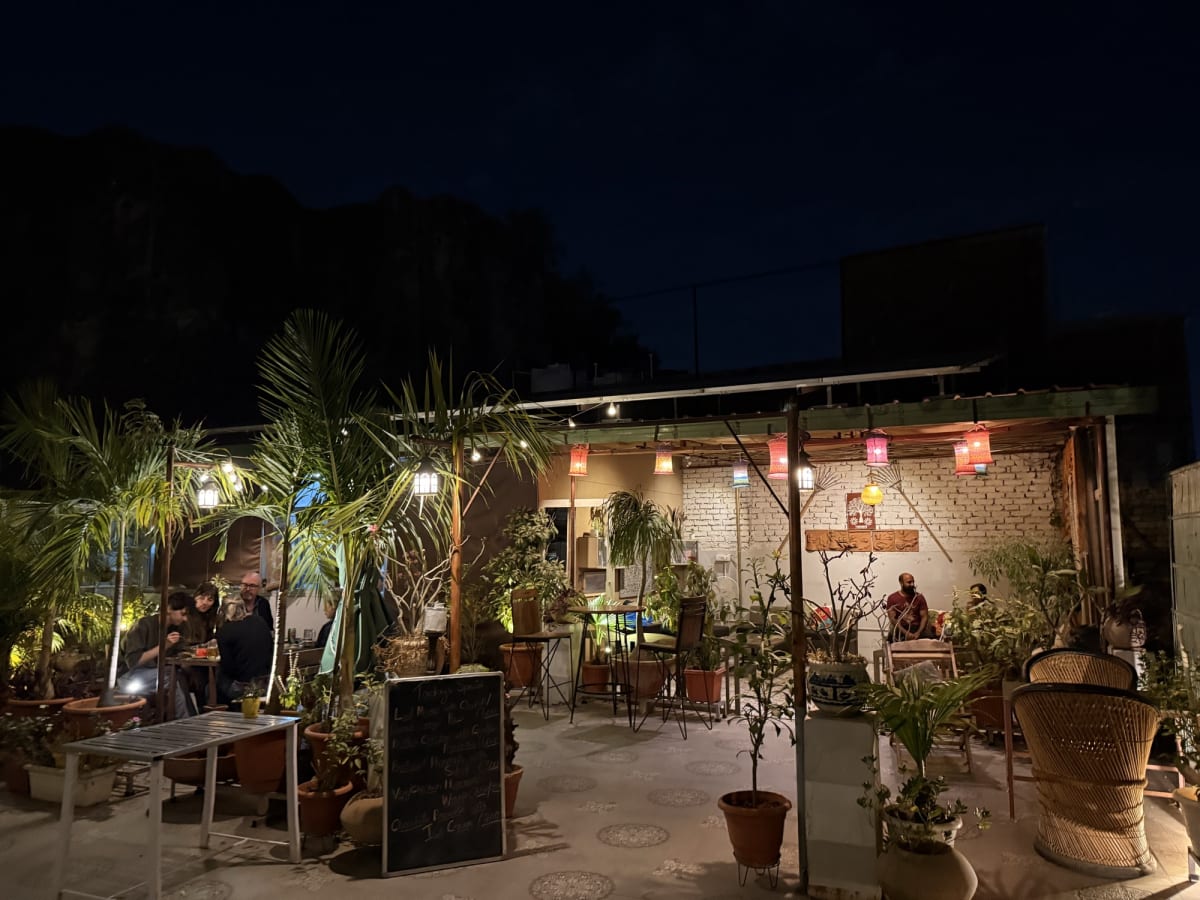
The rooftop was a space for ordering something to eat and drink, or just for chatting.
The owner, bald and bearded and looking like a monk, who had been chatting away happily with a woman in the corner, spotted me.
And as if he had been waiting for me he took me down a floor and showed me my room.
He said it was late, so I should rest well and we could settle up tomorrow.

The moment I opened the door, an antique interior of marble that called the Taj Mahal to mind greeted me.
It was the guesthouse whose interior I liked best of any I had stayed in.
I unpacked and, tired as I was, did laundry for about an hour and dried it hard with the hairdryer before sleeping.
A good guesthouse, a shame to stay only one night.
The drawback was that the towels were full of lint, so drying myself left lint stuck all over my hair and body.
Given how immaculately tidy everything was, it seemed only the towel washing had gone wrong.
I was too tired to ask for another towel, so I just dried myself roughly and slept.
A Traveller's Arithmetic
This thought came to me.
Will the day ever come when I think I should have paid more and not been stingy while travelling?
Because I think my parents would simply have been glad to spend a little more.
If I become comfortable, will I spend money comfortably?
I do not think so.
Where it is not honest labour or service that matches what I expect, but people who nag and pester, I do not think I would spend more, not out of resentment but simply because it does not meet my standard.
On the System
What the guides and the touts in every line of work say is probably a repertoire built up from data picked up around them and from what they have experienced themselves.
That means they are already following a system of a kind, but a system that does not follow what is right, only what has adapted to making a living.
In a way it may be only natural to live like that.
But at some point the government or the departments in a position to manage it have to step in and build a proper system.
Because there is a great deal that makes tourists uncomfortable.
If living off tourists rather than for them is right, then they can carry on as they are.
But would it not be better to live by helping one another in a proper win-win?
Given that the perception of travel in India is poor even just in Korea, at this rate the number of tourists may well fall further.