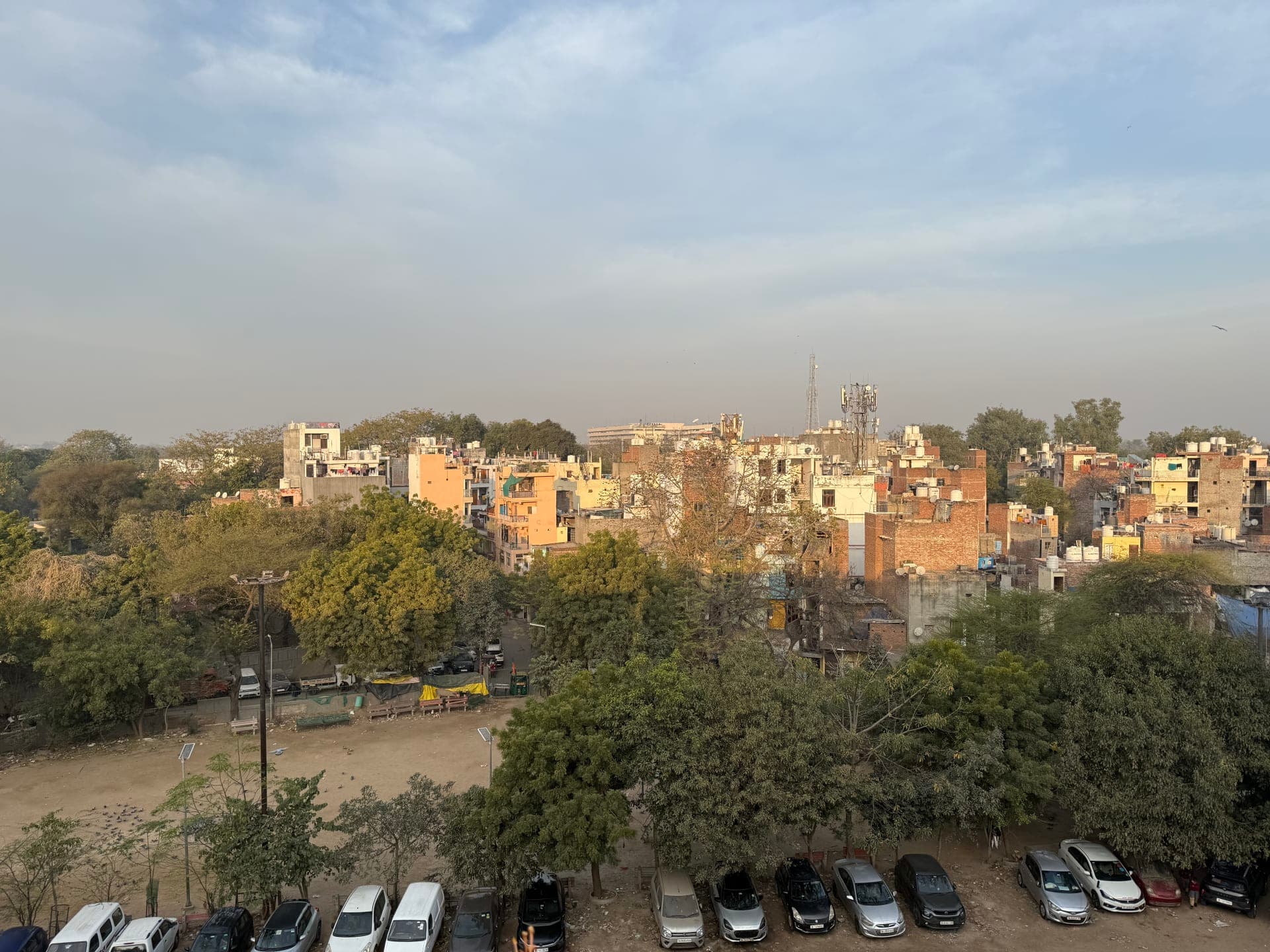
India 2-1 · The Deer Park
The Route, in Short
The itinerary for this trip runs like this.
New Delhi -> Sarnath -> Varanasi -> Agra -> Jaipur -> New Delhi
Today is the day I move to Sarnath.
In planning this trip I leaned heavily on the UNESCO heritage list.
But a month would not be enough to visit every place on it.
In the end I had to choose, and simplify.
Going everywhere was beyond me in both time and money.
So: pull out the places I absolutely had to see, then prune.
Doing that produced a route centred on North India of its own accord.
India is so vast that getting anywhere eats a lot of time.
The time I had was far too short to travel the north and then carry on down to the centre or the south.
So I decided to see the north only, and that seems enough to see what is essential about India.
Going further would be greed, and I judged my body would not keep up.
These are the reasons I picked each city.
New Delhi: the capital, holding India’s modern history, where heritage like the Qutub Minar and Humayun’s Tomb sits side by side
Sarnath: where the Buddha actually first taught, one of the four great Buddhist sites
Varanasi: the Hindu holy city where you can see the Ganges
Agra: capital during the Mughal period, home of India’s landmark, the Taj Mahal
Jaipur: the city called the ‘Pink City’, capital of Rajasthan, holding Amber Fort
Morning
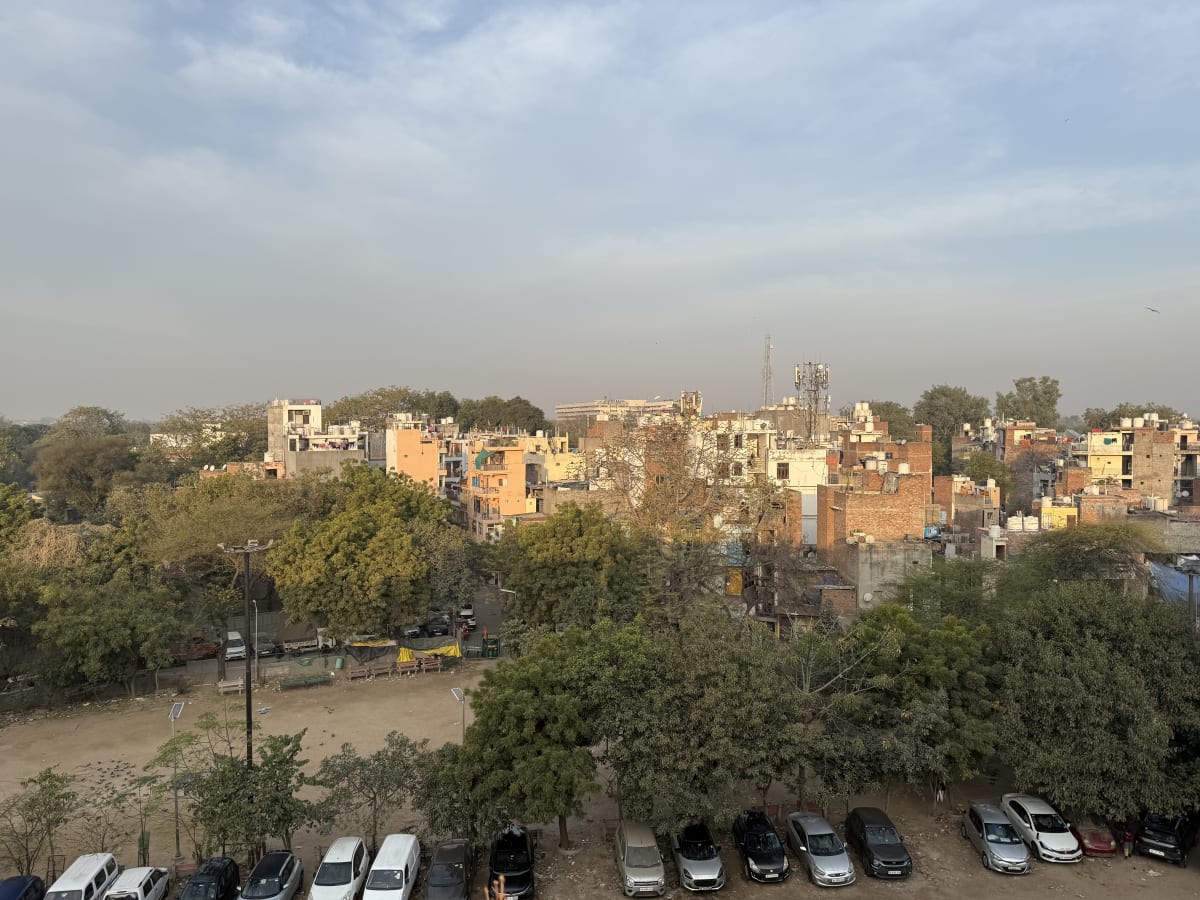
I got up at 6:50 today.
One of the hardest things about travelling is getting up early.
At the moment of waking it feels like commuting to work on a holiday.
By the time I had showered and got ready to go out it was already half past seven.
Looking down from the rooftop the neighbourhood was still steeped in smog, but there was still a little of that freshness particular to morning.
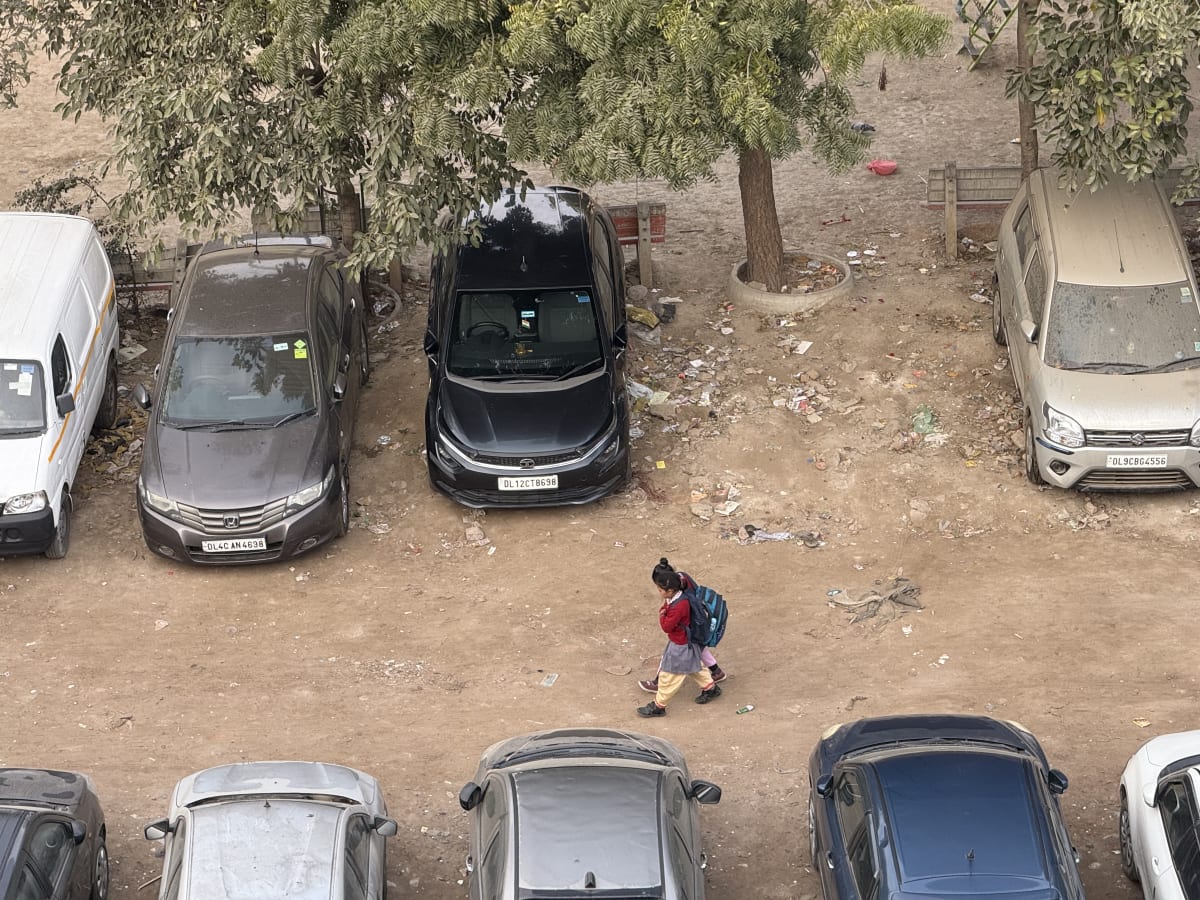
From the rooftop I could see small children heading to school.
Trudging off to school from primary age seems to be much the same everywhere in the world.
Stepping out of the hostel I saw more children on their way to school, and the innocence coming off them was endearing and warm.
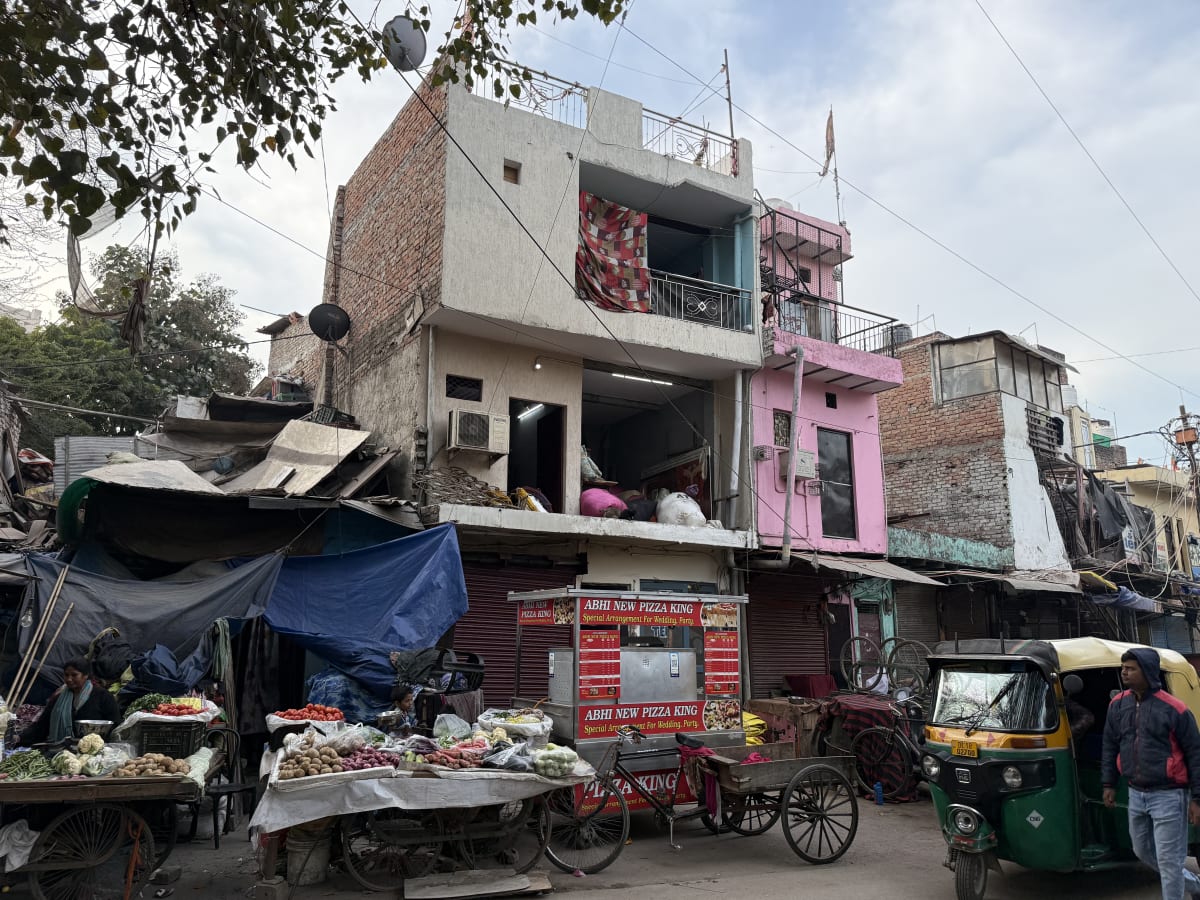
While waiting for the Uber I took photos of the neighbourhood.
Houses with no walls or no windows made an impression.
At first I wondered whether they had been left unfinished.
But that is not necessarily it — many of the buildings seem to have been deliberately built that way from the start.
The Uber arrived three minutes after I called it.
To find out just how much the horns go off on the way, I shot a ten-second video.
I had assumed once a second, but with them going off in several places at once it felt like four or five times a second.
To Varanasi
After about thirty minutes we reached New Delhi airport at half past eight.
When I went to pay I still could not register a card in the app, so again I had to pay cash.
I had two 20-rupee notes and four 100s, and the fare was 313 rupees. In the end I had no choice but to pay 320.
I watched to see whether the driver would give me change, but again he hedged, pretended he had none in his wallet, and just kept pouring out Hindi.
I knew 7 rupees is next to nothing in Korean money, and grudging the time more, I let it go as a tip.
I need to register the Travel Wallet card on Uber, but Uber keeps blocking it.
The airport staff were all in military uniform.
From the baggage check to the gate took less than twenty minutes.
I went looking for drinking water first and bought water and a coffee at Costa Coffee.
In India even the water you buy needs care.
There is a chance unclean water was used.
Having to pick out only safe water to drink is quite tiring.
The day before I forgot to buy water and went to sleep without a single mouthful.
I also could not take the malaria tablets I had prepared, for want of water; at last I could.
I took the chance to use the toilet somewhere clean, too.
Indian toilets were unexpectedly quite clean.
The cleaners kept watching for people to leave and came in to wipe roughly once a minute.
It made me wonder why they clean this hard.
It may be because an airport is a special sort of facility.
At the very least, I decided you should always use the toilet at the airport.
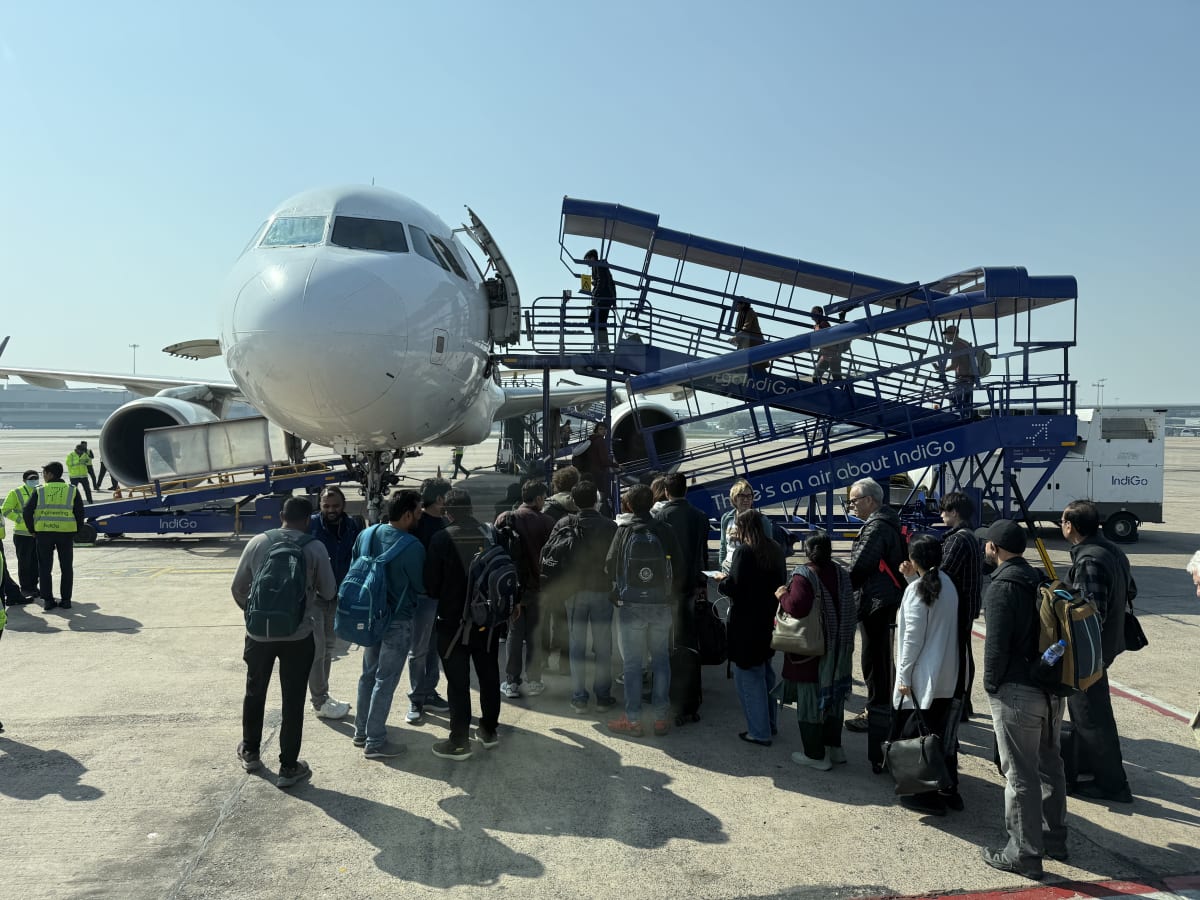
We had to take a bus out to the plane.
Getting off the bus, a young Indian man asked where I was from and said “Nice to meet you.”
India also has plenty of cheerful, easy-going people like this.
I saw almost no Koreans; the East Asians I had seen so far were mostly Japanese.
On my plane there was a slight Japanese man who seemed to be travelling alone, and two groups of Japanese women travelling with friends.
Varanasi airport was supposed to be about an hour away.
The schedule was to take off at eleven and land at twelve, but we left at twelve, so we landed an hour late too.
The shampoo had burst inside the small bag holding my shower things.
I wrapped the bag in the zip-lock sick bag from the seat pocket and put it in the big bag, but it felt like a time bomb that could leak at any moment.
That day I had a sleeping bus to catch, so there was no showering and no laundry on the schedule, and if the whole bag got soaked in shampoo I would be, literally, screwed.
What worried me most that day was whether I would manage to catch the bus I had booked through 12Go.
I had read a lot of reviews saying buses booked through this platform are vague about where you board, that the location changes often, that they are hard to reach, and that delays are frequent.
It was close to a savaging, but there was no alternative, so I had to book there.
The moment I landed in Varanasi and got off the plane I took off the long sleeves and changed the long trousers for shorts.
I wiped down the burst wash bag and separated the leaked items into the zip-lock bag I had taken from the cabin.
I got an Uber as soon as I stepped out of the airport around one.
But then the driver asked me for 50 rupees, saying it was for airport parking.
He kept trying to push it onto me, saying he had no money, but I held out that I had no cash. And in fact I had no 50-rupee note.
I was due to pay 650 for the Uber fare anyway, and I knew this man was not going to give up 650 rupees over 50.
In the end he settled it himself with the man collecting the parking fee and we drove out.
The two of them have probably run this arrangement on tourists dozens of times.
The Begging Boy
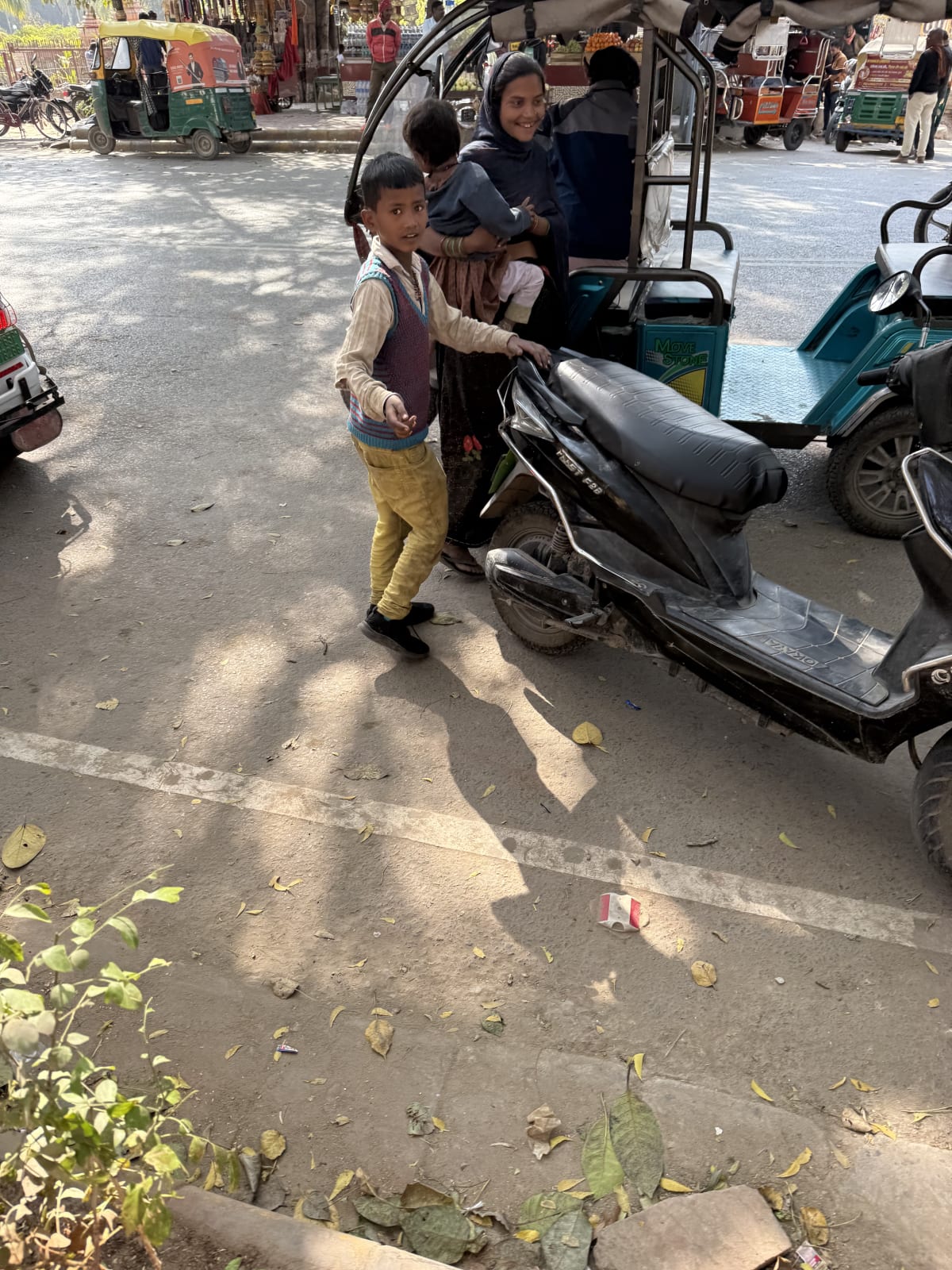
From the moment the taxi was stopped, a bright-eyed boy of about seven had been watching me pitifully.
When I got out of the car he tapped at my arm, put out his hand and started begging straight away.
He would put on a sad face and then break into a bright smile, and he kept following along beside me.
The ticket had to be paid by QR code, and the internet barely worked.
I got as far as the payment screen somehow, but in the end it failed.
Online was about 270 rupees; buying with cash on the spot was 300.
I could not be bothered, so I just paid 300 and bought it there.
Only when I stepped through the entrance to the site did the boy fall away.
The boy who would not come off even when I met his eyes and laughed and played along gave up in the end, once he could not follow me inside.
He had stuck to me for roughly ten or fifteen minutes.
If you hand money to a begging child easily, that child may go on living off begging.
I thought that a structure where you make your living off tourists’ pity cannot be a good way for anyone, however young.
What is not on is not on.
Into the Deer Park
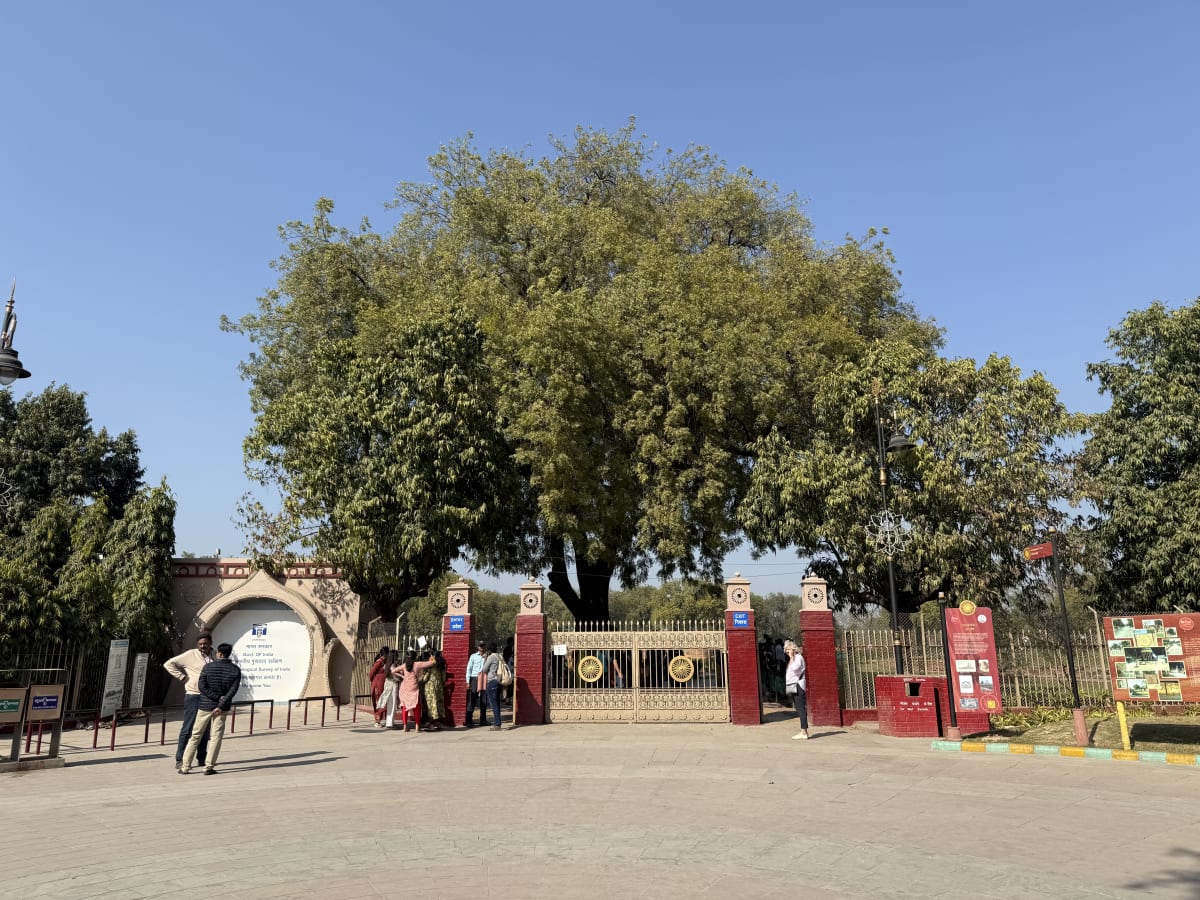
The moment I entered the ruins a man attached himself to me, asking whether I needed a guide.
I declined politely — no thank you.
At which he said “No problem” and withdrew courteously.
There are guides as polite as that.
The Ashoka Pillar
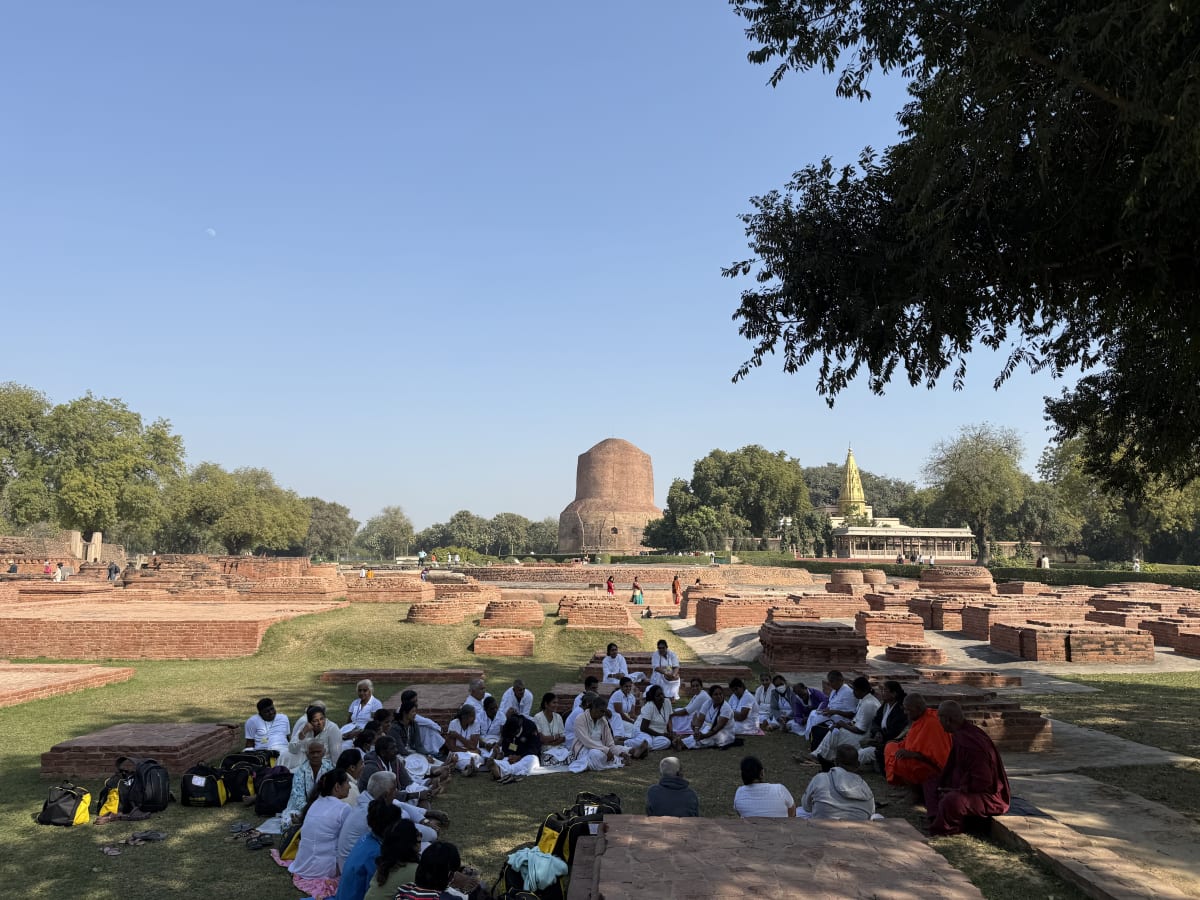
A little further in, two monks sat under a large tree, and several Indians in what looked like white priestly robes were receiving teaching in front of them.
Further in still I saw middle-aged travellers carrying a Korean flag.
That was the first time I had seen Korean travellers here.
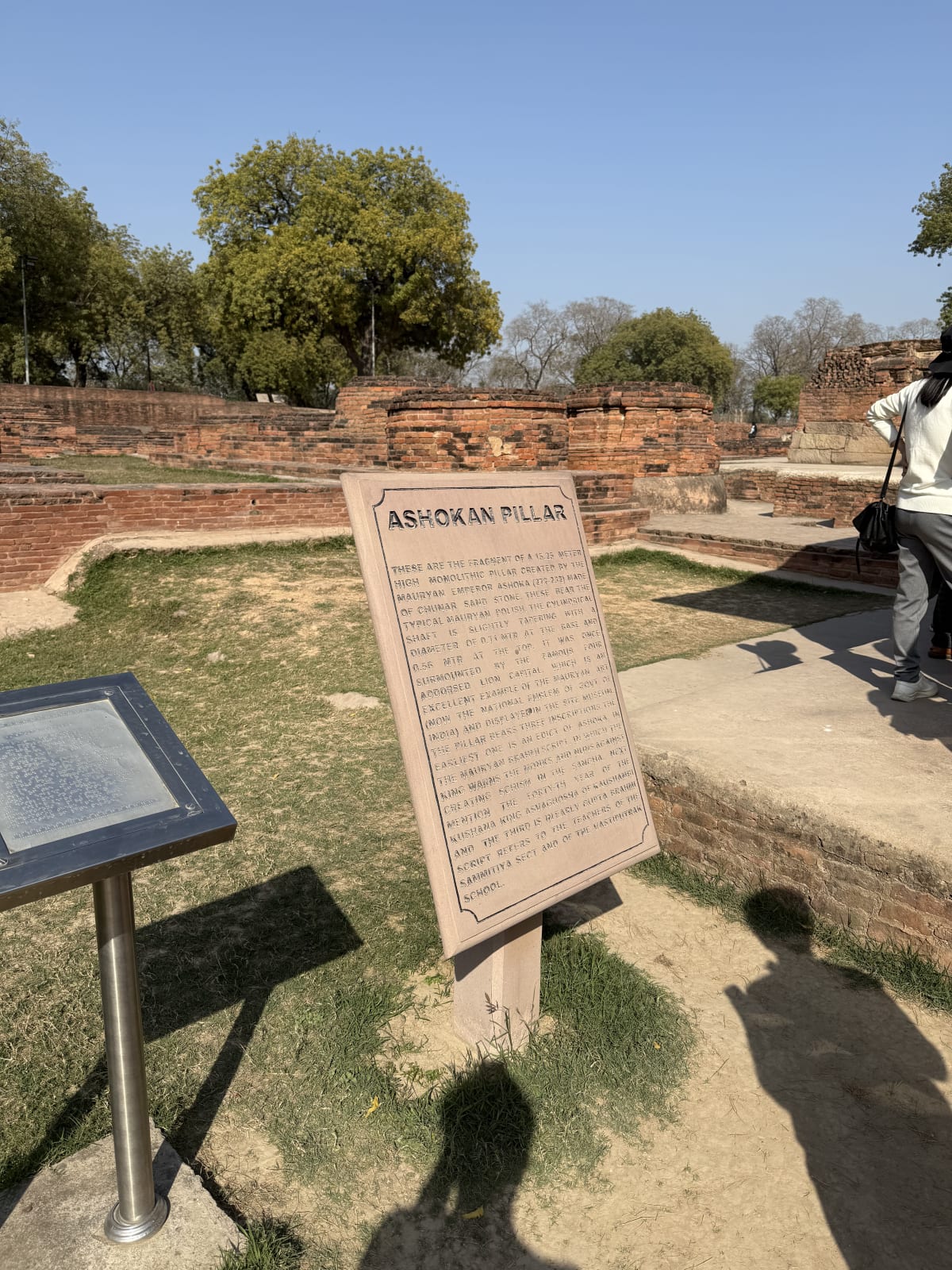
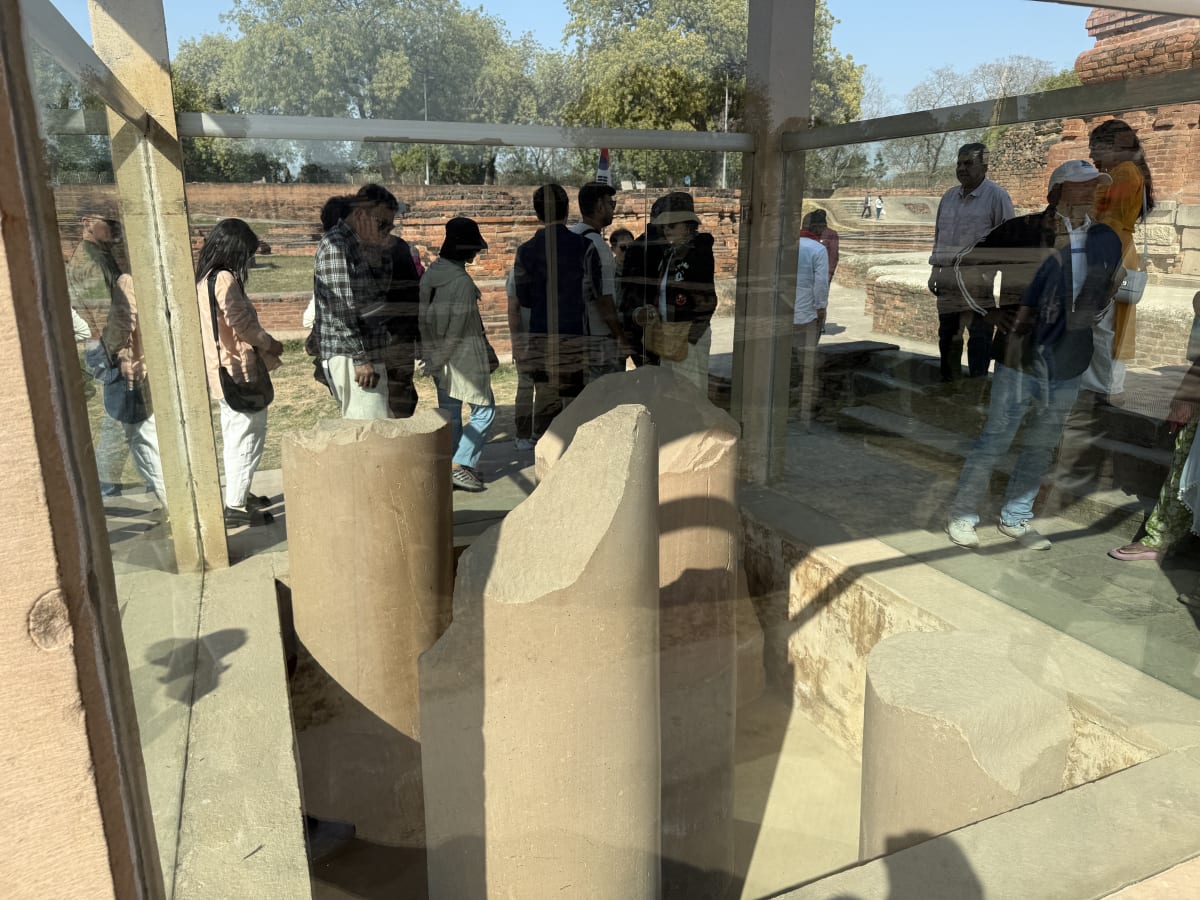
What you are looking at is the Ashoka pillar.
It is a pillar raised in the third century BC by Ashoka the Great.
More than thirty or so were raised across India, for the purpose of spreading Buddhism and proclaiming the ideology of his rule.
The Sarnath pillar matters especially, because this is where the Buddha gave his first sermon.
Originally the top of the pillar carried a sculpture of four lions — the Lion Capital of Sarnath.
That lion capital is now used as India’s state emblem.
Let me lay out a little more about the Maurya Empire and Ashoka the Great here.
The Maurya Empire was founded around 322 BC by Chandragupta Maurya.
At its founding, the Nanda Empire held the east of North India as the dominant power.
And in the west, the Macedonian army of the famous Alexander III — Alexander the Great — was on campaign.
After the long campaign Alexander turned back, and Chandragupta destroyed the Nanda Empire and unified India.
It was the first empire in Indian history to unify India — think of it as India’s equivalent of Qin, the first to unify China.
And within that Maurya Empire, the king who ruled at its height was Ashoka the Great.
Ashoka was Chandragupta’s grandson and the third king of the Maurya Empire.
He was famous for cruelty.
There is an account that in the fight over succession he killed 99 half-brothers, sparing only his full brother, and killed all the officials and court women who had followed them.
And that he killed hundreds even among those who had helped him to the throne, in the name of testing their loyalty.
Once, they say, he had a woman given 500 lashes for picking flowers from a tree he was fond of.
He also built a torture palace known as ‘Ashoka’s Hell’, where he had prisoners tortured.
What changed Ashoka was the invasion of the kingdom of Kalinga, in the eighth year of his reign.
In that war, they say, 100,000 died and 150,000 were taken prisoner.
After the fighting, the accounts say the blood came up to the ankles, and that children were orphaned or driven mad.
Only then was he shaken, and out of guilt he converted to Buddhism.
Repented awfully quickly, that one. Might have thought of it earlier…
In any case, what he did after converting to Buddhism was positive.
He stopped the wars, funded public works, and built hospitals, orphanages and homes for the old so that people would be treated and cared for.
And he brought in animal protection policies, limits on the killing of animals, even medical care for animals.
He raised stupas and sent monks into neighbouring countries to spread the teaching.
He was tolerant not only of Buddhism but of other religions too.
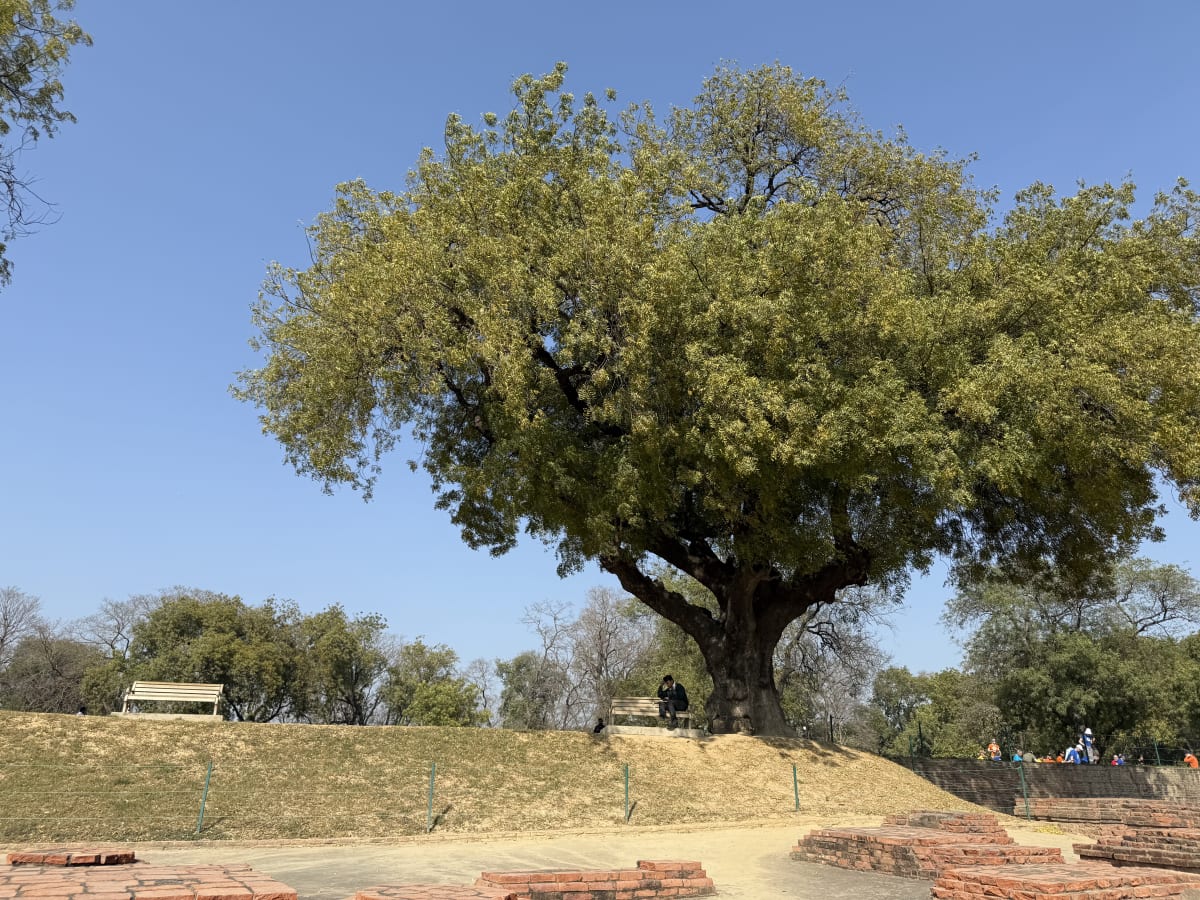
Perhaps because the place has such deep history, the trees too were huge and dense, as though they had aged along with it.
The Dhamek Stupa
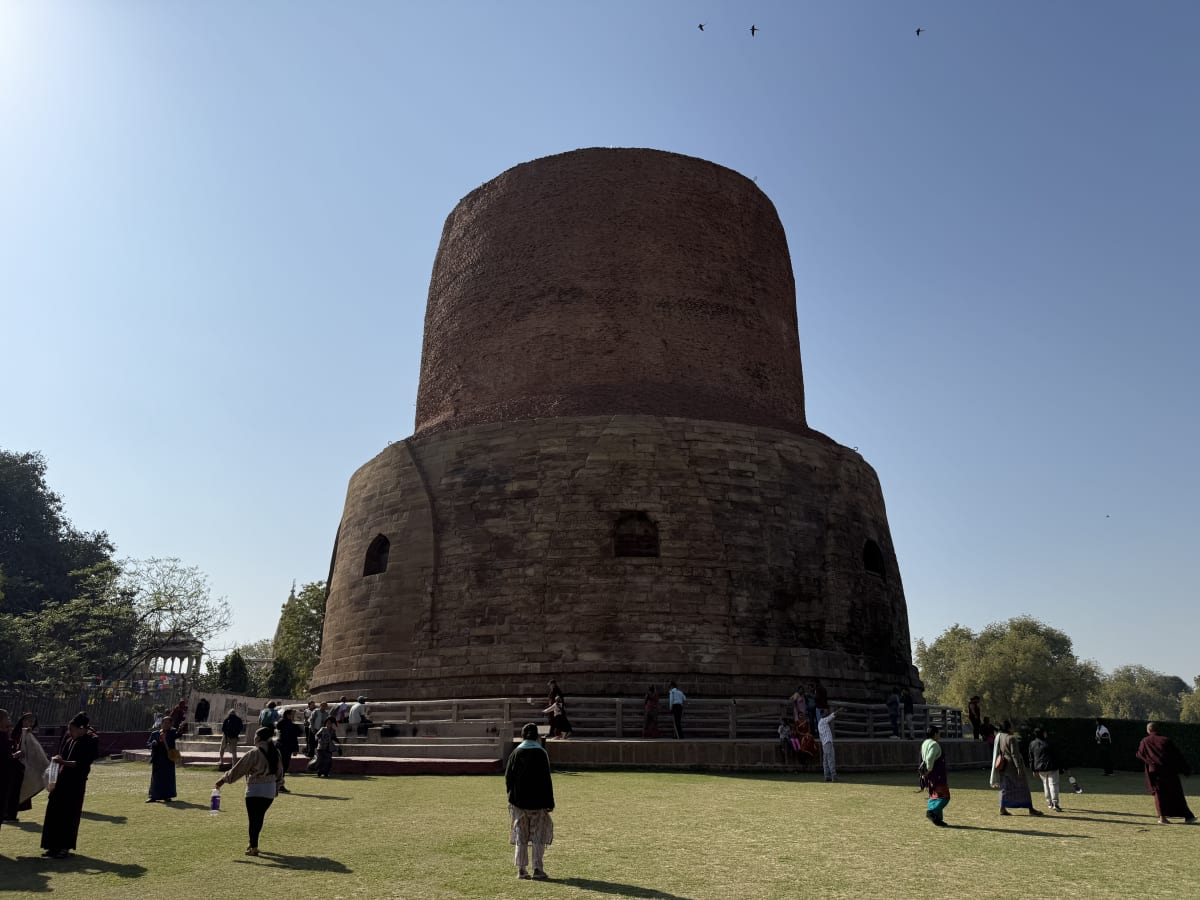
The site is so old that much of it has collapsed into bare foundations, so at first glance it does feel a little empty.
In the end the highlight here was the Dhamek Stupa.
It was far bigger than I expected, and facing it in person it was genuinely imposing.
Up close it was certainly worth seeing, with a heavy presence to it.
Shade fell behind it, and a fair number of people had gathered there to rest or to look.
Only, given that this is the actual place where the Buddha is said to have taught, the kind of sanctity or atmosphere I had expected felt somewhat lacking.
That does not mean I was disappointed.
I had not come expecting to feel that in the first place, and setting that standard aside it was a perfectly good place.
Yoga Experience? Meditation Experience?
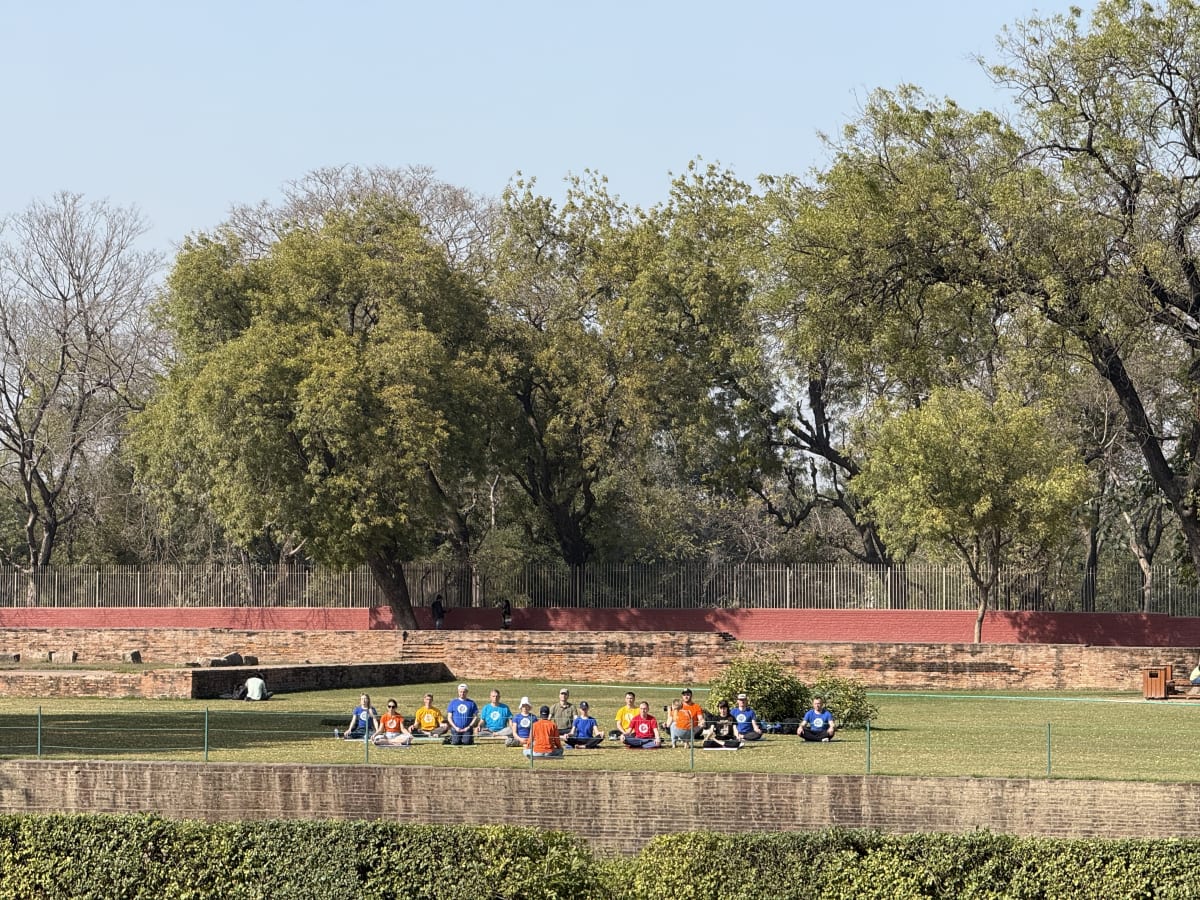
Off to one side, foreigners in clothes of various colours were gathered learning to meditate, and people meditating quietly alone stood out too.
But with smog thick on every side, honestly, the romantic atmosphere I had expected did not amount to much.
They are probably travellers staying in Varanasi for a few days and taking in programmes like this as well.
Coming all this way and trying something like that seemed no bad thing.
It would certainly make for a memorable, particular experience.
On another note, there was something I felt while looking around here.
With a site this important to the world in its hands, I found myself thinking that India is not making enough of its value, for want of upkeep.
Even romance, in the end, only holds up when present-day upkeep and preservation are behind it.
Among the sites that will stand in human history, like Babylon or Assyria, there are those that have been destroyed and lost to extremist armed groups.
And even if you took the risk and went to those places, I doubt you could feel the emotion and the atmosphere people had imagined.
Going to the actual place is plainly different from learning it from a book or the internet.
Feeling the breath of the past, and seeing with your own eyes what has changed and how as time has passed, stays with you a long time.
Which is why it is all the more of a shame to watch such places lose their appeal to neglect or to practical problems.
All the more so for someone who likes history and likes travel he can experience directly.
A Pity, But...
The boy who begged earlier was mild by comparison.
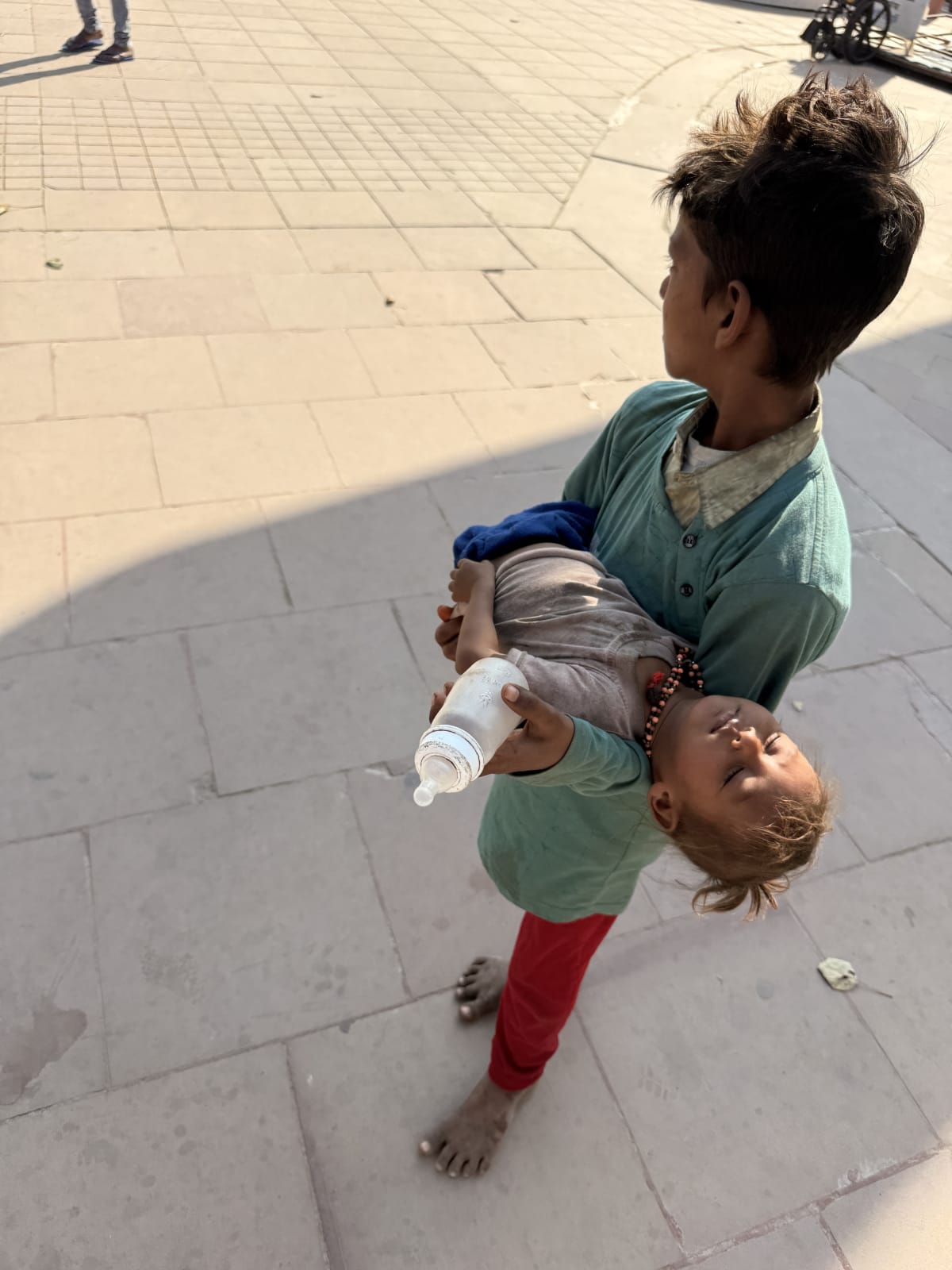
The one who came begging this time was holding a small child, and I could not tell whether it was asleep or dead. It gave me a shock.
The moment I saw the child in his arms my skin went cold all over.
It is a harsh way to put it, but the child really did look dead.
I put a hand to its nose, and it was not so.
It shook me badly.
In fact, before coming to India I had read about begging children and looked things up.
Many children do not go to school at all and live by begging.
Because that earns more money right now.
There are real cases of families pushing them out onto the street to do it.
So even when relief organisations like NGOs put out a hand, the children beg instead of going to school.
And it is not only families — in many cases thugs put them up to it, and there were accounts that the thugs collect most of what is earned.
I cannot know what is true and how far, but I think handing over money as it is does not break the cycle of a bad practice; it hardens it.
This was not a problem to be solved simply, out of a moment’s pity.
The shock was heavy and my resolve weakened, and it was not easy to move my feet, but I turned my head away and walked straight on.
There is a place called the Mulagandha Kuti Vihara too, but I did not go inside — I only looked from outside.
The Streets of Varanasi
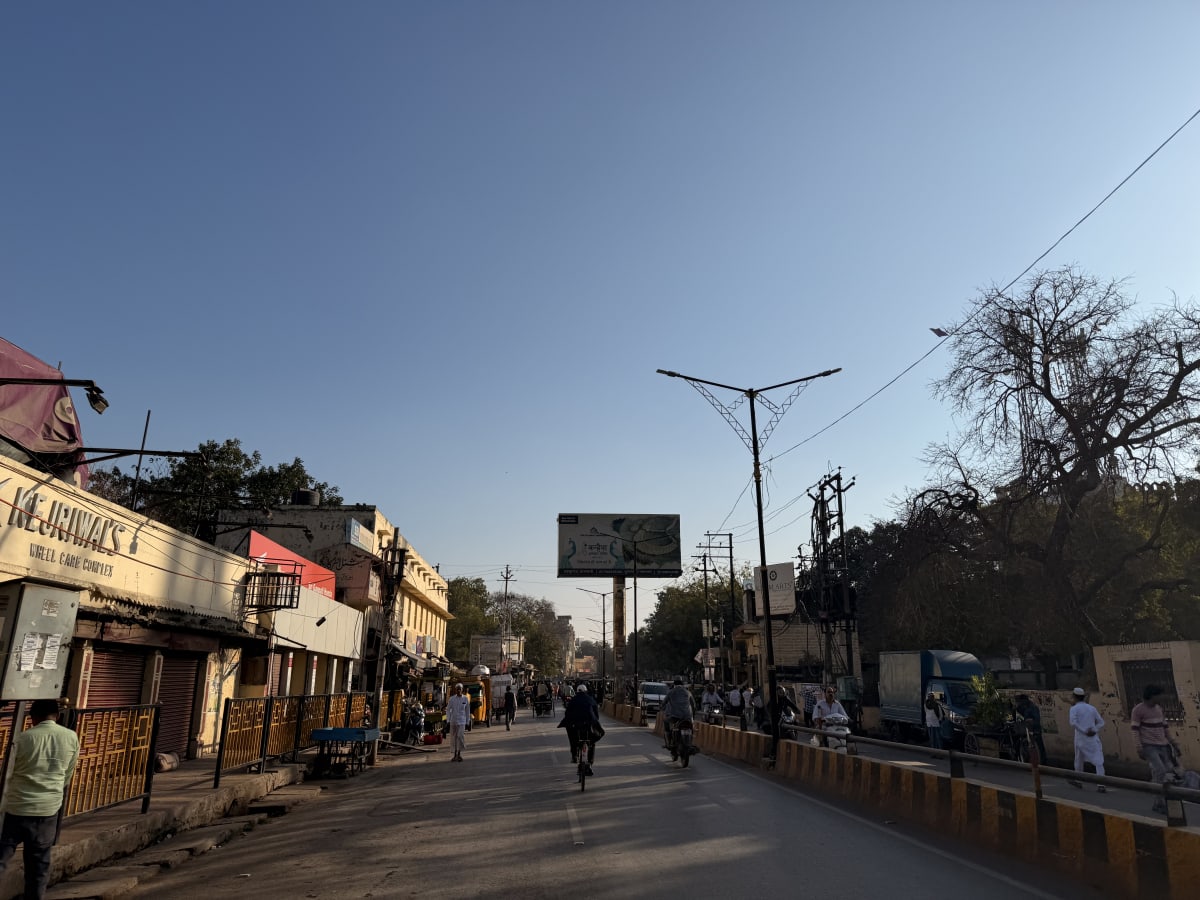
The taxi I took from the vihara could barely move forward.
The destination was Panchganga Ghat, but as we went on, more and more vehicles piled in and the road blocked completely.
The driver made his displeasure clear, and I decided to go as far as we could for now.
Doing that, I came to the judgement that walking would be faster, and asked him to stop about ten minutes short of the destination.
The driver is in the apologetic position, in a way. He is taking money without having got me there.
Even so, this driver seemed relatively honest, and he gave back a reasonable amount of change.
It came out about 8 rupees short, but against the time it would take to argue, the sum was beneath trivial.
I was short on time, so I pressed straight on.
It was effectively my first time walking the streets of India in earnest.
And within a few minutes of walking my skin started to crawl.
Because every gaze on the street was on me.
They all started looking at once, as though an alien had dropped in, and that gaze did not let up for a second.
The rickshaws coming up behind all honked at me.
One man knocked into me as he passed, and it was so unpleasant I nearly hit him.
My skin crawled the whole way.
The horns behind me went off several at a time, and without pause.
The sky was clouded white with smog, and even breathing was painful.
It was at the level where I worried my skin would rot right through.
And the streets here were stranger and more unpleasant than anywhere I have been.
Partly because the winding shapes of Hindi gave the feeling of having arrived somewhere alien.
Road discipline, order, all of it — a complete shambles.
The Procession
Wherever I go I tend to imagine what it would feel like to live there.
Simply and honestly: if I had been born in India, living would not be easy at all.
That came to me within tens of minutes of walking the streets in India.
Turning off into an alley as I walked changed nothing.
Even in the narrow lanes, motorbikes came up fast behind, sounding their horns.
To them the meaning of it — warning, or picking a fight — does not matter at all.
The approach is simply to sound it first and see.
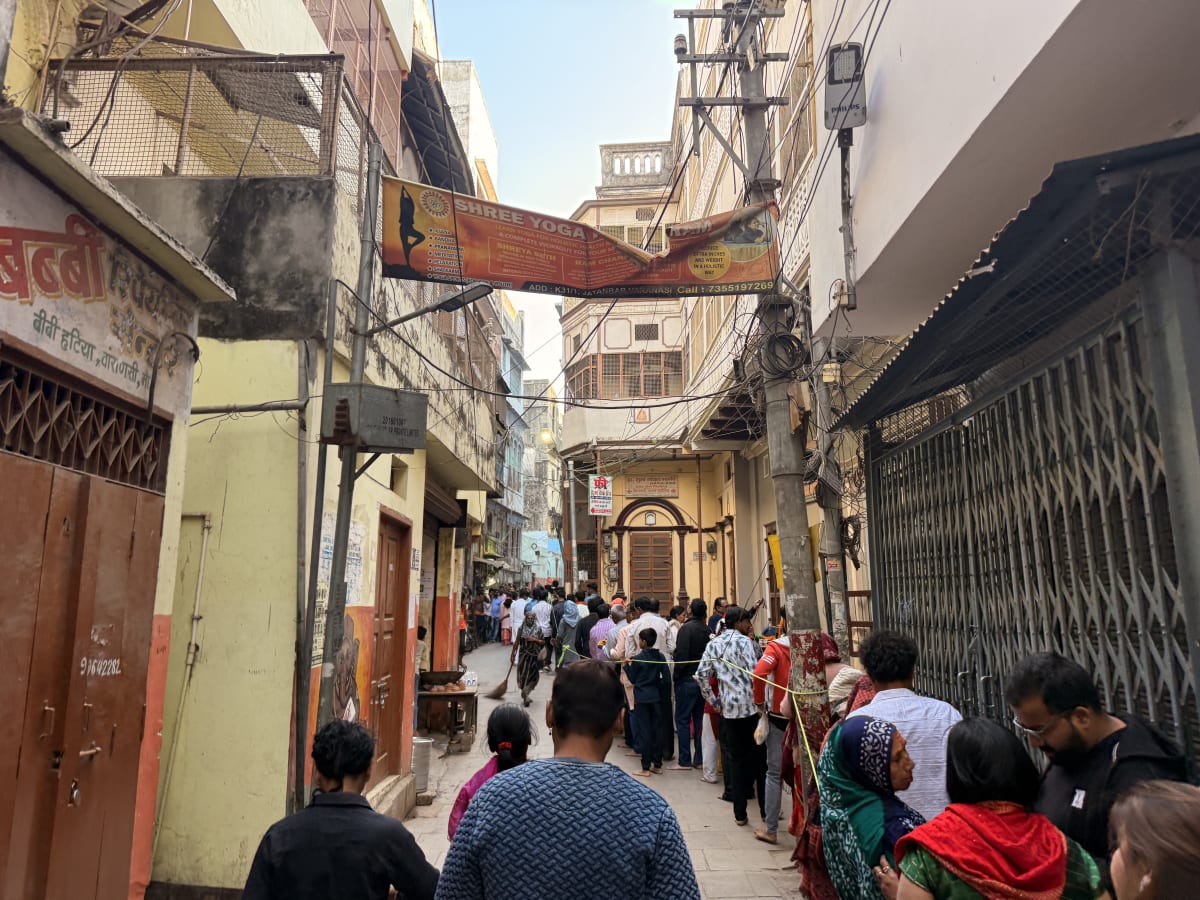
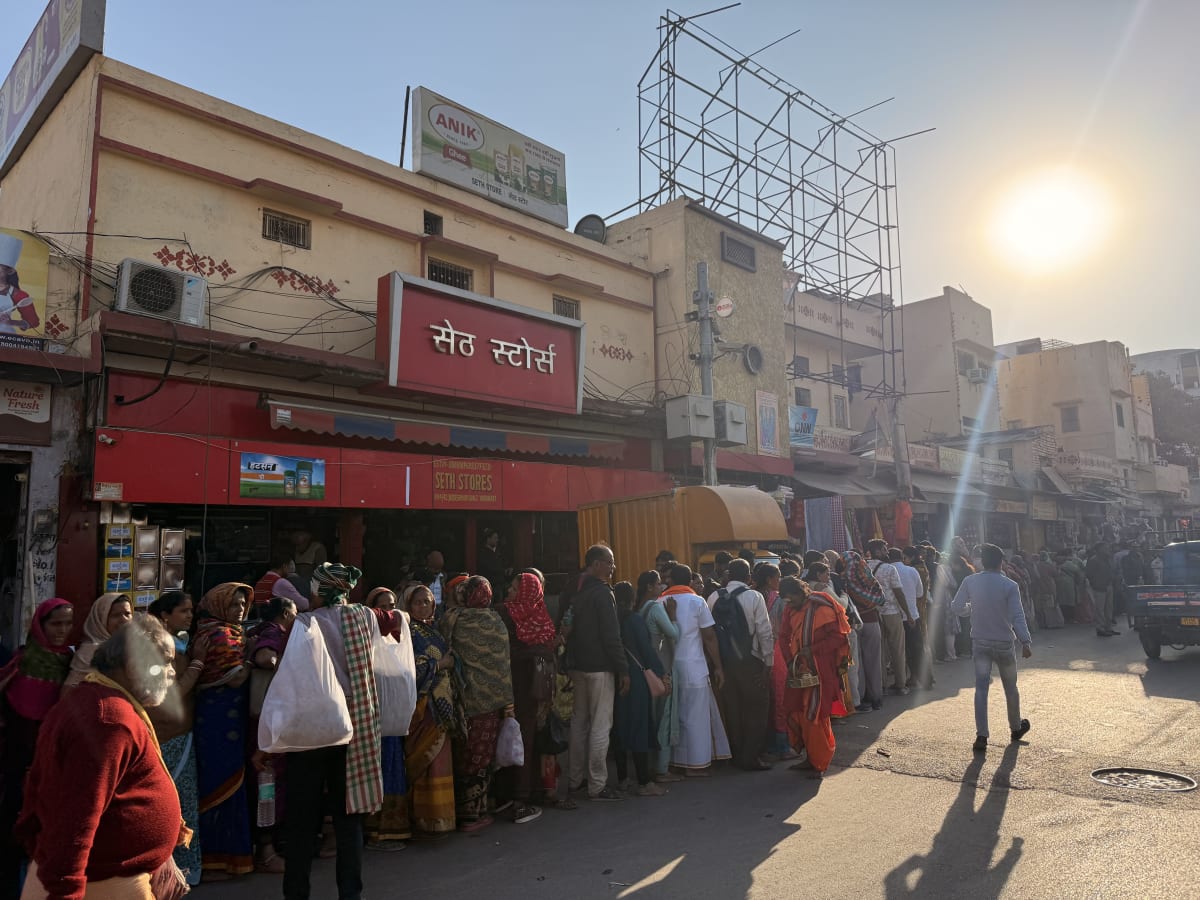
At some point a long queue blocked my way.
I was walking by Google Maps, and the queue was strung out along the route toward Panchganga Ghat, where I was headed.
The queue was so long that people were not moving forward at all, and it had no end.
Men and women, old and young alike, all held a dish in their hands, with flowers and something like pigment laid on top.
Even at a glance they seemed to be on their way to a festival or a rite held at the river.
As I walked, a group of men spoke to me and asked where I was going.
I said Panchganga Ghat and showed them the map, at which one man told me flatly to just follow him.
But the direction differed from the route on Google Maps, so after a few steps I judged this was not right.
So I turned around without a word.
Only then did the man follow, shouting “Boat! Boat!”
I realised he had been taking me off to sell me a boat ride on the river.
I ignored him and walked on, and when one of the group tried to grab me I threw the arm off and just barrelled on my way.
I have yet to meet a genuinely vicious Indian, but some of them are less vicious than the sort who wear you out.
To the Ganges
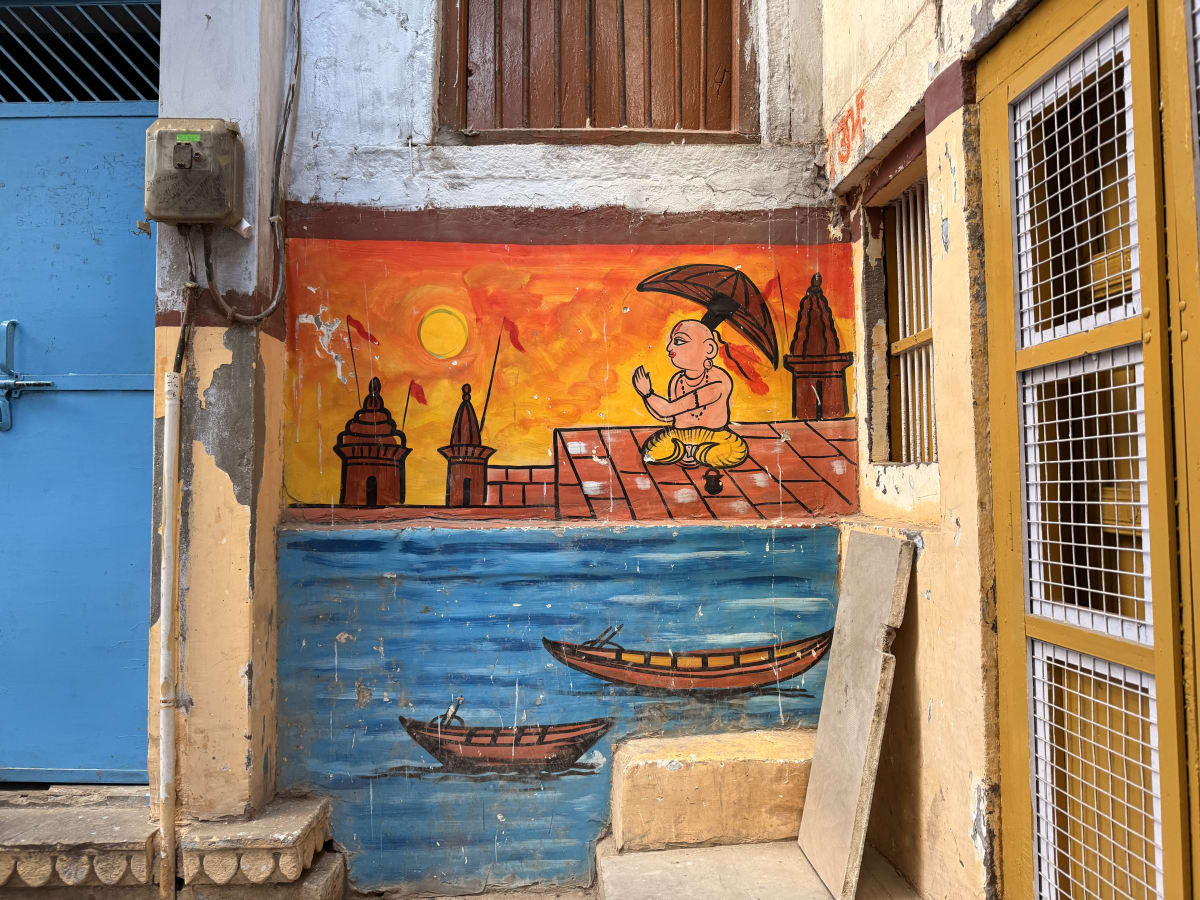
On the way to the Ganges, every alley had paintings to do with the river like this on the walls.
They were quite good fun to look at.
There are so many alleys here, and they are so tangled, that it is easy to get lost even walking with Google Maps open.
You are better off just lifting your head and looking for the paintings — follow them and you will meet the Ganges naturally.
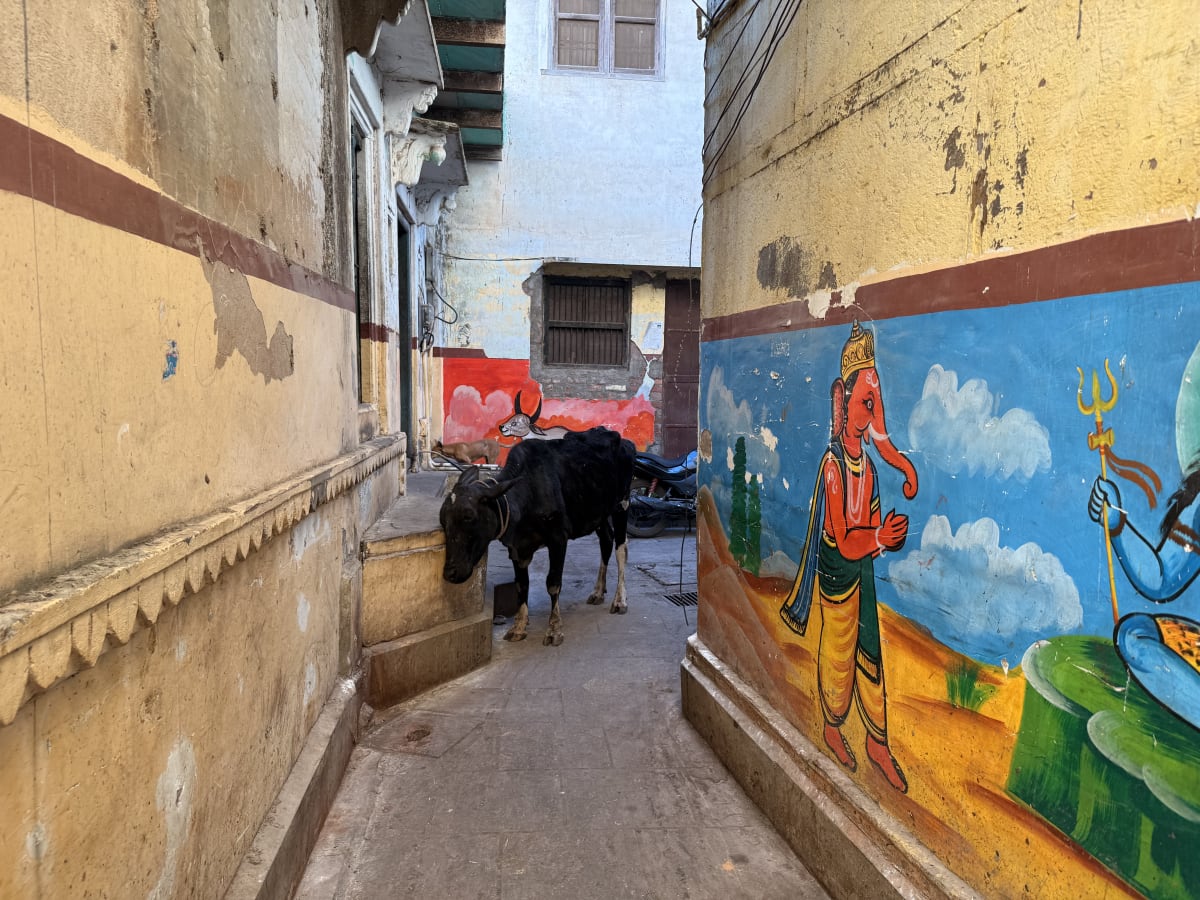
Passing through the alleys, I understood once again what cows are in India.
Being an animal held sacred in Hinduism, the atmosphere took it for granted that you meet one on the road, leave it well alone, and walk on past.